


Glasgow, United Kingdom
Glasgow is a city of 626,410 people in Scotland, United Kingdom.
Why visit Glasgow
Townapedia lists 244 museums and landmarks, 168 parks and trails, 298 places to eat, 79 places to stay and 172 attractions in and around town.
Highlights include The Grosvenor Cinema, Citizens' Theatre, Glasgow Science Centre and Sharmanka Kinetic Theatre/Gallery.
Weather in Glasgow
Forecast from MET Norway (CC BY 4.0). Full forecast
About Glasgow
Glasgow is the most populous city in Scotland, located on the banks of the River Clyde in west central Scotland. It is the third-most populous city in the United Kingdom and comprises 23 wards which represent the areas within the city boundaries. Glasgow is a leading city in Scotland for university education and research, finance, industry, commerce, shopping, culture and fashion, and was commonly referred to as the "second city of the British Empire" for much of the Victorian and Edwardian eras.
From the Wikipedia article Glasgow (this version), under CC BY-SA 4.0.
Travel tips from other travellers: Glasgow on Wikivoyage (CC BY-SA 4.0).
Photos of Glasgow


Things to do172

The Grosvenor Cinema
Cinema and theater · 1.5 mi
Refurbished and restored licensed cinema showing largely mainstream films plus unusual events and cafe patio.
24 Ashton Lane, Glasgow
Mo-Fr 12:00-22:00; Sa-Su 10:00-22:00

Citizens' Theatre
Cinema and theater · 1.0 mi
Theatre in Glasgow, Scotland, UK
119 Gorbals Street, Glasgow

Glasgow Film Theatre
Cinema and theater
GFT screens a wide variety of international cinema, classic films and documentaries alongside locally made work and material aimed at a...
12 Rose Street, Glasgow


Blackhall Railway Viaduct
Bridge · 6.0 mi
Former aqueduct, now railway bridge, in Renfrewshire, Scotland


Bell's Bridge
Bridge · 1.3 mi
Footbridge in Glasgow, Scotland, UK, across the River Clyde
160 more on the map.
Museums and landmarks244

Glasgow Science Centre
Museum · 1.5 mi
Science centre in Glasgow, Scotland, UK
50 Pacific Quay, Glasgow
Nov 04-Mar 30 We-Fr 10:00-15:00; Nov 04-Mar 30 Sa,Su 10:00-17:00;...

Sharmanka Kinetic Theatre/Gallery
Museum · 0.7 mi
A theatre of kinetic sculpture, where hundreds of carved figures and pieces of old scrap perform an incredible choreography to haunting...
103 Trongate, Glasgow
Mo-Tu off; We 17:00-17:45; Th 17:00-20:10; Fr 13:00-13:45; Sa 15:00-15:

The Lighthouse
Museum · 0.4 mi
Architecture and Design Centre
11 Mitchell Lane, Glasgow
Mo-Sa 10:30-17:00; Su 12:00-17:00

Tramway
Museum · 1.7 mi
Arts venue in postindustrial space hosting visual and performance art, music, film and theatre.
25 Albert Drive, Glasgow
Mo-Sa 09:30-20:00, Su 12:00-18:00

Hunterian Art Gallery
Museum · 1.3 mi
82 Hillhead Street, Glasgow
Mo off; Tu-Sa 10:00-17:00; Su 11:00-16:00

Kelvingrove Art Gallery and Museum
Museum · 1.3 mi
Argyle Street, Glasgow
Mo-Th 10:00-17:00; Fr 11:00-17:00; Sa 10:00-17:00; Su 11:00-17:00

Riverside Museum
Museum · 1.9 mi
Transport museum in Glasgow, Scotland, United Kingdom
100 Pointhouse Place, Glasgow
Mo-Sa 10:00-17:00; Fr,Su 11:00-17:00


St Mungo Museum of Religious Life & Art
Museum · 0.8 mi
2 Castle Street, Glasgow
Mo-Th 10:00-17:00; Fr 11:00-17:00; Sa 10:00-17:00; Su 11:00-17:00

The Burrell Collection
Museum · 3.1 mi
2060 Pollokshaws Road, Glasgow
Mo-Th 10:00-17:00; Fr 11:00-17:00; Sa 10:00-17:00; Su 11:00-17:00

The Govan Stones
Museum · 2.1 mi
Early medieval carved stones displayed at Govan Old Parish Church, Glasgow, Scotland, UK
866 Govan Road, Glasgow
Apr-Oct 11:00-16:00
232 more on the map.
Parks, trails and playgrounds168




Mount Florida Community Garden
Park · 2.6 mi
Work in progress community garden.
Stanmore Road, Glasgow
open
156 more on the map.
Restaurants and cafes298
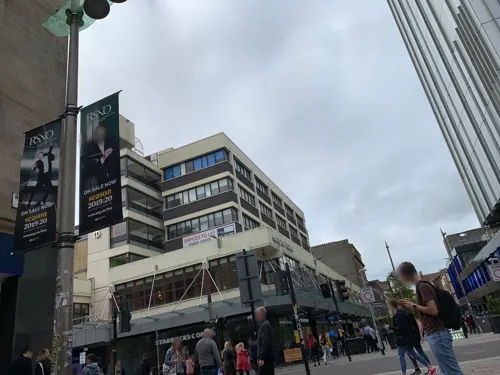
Caffè Nero
Cafe · Coffee Shop
8 Sauchiehall Street, Glasgow
Mo-Fr 07:00-19:00; Sa 07:30-19:00; Su 08:30-17:30


Jackton Distillery
Brewery and winery · 7.8 mi
Scotch whisky distillery on former farmland with tours, shop and bar.
Hayhill Road, Glasgow
Mo-Su 10:00-18:00
Jackton Distillery Tasting Bar
Bar and pub · 7.8 mi
Tasting bar and shop at Scotch whisky distillery with wine and cocktails.
Hayhill Road, Glasgow
Mo-Su 10:00-18:00


The Curler's Rest
Bar and pub · 1.6 mi
256-260 Byres Road, Glasgow
Mo-Fr 12:00-00:00; Sa 10:00-00:00; Su 12:00-23:00
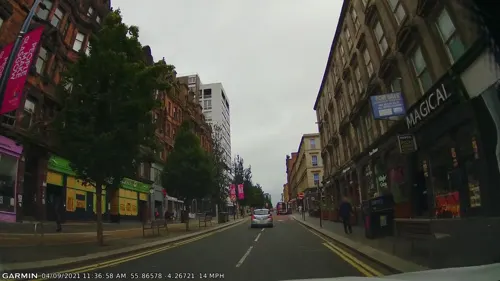
The Hengler's Circus
Bar and pub · 0.4 mi
351-363 Sauchiehall Street, Glasgow
Mo,Tu,We,Th,Fr,Sa,Su 08:00-24:00
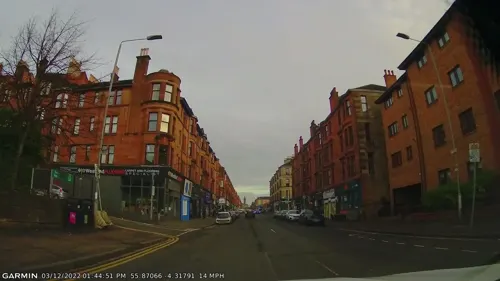
Bibi's Cantina
Restaurant · Mexican · 2.3 mi
A relaxed, affordable neighbourhood restaurant with an honest approach to fresh, healthy and hearty Mexican food.
599-601 Dumbarton Road, Glasgow
Su-Th 12:00-22:30; Fr-Sa 12:00-24:00
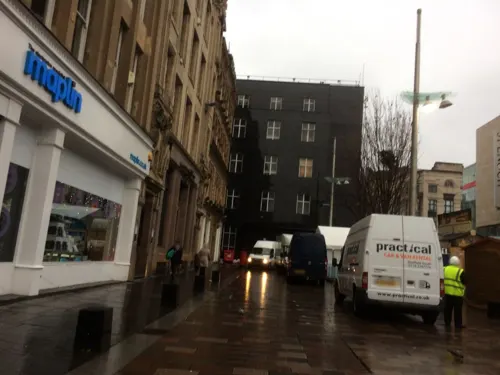



Cafe Andaluz
Restaurant · Spanish, Tapas · 1.5 mi
Andalusian-style basement tapas bar.
2 Cresswell Lane, Glasgow
Mo-Sa 12:00-22:00; Su 12:30-22:00
286 more on the map.
History
The area around Glasgow has hosted communities for millennia, with the River Clyde providing a natural location for fishing. The Romans later built outposts in the area and, to protect Roman Britannia from the Brittonic speaking (Celtic) Caledonians, constructed the Antonine Wall. Items from the wall, such as altars from Roman forts of Balmuildy, are now located at the Hunterian Museum.
Glasgow itself was reputed to have been founded by the Christian missionary Saint Mungo in the 6th century. He established a church on the Molendinar Burn, where the present Glasgow Cathedral stands, and in the following years Glasgow became a religious centre.
Glasgow grew over the following centuries as part of the Kingdom of Strathclyde and the Kingdom of Scotland. The Glasgow Fair began in 1190. A bridge over the River Clyde was recorded from around 1285, where Victoria Bridge now stands. As the lowest bridging point on the Clyde it was an important crossing. The area around the bridge became known as Briggait.
Read more of the history
The founding of the University of Glasgow adjoining the cathedral in 1451 and elevation of the bishopric to become the Archdiocese of Glasgow in 1492 increased the town's religious and educational status and landed wealth. By the fifteenth century the urban area stretched from the area around the cathedral and university in the north down to the bridge and the banks of the Clyde in the south along High Street, Saltmarket and Bridgegate, crossing an east–west route at Glasgow Cross which became the commercial centre of the city.
Following the European Protestant Reformation and with the encouragement of the Convention of Royal Burghs, the 14 incorporated trade crafts federated as the Glasgow Trades House in 1605 to match the power and influence in the town council of the earlier Merchants' Guilds, who established their Merchants House in the same year. In 1611, Glasgow was raised to the status of Royal Burgh. Daniel Defoe visited the city in the early 18th century and famously opined in his book A tour thro' the whole island of Great Britain, that Glasgow was "the cleanest and beautifullest, and best built city in Britain, London excepted". At that time the city's population was about 12,000, and the city was yet to undergo the massive expansionary changes to its economy and urban fabric, brought about by the Scottish Enlightenment and Industrial Revolution.
Its early trade was in agriculture, brewing and fishing, with cured salmon and herring being exported to Europe and the Mediterranean. Trade greatly expanded and, starting in 1668, the city's magistrates created a new town and deep water port at Port Glasgow about 20 mi (32 km) down the River Clyde, as the river from the city to that point was then too shallow for seagoing merchant ships. After the Acts of Union in 1707, Scotland gained further access to the vast markets of the new British Empire, and Glasgow became prominent as a hub of international trade to and from the Americas, especially in sugar, tobacco, cotton, and manufactured goods, to be followed by trade with India and Asia. The city prospered from its involvement in the triangular trade and the Atlantic slave trade that the former depended upon. Glasgow merchants dealt in slave-produced cash crops such as sugar, tobacco, and cotton. From 1717 to 1766, Scottish slave ships mainly operating out of Glasgow's early satellite ports of Greenock and Port Glasgow transported approximately 3,000 enslaved Africans from Africa to the Americas (out of a total number of 5,000 slaves carried by ships from Scotland). By the late 18th century more than half of the British tobacco trade was concentrated on the River Clyde, with more than 47,000,000 lb (21,000 t) of tobacco being imported each year at its peak, to be re-exported to England and Europe, most notably France.
From the second half of the 1700s, and onwards, textile manufacturing and exporting dominated trade in Glasgow and its surrounding counties on a par with Manchester. Local coalfields provided the energy to support mechanisation and expansion. Glasgow's connected chemical industry achieved world-status. In 1801 the discovery of ironstone within the vast coalfields to the east of the city started iron manufacturing and exporting, helped by the invention in 1828 of hot-blast furnaces, to be followed by the creation of steel-making. The new sciences and inventions, much coming from its universities and technical colleges, opened all branches of engineering. Glasgow and the Clyde became the undisputed world centre of shipbuilding. Its port increased to 12 miles of quays and docks and 500 miles of railway. Dozens of new shipping companies were formed, including Cunard, Allan, British India, Union-Castle, City Line, Clan Line and others. Glasgow became the largest centre of locomotive building in Europe. Commerce and banking flourished.
From the mid-eighteenth century the city began expanding westwards from its medieval core at Glasgow Cross, with a grid-iron street plan starting from the 1770s and eventually reaching George Square to accommodate much of the growth (with that expansion much later becoming known in the 1980s onwards as the Merchant City. The largest growth in the city centre area, building on the wealth of trading internationally, was the next expansion being the grid-iron streets west of Buchanan Street riding up and over Blythswood Hill from 1800 onwards.
From the History section of Glasgow on Wikipedia, under CC BY-SA 4.0.
More about Glasgow
Geography
Glasgow is located on the banks of the River Clyde, in West Central Scotland. Another important river is the Kelvin, a tributary of the River Clyde, whose name was used in creating the title of Baron Kelvin the renowned physicist for whom the SI unit of temperature, Kelvin, is named. The burgh of Glasgow was historically in Lanarkshire, but close to the border with Renfrewshire. When elected county councils were established in 1890, Glasgow was deemed capable of running its own affairs and so was excluded from the administrative area of Lanarkshire County Council, whilst remaining part of Lanarkshire for lieutenancy and judicial purposes.
The burgh was substantially enlarged in 1891 to take in areas from both Lanarkshire and Renfrewshire where the urban area had grown beyond the old burgh boundary. In 1893, the burgh became its own county for lieutenancy and judicial purposes too, being made a county of itself. From 1975 to 1996 the city was part of Strathclyde Region, with the city's council becoming a lower-tier district council. Strathclyde was abolished in 1996, since when the city has again been responsible for all aspects of local government, being one of the 32 council areas in Scotland.
Economy
Glasgow has the largest economy in Scotland and is at the hub of the metropolitan area of West Central Scotland. Glasgow sustains more than 410,000 jobs in more than 12,000 companies. More than 153,000 jobs were created in Glasgow between 2000 and 2005 – a growth rate of 32%. Glasgow's annual economic growth rate of 4.4% is now second only to that of London. In 2005, more than 17,000 new jobs were created, and 2006 saw private-sector investment in the city reaching £4.2 billion, an increase of 22% in a single year. 55% of the residents in the Greater Glasgow area commute to the city every day.
Once dominant export orientated manufacturing industries such as passenger and cargo shipbuilding and other heavy engineering have been gradually replaced in importance by more diversified forms of economic activity. Major manufacturing firms continue to be headquartered in the city, such as Aggreko, Weir Group, Clyde Blowers, Howden, Linn Products, Firebrand Games, William Grant & Sons, Whyte and Mackay, The Edrington Group, British Polar Engines and Albion Motors. Naval shipbuilding and the defence industry continue to be significant, with companies such as BAE Systems, the Thales Group and others.
Arts and culture
Glasgow has many amenities for a wide range of cultural activities, from curling to opera and ballet and from football to art appreciation; it also has a large selection of museums and art galleries noted in the following section. Many of the city's cultural sites were celebrated in 1990 when Glasgow was designated European Capital of Culture.
Glasgow's principal municipal library, the Mitchell Library, has grown into one of the largest public reference libraries in Europe, currently housing some 1.3 million books, an extensive collection of newspapers and thousands of photographs and maps.
Of academic libraries, Glasgow University Library started in the 15th century and is one of the oldest and largest libraries in Europe, with unique and distinctive collections of international status.
Most of Scotland's national arts organisations are based in Glasgow, including Scottish Opera, Scottish Ballet, National Theatre of Scotland, Royal Scottish National Orchestra, BBC Scottish Symphony Orchestra and Scottish Youth Theatre.
Glasgow has its own Poet Laureate, a post created in 1999 for Edwin Morgan and occupied by Liz Lochhead from 2005 until 2011, when she stood down to take up the position of Scots Makar. Jim Carruth was appointed to the position of Poet Laureate for Glasgow in 2014 as part of the 2014 Commonwealth Games legacy.
Education
Glasgow is a major centre of higher and academic research, with the following universities and colleges within 10 mi (16 km) of the city centre:
In 2011 Glasgow had 53,470 full-time students aged 18–74 resident in the city during term time, more than any other city in Scotland and the fifth-highest number in the United Kingdom outside London. The majority of those who live away from home reside in Shawlands, Dennistoun and the West End of the city.
The City Council operates 29 secondary schools, 149 primary schools and three specialist schools – the Dance School of Scotland, Glasgow School of Sport and the Glasgow Gaelic School (Sgoil Ghàidhlig Ghlaschu), the only secondary school in Scotland to teach exclusively in Gaelic. Outdoor Education facilities are provided by the city council at the Blairvadach Centre, near Helensburgh. Jordanhill School is operated directly by the Scottish Government. Glasgow also has a number of Independent schools, including The High School of Glasgow, founded in 1124 and the oldest school in Scotland; Hutchesons' Grammar School, founded in 1639 and one of the oldest school institutions in Scotland; and others such as Craigholme School (closed 2020), Glasgow Academy, Kelvinside Academy and St. Aloysius' College. Glasgow is part of the UNESCO Global Network of Learning Cities.
From the Wikipedia article Glasgow, under CC BY-SA 4.0.
Notable people from Glasgow
 Alex FergusonScottish association football manager and former playerPhoto: Austin Osuide, CC BY 2.0
 Andy MurrayBritish tennis playerPhoto: Brendan Dennis, CC BY-SA 4.0
 James McAvoyScottish actor (born 1979)Photo: Kacy Bao, CC BY-SA 4.0
 Angus YoungAustralian guitaristPhoto: Raph_PH, CC BY 2.0
 Billy ConnollyScottish actor and comedianPhoto: Eva Rinaldi, CC BY-SA 2.0
 Mark KnopflerBritish musician (born 1949)Photo: Sebastien.gross, CC BY-SA 4.0
 Henry Campbell-BannermanBritish Prime Minister from 1905 to 1908 (1836–1908)Photo: George Charles Beresford, Public domain
 Andy RobertsonScottish association football player (born 1994)Photo: Bryan Berlin, CC BY-SA 4.0
 Frank LloydBritish film director (1886–1960)Photo: Internet Archive Book Images, No restrictions
- John A. Macdonald1st prime minister of Canada from 1867 to 1873 and 1878 to 1891
- Kenny DalglishScottish association football player and manager
- Charles Rennie MackintoshScottish architect, designer, water colourist and artist (1868-1928)


Born in Glasgow, according to Wikidata (CC0). Each name links to its Wikipedia article.
Where to stay79
Churches and places of worship107
Knightswood St Margaret's Parish Church
Church · Church Of Scotland · 3.9 mi
1996 Great Western Road, Glasgow
St Charles' Kelvinside Roman Catholic Church
Church · Roman Catholic · 1.2 mi
Kelvinside Gardens East, Glasgow
Shopping155
Roots, Fruits & Flowers: Wholefoods, Organics & Deli
Grocery · 1.1 mi
455 Great Western Road, Glasgow
Gas and EV charging70
Schools, colleges and libraries79
Healthcare74
Map of Glasgow
250 places. The map loads OpenStreetMap tiles when you open it.
Getting there and nearby towns
Glasgow Airport (GLA) is the nearest airport with scheduled flights listed in OpenStreetMap, 7 miles away.
- Rutherglen 3 mi southeast, about 5 min by car
- Bishopbriggs 3 mi northeast, about 5 min by car
- Giffnock 4 mi south, about 7 min by car
- Stepps 4 mi east, about 7 min by car
- Bearsden 5 mi northwest, about 7 min by car
- Renfrew 5 mi west, about 8 min by car
- Cambuslang 5 mi southeast, about 9 min by car
- Thornliebank 5 mi southwest, about 8 min by car
- Clarkston 6 mi south, about 9 min by car
- Milngavie 6 mi northwest, about 9 min by car
Drive times are estimates from straight-line distance, not routes.
Keep exploring
Local news
Headlines from INDB.
Reviews, tips and questions
Loading what members have shared...
Sources and licences
- GeoNames (CC BY 4.0): population, coordinates, regions and time zone
- Mapillary (see each image): photos
- OpenStreetMap contributors (ODbL 1.0): places, airports, map data
- Wikidata (CC0 1.0): elevation, founding date, time zone, website, landmarks and historic places
- Wikimedia Commons (see each image): photos
- Wikipedia (CC BY-SA 4.0): overview and history text
Photo credits
- Glasgow - aerial - 2025-04-17 12, 瑞丽江的河水, CC BY-SA 4.0
- At Hope Street in Glasgow, Tbatb, CC BY-SA 4.0
- U Glasgowu 25.7.2024, August Dominus, CC0
- Sunday afternoon in Glasgow (53327434915) (cropped), Daniel from Glasgow, United Kingdom, CC BY 2.0
- Sunday afternoon in Glasgow (53327434885), Daniel from Glasgow, United Kingdom, CC BY 2.0
- Sunday afternoon in Glasgow (53327434915), Daniel from Glasgow, United Kingdom, CC BY 2.0
- Sunday afternoon in Glasgow (53326976546), Daniel from Glasgow, United Kingdom, CC BY 2.0
- Early morning in Glasgow (51526395253), Daniel from Glasgow, United Kingdom, CC BY 2.0
- 119 Gorbals Street, Citizen's Theatre 01, Stinglehammer, CC BY-SA 4.0
- Paisley Blackhall bridge, Afterbrunel, CC BY-SA 4.0
- Glasgow, October 24th 2017 (7) (37874306732), Daniel from Glasgow, United Kingdom, CC BY 2.0
- Riverside Museum Glasgow EC2018, Cutkiller2018, CC BY-SA 4.0
- Hogback stone in Govan Old Church, Joedkins, CC BY-SA 3.0
- Ibroxhill House Portico, Rosser1954 Roger Griffith, Public domain
- Cathkinpark, Celticfcuk ( talk ), Public domain
- Linnpark fromcastle, Zeddy ( talk ), Public domain
- Hampden Park (Glasgow) aerial view cropped, Dan Kearney, cropped by Blackcat, CC BY-SA 3.0
- Ibrox Inside, Archibald99, Public domain
- Wfm barrowland ballroom, user:Finlay McWalter, CC BY-SA 3.0
- Wfm Glasgow Botanic Gardens, No machine-readable author provided. Finlay McWalter assumed (based on copyright claims)., CC BY-SA 3.0
- Wfm burrell collection, Unknown author, CC BY-SA 3.0
- Kelvingrove Art Gallery and Museum - aerial - 2025-04-17, 瑞丽江的河水, CC BY-SA 4.0
- Firhill No2, Andrew Hendo, CC BY-SA 3.0
- Hunterian Art Gallery, Ham, CC BY-SA 3.0
- 2018 07 19 Schottland (33), Bewahrerderwerte, CC BY-SA 4.0
- 201 North Street, Mitchell Library, Glasgow 01, Stinglehammer, CC BY-SA 4.0
- Wfm glasgow central mosque front, No machine-readable author provided. Finlay McWalter assumed (based on copyright claims)., CC BY-SA 3.0
- Queens Cross Church07a, dave souza, CC BY-SA 4.0
- Giffnock Synagogue East Renfrewshire, WS212121, CC BY-SA 4.0
- Glasgow Film Theatre, Stinglehammer, CC BY-SA 4.0
- Glasgow University Library 000 0124, Unknown author, Public domain
- Glasgow Women's Library exterior, Lirazelf, CC BY-SA 4.0
- Hilton Hotel, Glasgow, Scotland 09, Michal Klajban, CC BY-SA 4.0
- Kelvinside Hillhead Parish Church, LornaMCampbell, CC BY-SA 4.0
- King's Theatre, Glasgow 01, Stinglehammer, CC BY-SA 4.0
- Pavilion Theatre, Stinglehammer, CC BY-SA 4.0
- Scotland Street School infants entrance DSCN8975, AlasdairW, CC BY-SA 4.0
- Sharmanka Kinetic Theatre 01, Stinglehammer, CC BY-SA 4.0
- 25 Albert Drive, Tramway Theatre, Stinglehammer, CC BY-SA 4.0
- The Britannia Music Hall, Keith Edkins, CC BY-SA 2.0
- Glasgow, najveći grad u Škotskoj, August Dominus, CC0
- 4 Nelson Mandela Place, Glasgow LB33233, Gareth E. Kegg, CC BY-SA 4.0
- Stmungorc, Maltesedog, CC BY-SA 3.0
- Menzies Glasgow Hotel, 27 Washington Street, Glasgow, Sonictiller, CC BY-SA 4.0
- 07023 St Teresa of Lisieux's Roman Catholic Church, Possilpark 001, WeeHolly, CC BY-SA 4.0
- 5913 Dennistoun New Church of Scotland, Dennistoun 001, WeeHolly, CC BY-SA 4.0
- Strathblane Country House, Akerbeltz, CC BY-SA 4.0
- Bridgeton Library at Olympia, User:Laura Dolan, CC BY-SA 3.0
- Grosvenor Cinema, Lirazelf, CC BY-SA 3.0
- Category Is Books (Queer Bookshop), Glasgow, Scotland 08, Michal Klajban, CC BY-SA 4.0
- Hilton Garden Inn Glasgow City Centre, Frombowen, CC BY-SA 4.0
- Merchant City Inn, Kirsty S. Ross, CC BY 4.0
- Glasgow. North Kelvinside. Crosslands. 182 Queen Margaret Drive, Daniel Naczk, CC BY-SA 4.0
- RAER's Unique Copper Stills at Jackton Distillery, East Kilbride, WhiskyLass, CC BY-SA 4.0
- West Coats Primary School showing original building and new building, Helen Bradshaw, Public domain
- The Lighthouse DSCN8991, AlasdairW, CC BY-SA 4.0
- From St. Mungo Museum of Religious Life & Art, Glasgow (6832490174), dun_deagh, CC BY-SA 2.0
- Street-level photo, gmc, CC BY-SA 4.0
- Street-level photo, gmc, CC BY-SA 4.0
- Street-level photo, gmc, CC BY-SA 4.0
- Street-level photo, gmc, CC BY-SA 4.0
- Street-level photo, gmc, CC BY-SA 4.0
- Street-level photo, gmc, CC BY-SA 4.0
- Street-level photo, hobgoblin, CC BY-SA 4.0
- Street-level photo, gmc, CC BY-SA 4.0
- Street-level photo, hobgoblin, CC BY-SA 4.0
- Street-level photo, gmc, CC BY-SA 4.0
- Street-level photo, gmc, CC BY-SA 4.0
- Street-level photo, gmc, CC BY-SA 4.0
- Street-level photo, gmc, CC BY-SA 4.0
- Street-level photo, gmc, CC BY-SA 4.0
- Street-level photo, gmc, CC BY-SA 4.0
- Street-level photo, gmc, CC BY-SA 4.0
- Street-level photo, gmc, CC BY-SA 4.0
- Street-level photo, gmc, CC BY-SA 4.0
- Street-level photo, marscot, CC BY-SA 4.0
- Street-level photo, gmc, CC BY-SA 4.0
- Street-level photo, gmc, CC BY-SA 4.0
- Street-level photo, ccbb7766, CC BY-SA 4.0
- Street-level photo, gmc, CC BY-SA 4.0
- Street-level photo, EDINBURGH_11, CC BY-SA 4.0
- Street-level photo, gmc, CC BY-SA 4.0
- Street-level photo, IpswichEdits, CC BY-SA 4.0
- Street-level photo, gmc, CC BY-SA 4.0
- Street-level photo, gmc, CC BY-SA 4.0


Page built November 10, 2026. Spotted a mistake? Tell us or suggest a place.