


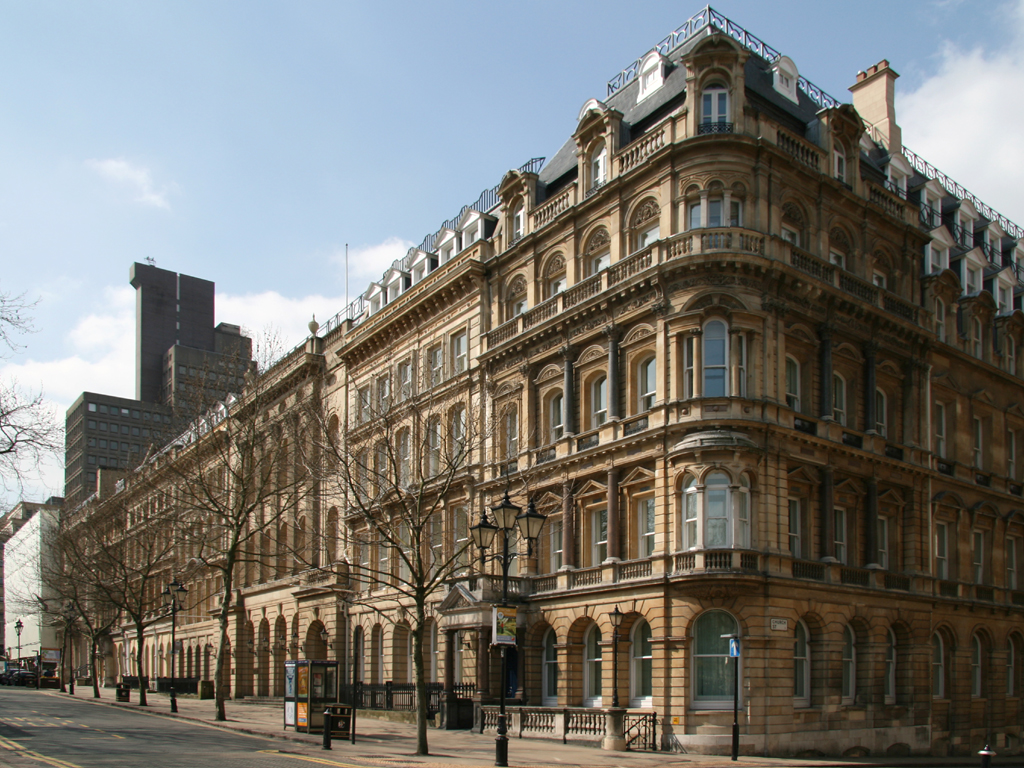


Birmingham, United Kingdom
Birmingham is a city of 1,157,603 people in England, United Kingdom, founded in 601.
Why visit Birmingham
Townapedia lists 237 museums and landmarks, 170 parks and trails, 326 places to eat, 82 places to stay and 103 attractions in and around town.
Highlights include Birmingham Wildlife Conservation Park, Dudley Zoo & Castle, West Midlands Police Museum and Birmingham Museum & Art Gallery.
Weather in Birmingham
Forecast from MET Norway (CC BY 4.0). Full forecast
About Birmingham
Birmingham is a city and metropolitan borough in the centre of the West Midlands region of England. It is the largest local authority district in England by population and the second-largest city in Britain – commonly referred to as the second city of the United Kingdom – with a population of 1.2 million people in the city proper in 2025. Birmingham is the centre of the ceremonial West Midlands county, and borders the Black Country to its west and, together with the city of Wolverhampton and towns including Walsall, West Bromwich, Dudley and Solihull, forms the West Midlands conurbation. The Royal Town of Sutton Coldfield is incorporated within the city limits to the north and northeast.
From the Wikipedia article Birmingham (this version), under CC BY-SA 4.0.
Travel tips from other travellers: Birmingham on Wikivoyage (CC BY-SA 4.0).
Photos of Birmingham


Things to do103

Birmingham Wildlife Conservation Park
Zoo and aquarium · 2.2 mi
Zoo
Pershore Road, Birmingham
Apr 01-Oct Su[-1] 10:00-17:00, Oct Su[-1]-Apr 01 10:00-17:00

Dudley Zoo & Castle
Zoo and aquarium · 7.9 mi
Castle Hill, Dudley
Mo-Su 10:00-16:30; Mar-Sep 10:00-17:30; Dec 25 off


Alexandra Theatre
Cinema and theater · 0.4 mi
Theatre in Birmingham, England
Suffolk Street Queensway, Birmingham



Mockingbird Cinema & Kitchen
Cinema and theater · 0.8 mi
Independent theatre in a restored Victorian factory showing arty and mainstream movies.
Gibb Street, Birmingham
91 more on the map.
Museums and landmarks237


Birmingham Museum & Art Gallery
Museum
Chamberlain Square, Birmingham
Mo-Th 10:00-17:00, Fr 10:30-17:00,Sa-Su 10:00-17:00


Oldbury Cenotaph
Monument and historic site · 5.2 mi
The pylon rises from a five-stepped base, rectangular on plan, and at the top dies back to the foot of the empty tomb. The tomb is in...
Birmingham Street



Haden Hill House Museum
Museum · 6.9 mi
Historic house museum, United Kingdom
Apr-Sep: Th,Fr 10:00-17:00; Apr-Sep: Sa,Su 14:00-18:00; Oct-Nov:...
225 more on the map.
Parks, trails and playgrounds170


Birmingham Botanical Gardens
Park · 1.7 mi
Jun-Aug: Mo-Su 10:00-18:00; Nov-Jan: Mo-Su 11:00-16:00;...


Edgbaston Reservoir Local Nature Reserve
Hiking and trails · 1.7 mi
70 acre site, less than two miles from the City centre is a site of historic importance, designed and built by Thomas Telford in 1827 to...
Reservoir Road


Cannon Hill Park
Park · 2.0 mi
Public park in Birmingham, West Midlands, England, UK


158 more on the map.
Restaurants and cafes326

Dirty Martini
Bar and pub · Brazilian
7 Bennett's Hill, Birmingham
Mo-Th 16:00-00:00; Fr 16:00-02:00; Sa 12:00-02:00; Su 14:00-00:00

The Court of Requests
Bar and pub · Pizza, Burger, Italian, Mexican, Indian, American, Breakfast, Steak House, Fish And Chips, Curry, Wings · 5.1 mi
19 Church Street, Oldbury
Su-Fr 08:00-24:00, Sa 08:00-01:00

Theatrix
Restaurant · Pizza, Burger
130 Colmore Row, Birmingham
Mo 15:00-21:30; Tu-Th 12:00-22:00; Fr-Sa 12:00+; Su 12:00-19:00

Henman & Cooper
Bar and pub
110 Colmore Row, Birmingham
Mo 15:00-21:00; Tu-Th 12:00-22:00; Fr-Sa 12:00-02:30; Su 12:00-20:00

The Jewellers Arms
Bar and pub · 0.7 mi
23 Hockley Street, Birmingham
Su-Th 12:00-23:00; Fr-Sa 12:00-00:00


Roxy Ball Room
Bar and pub · American
Hill Street, Birmingham
Mo-Th 15:00-01:00; Fr-Sa 12:00-02:00; Su 12:00-01:00


The Old Joint Stock
Bar and pub · British, Pie
4 Temple Row West, Birmingham
Mo-Sa 11:00-23:00; Su 12:00-18:00



314 more on the map.
History
There is evidence of early human activity in the Birmingham area dating back to around 8000 BC, with Stone Age artefacts suggesting seasonal settlements, overnight hunting parties and woodland activities such as tree felling. The many burnt mounds that can still be seen around the city indicate that modern humans first intensively settled and cultivated the area during the Bronze Age, when a substantial but short-lived influx of population occurred between 1700 BC and 1000 BC, possibly caused by conflict or immigration in the surrounding area. During the 1st-century Roman conquest of Britain, the forested country of the Birmingham Plateau formed a barrier to the advancing Roman legions, who built the large Metchley Fort in the area of modern-day Edgbaston in AD 48, and made it the focus of a network of Roman roads. Birmingham was then later established by the Beormingas around the 6th or 7th century as a small settlement in the then heavily forested Arden region in Mercia.
Read more of the history
The development of Birmingham into a significant urban and commercial centre began in 1166, when the Lord of the manor Peter de Bermingham obtained a charter to hold a market at his castle, and followed this with the creation of a planned market town and seigneurial borough within his demesne or manorial estate, around the site that became the Bull Ring. This established Birmingham as the primary commercial centre for the Birmingham Plateau at a time when the area's economy was expanding rapidly, with population growth nationally leading to the clearance, cultivation and settlement of previously marginal land. Within a century of the charter Birmingham had grown into a prosperous urban centre of merchants and craftsmen. By 1327 it was the third-largest town in Warwickshire, a position it would retain for the next 200 years.
The principal governing institutions of medieval Birmingham – including the Guild of the Holy Cross and the lordship of the de Birmingham family – collapsed between 1536 and 1547, leaving the town with an unusually high degree of social and economic freedom and initiating a period of transition and growth.
The importance of the manufacture of iron goods to Birmingham's economy was recognised as early as 1538, and grew rapidly as the century progressed. Equally significant was the town's emerging role as a centre for the iron merchants who organised finance, supplied raw materials and traded and marketed the industry's products. By the 1600s Birmingham formed the commercial hub of a network of forges and furnaces stretching from South Wales to Cheshire and its merchants were selling finished manufactured goods as far afield as the West Indies. These trading links gave Birmingham's metalworkers access to much wider markets, allowing them to diversify away from lower-skilled trades producing basic goods for local sale, towards a broader range of specialist, higher-skilled and more lucrative activities.
By the time of the English Civil War Birmingham's booming economy, its expanding population, and its resulting high levels of social mobility and cultural pluralism, had seen it develop new social structures very different from those of more established areas. Relationships were built around pragmatic commercial linkages rather than the rigid paternalism and deference of feudal society, and loyalties to the traditional hierarchies of the established church and aristocracy were weak. The town's reputation for political radicalism and its strongly Parliamentarian sympathies saw it attacked by Royalist forces in the Battle of Birmingham in 1643, and it developed into a centre of Puritanism in the 1630s and as a haven for Nonconformists from the 1660s.
By 1700 Birmingham's population had increased fifteen-fold and the town was the fifth-largest in England and Wales. The 18th century saw this tradition of free-thinking and collaboration blossom into the cultural phenomenon now known as the Midlands Enlightenment. The town developed into a notable centre of literary, musical, artistic and theatrical activity; and its leading citizens – particularly the members of the Lunar Society of Birmingham – became influential participants in the circulation of philosophical and scientific ideas among Europe's intellectual elite. The close relationship between Enlightenment Birmingham's leading thinkers and its major manufacturers – in men like Matthew Boulton and James Keir they were often in fact the same people – made it particularly important for the exchange of knowledge between pure science and the practical world of manufacturing and technology. This created a "chain reaction of innovation", forming a pivotal link between the earlier Scientific Revolution and the Industrial Revolution that would follow.
Birmingham's explosive industrial expansion started earlier than that of the textile-manufacturing towns of the North of England, and was driven by different factors. Instead of the economies of scale of a low-paid, unskilled workforce producing a single bulk product such as cotton or wool in large, mechanised units of production, Birmingham's industrial development was built on the adaptability and creativity of a highly paid workforce with a strong division of labour, practising a broad variety of skilled specialist trades and producing a constantly diversifying range of products, in a highly entrepreneurial economy of small, often self-owned workshops. This led to exceptional levels of inventiveness: between 1760 and 1850 – the core years of the Industrial Revolution – Birmingham residents registered over three times as many patents as those of any other British town or city.
From the History section of Birmingham on Wikipedia, under CC BY-SA 4.0.
More about Birmingham
Geography
Birmingham is located in the centre of the West Midlands region of England on the Birmingham Plateau – an area of relatively high ground, ranging between 500 and 1,000 feet (150 and 300 metres) above sea level and crossed by Britain's main north–south watershed between the basins of the Rivers Severn and Trent. To the immediate south west of the city lie the Lickey Hills, Clent Hills and Walton Hill, which reach 1,033 feet (315 m) and have extensive views over the city. Birmingham is drained only by minor rivers and brooks, primarily the River Tame and its tributaries the Cole and the Rea. Birmingham is located significantly inland, and its nearest body of sea is at Liverpool Bay. It lies at the same latitude as Lowestoft, Britain's easternmost settlement; it is therefore much more proximate to the western coast of Wales, at Cardigan Bay.
Economy
Birmingham grew to prominence as a centre of manufacturing and engineering. The economy of Birmingham is dominated by the service sector, which accounted for 88% of the city's employment in 2012. Birmingham is the largest centre in the UK for employment in public administration, education and health; and after Leeds the second-largest centre outside London for employment in financial and other business services.
The Gun Quarter is a district of the city that was, for many years, a centre of the world's gun-manufacturing industry. The first recorded gun maker in Birmingham was in 1630, and locally made muskets were used in the English Civil War. The Gun Quarter is an industrial area to the north of the city centre, bounded by Steelhouse Lane, Shadwell Street, and Loveday Street, specialising in the production of military firearms and sporting guns. Many buildings in the area are disused but plans are in place for redevelopment including in Shadwell Street and Vesey Street.
Arts and culture
Birmingham has two major public art collections. Birmingham Museum & Art Gallery is best known for its works by the Pre-Raphaelites, a collection "of outstanding importance". It also holds a significant selection of old masters – including major works by Bellini, Rubens, Canaletto and Claude – and particularly strong collections of 17th-century Italian Baroque painting and English watercolours. Its design holdings include Europe's pre-eminent collections of ceramics and fine metalwork. The Barber Institute of Fine Arts in Edgbaston is one of the finest small art galleries in the world, with a collection of exceptional quality representing Western art from the 13th century to the present day.
Birmingham Museums Trust runs other museums in the city including Aston Hall, Blakesley Hall, the Museum of the Jewellery Quarter, Soho House and Sarehole Mill. The Birmingham Back to Backs are the last surviving court of back-to-back houses in the city. Cadbury World is a museum showing visitors the stages and steps of chocolate production and the history of chocolate and the company. The Ikon Gallery hosts displays of contemporary art, as does Eastside Projects.
Education
Birmingham is home to five universities: Aston University, University of Birmingham, Birmingham City University, University College Birmingham and Newman University. The city also hosts major campuses of the University of Law and BPP University, as well as the Open University's West Midlands regional base. In 2011 Birmingham had 78,259 full-time students from all over the world aged 18–74 resident in the city during term time, more than any other city in the United Kingdom outside London. Birmingham has 32,690 research students, also the highest number of any major city outside London.
The Birmingham Business School, established by Sir William Ashley in 1902, is the oldest graduate-level business school in the United Kingdom. Another top business school in the city includes Aston Business School, one of fewer than 1% of business schools globally to be granted triple accreditation, and Birmingham City Business School. Royal Birmingham Conservatoire, part of Birmingham City University, offers professional training in music and acting.
From the Wikipedia article Birmingham, under CC BY-SA 4.0.
Notable people from Birmingham
 Neville ChamberlainPrime Minister of the United Kingdom from 1937 to 1940Photo: Bassano Ltd, Public domain
 Ozzy OsbourneEnglish musician and television personality (1948–2025)Photo: Warner Bros. Records, Public domain
 Francis GaltonBritish eugenist, polymath, and behavioural geneticist (1822–1911)Photo: not stated, Public domain
 Felicity JonesBritish actress (born 1983)Photo: Gabriel Hutchinson, CC BY-SA 4.0
 Jack GrealishEnglish association football player (born 1995)Photo: Hameltion, CC BY-SA 4.0
 Nick MasonEnglish drummerPhoto: Raph_PH, CC BY 2.0
 Tony IommiBritish rock guitarist (born 1948)Photo: Photobra (Adam Bielawski), CC BY-SA 3.0
 Matthew BoultonEnglish manufacturer, industrialist, business partner of James Watt (1728–1809)Photo: Carl Frederik von Breda, Public domain
 Enoch PowellBritish politician (1912–1998)Photo: Allan Warren, CC BY-SA 3.0
- Francis William AstonBritish chemist (1877-1945)
- Austen ChamberlainBritish politician (1863-1937)
- Edward Burne-JonesBritish Pre-Raphaelite painter (1833-1898)


Born in Birmingham, according to Wikidata (CC0). Each name links to its Wikipedia article.
Where to stay82
Hampton by Hilton Birmingham Jewellery Quarter
Motel and hotel · 0.5 mi
98-104 Constitution Hill, Birmingham
Churches and places of worship124
Shopping160
Gas and EV charging79
Schools, colleges and libraries84
Healthcare80
Map of Birmingham
250 places. The map loads OpenStreetMap tiles when you open it.
Getting there and nearby towns
Birmingham Airport (BHX) is the nearest airport with scheduled flights listed in OpenStreetMap, 7 miles away.
- Dudley Canal and Caverns map
- Smethwick 3 mi west, about 5 min by car
- West Bromwich 5 mi northwest, about 8 min by car
- Bartley Green 5 mi southwest, about 8 min by car
- Castle Vale 5 mi northeast, about 8 min by car
- Oldbury 5 mi west, about 8 min by car
- Solihull 7 mi southeast, about 11 min by car
- Sutton Coldfield 7 mi northeast, about 11 min by car
- Halesowen 7 mi west, about 11 min by car
- Dudley 8 mi west, about 13 min by car
- Worcester 24 mi southwest, about 39 min by car
Drive times are estimates from straight-line distance, not routes.
Keep exploring
Local news
Headlines from INDB.
Reviews, tips and questions
Loading what members have shared...
Sources and licences
- GeoNames (CC BY 4.0): population, coordinates, regions and time zone
- Mapillary (see each image): photos
- OpenStreetMap contributors (ODbL 1.0): places, airports, map data
- Wikidata (CC0 1.0): elevation, founding date, time zone, website, landmarks and historic places
- Wikimedia Commons (see each image): photos
- Wikipedia (CC BY-SA 4.0): overview and history text
Photo credits
- Birmingham-Skyline-from-Edgbaston-crop, JimmyGuano, CC BY-SA 4.0
- The Birmingham and Midland Eye Hospital 01, andrewrabbott, CC BY-SA 4.0
- St Philip's Cathedral, Birmingham - On Your Marks - Runner 1 - wicker sculpture (7759739476), Elliott Brown from Birmingham, United Kingdom, CC BY 2.0
- ColmoreRowBirmingham, GavinWarrins, Public domain
- Birmingham - Old stock co, Victuallers, CC BY-SA 3.0
- Sightseeing (Birmingham) W501 RBB - Flickr - metrogogo, metrogogo, CC BY-SA 2.0
- Birmingham Big Brum Buz - Church Street (9272839447), Elliott Brown from Birmingham, United Kingdom, CC BY-SA 2.0
- Birmingham Wildlife Conservation Park, Elliott Brown, CC BY-SA 2.0
- Alexandra Theatre Birmingham, Oosoom, CC BY-SA 3.0
- Calthorpe Park, Birmingham, Rept0n1x, CC BY-SA 3.0
- Cannon Hill Park, Oosoom at English Wikipedia, CC BY-SA 3.0
- BirminghamOratorySouthFront, GavinWarrins, Public domain
- Birmingham St Philip's Cathedral, Unknown author, Public domain
- Blackcountrystreet, Jack1956, Public domain
- Green Lane Mosque, Oosoom, CC BY-SA 3.0
- Orion Building -Post Graduate Centre of London Metropolitan University-9June2009, Alan Stanton, CC BY-SA 2.0
- Eingang-SSU, Paul Heimann ( GoG at German Wikipedia ), Public domain
- University of Ulster, Belfast Campus, July 2010 (07), Ardfern, CC BY-SA 3.0
- Alexander Stadium Birmingham 2022, Broomcleaning2006, CC BY-SA 4.0
- 1 snow hill plaza, Bs0u10e01, CC BY-SA 3.0
- Aston Hall, Tony Hisgett from Birmingham, UK, CC BY 2.0
- BirminghamBarberInstitute, GavinWarrins, Public domain
- Birmingham - Children Hospital 1, photography taken by Christophe.Finot, CC BY-SA 3.0
- Birmingham Hippodrome, Oosoom at English Wikipedia, CC BY-SA 3.0
- The Rep from Broad Street, Birmingham, Erebus555, CC BY-SA 3.0
- BirminghamBIADFineArtMargaretStreet, GavinWarrins, Public domain
- Blakesley Hall (1), Tony Hisgett from Birmingham, England, CC BY 2.0
- Castle Bromwich Hall Gardens Parterre - North Garden, Graham High, CC BY 3.0
- Dudley Zoo entrance, pic 2, England, Brian Clift, CC BY-SA 2.0
- Edgbaston Reservoir, WikiImprovment78, CC BY-SA 4.0
- Grand Hotel Renovation, Stove1441, CC BY 3.0
- Birmingham - Hyawt, photography taken by Christophe.Finot, CC BY-SA 3.0
- Library of Birmingham 2024-07-19 - 1, The wub, CC BY-SA 4.0
- The National SEA LIFE Centre Birmingham, Gp258, CC BY-SA 4.0
- The Old Joint Stock, Oosoom at English Wikipedia, CC BY-SA 3.0
- Old Rep theatre Birmingham, Tony Hisgett from Birmingham, UK, CC BY 2.0
- St Agatha, Sparkbrook, Oosoom at English Wikipedia, CC BY-SA 3.0
- St Anne Park Hill Moseley, Oosoom, CC BY-SA 3.0
- Moseley St Marys church, Oosoom, CC BY-SA 3.0
- West Midlands Police Museum, Gilbert911, CC BY-SA 4.0
- Argent Centre, Oosoom at English Wikipedia, CC BY-SA 3.0
- Halesowen Church 4 (4205849913), Tony Hisgett from Birmingham, UK, CC BY 2.0
- Birmingham - 130 Colmore Row - 20220909151331, Wagphoto, CC BY-SA 4.0
- St Paul's Church, 405 Belchers Lane, Bordesley Green, P L Chadwick, CC BY-SA 2.0
- Black Horse Pub Northfield, Brianboru100, CC BY-SA 3.0
- Hen and Chickens pub Constitution Hill, Brianboru100, CC BY-SA 3.0
- ErdingtonLibrary, Simon Speed, Public domain
- Jewellers Arms, Brianboru100, CC BY-SA 4.0
- Waterstones Birmingham, Tony Hisgett from Birmingham, UK, CC BY 2.0
- From the Secret Garden - Midland Metropolitan Hospital, Elliott Brown, CC BY-SA 2.0
- New Oldbury Library, Tony Hisgett from Birmingham, UK, CC BY 2.0
- Roxy Ballroom, Albion Street, Leeds (12th April 2014), Mtaylor848, CC BY-SA 3.0
- WW1 centenary (34) (14841065584), Sandwell Council, CC BY-SA 2.0
- Dudley Zoo, West Midlands, England -entrance-8March2011 (1), Tony Hisgett from Birmingham, UK, CC BY 2.0
- Birmingamo muziejus ir meno galerija, Bearas, CC BY 4.0
- West Smethwick Park - 2015-08-17 - Andy Mabbett - 02, Andy Mabbett, CC BY-SA 4.0
- Former Inland Revenue Office, Waterloo Street, andrewrabbott, CC BY-SA 4.0
- Oldbury Court of Requests, MaryMooney100, CC BY-SA 3.0
- 110 Colmore Row, Birmingham, February 2023, No Swan So Fine, CC BY-SA 4.0
- Old Joint Stock Bank, Birmingham, andrewrabbott, CC BY-SA 4.0
- Wesleyan Church Oldbury (3681125499) (2), Tony Hisgett from Birmingham, UK, CC BY 2.0
- Christ Church Oldbury, Tony Hisgett, CC BY 2.0
- View from the ruined Halesowen Priory towards The Leasowes (c. 1750), "Engraved by D. Jenkins and originally produced for the John Cooke part-work publication 'The Modern Universal British Traveller' (London : 1779)." [1] hand coloured at a later date., Public domain
- New Smethwick Pumping Station, Oosoom at English Wikipedia, CC BY-SA 3.0
- Heartlands Hospital and Heartlands Treatment Centre, LostCause231, CC BY-SA 4.0
- Ikon Gallery, Matthew Black from London, UK, CC BY-SA 2.0
- Museum of the Jewellery Quarter (5981810708), Tony Hisgett from Birmingham, UK, CC BY 2.0
- 白花藍雪花 Plumbago capensis v alba -伯明翰植物園 Birmingham Botanical Gardens- (9240153862), 阿橋 HQ, CC BY-SA 2.0
- Pope Benedict in Cofton Park, Woody, CC BY-SA 3.0
- Street-level photo, 4004, CC BY-SA 4.0
- Street-level photo, southglos, CC BY-SA 4.0
- Street-level photo, matth81, CC BY-SA 4.0
- Street-level photo, tonys999, CC BY-SA 4.0
- Street-level photo, matth81, CC BY-SA 4.0
- Street-level photo, adam2, CC BY-SA 4.0
- Street-level photo, adam2, CC BY-SA 4.0
- Street-level photo, adam2, CC BY-SA 4.0
- Street-level photo, adam2, CC BY-SA 4.0
- Street-level photo, adam2, CC BY-SA 4.0
- Street-level photo, 4004, CC BY-SA 4.0
- Street-level photo, matth81, CC BY-SA 4.0
- Street-level photo, matth81, CC BY-SA 4.0
- Street-level photo, brianboru, CC BY-SA 4.0
- Street-level photo, 4004, CC BY-SA 4.0
- Street-level photo, brianboru, CC BY-SA 4.0
- Street-level photo, brianboru, CC BY-SA 4.0
- Street-level photo, brianboru, CC BY-SA 4.0
- Street-level photo, adam2, CC BY-SA 4.0
- Street-level photo, adam2, CC BY-SA 4.0
- Street-level photo, edloach, CC BY-SA 4.0
- Street-level photo, adam2, CC BY-SA 4.0
- Street-level photo, adam2, CC BY-SA 4.0


Page built November 10, 2026. Spotted a mistake? Tell us or suggest a place.