


Why visit Weimar
Townapedia lists 177 museums and landmarks, 34 parks and trails, 187 places to eat, 42 places to stay and 14 attractions in and around town.
Highlights include Mon Ami, DNT - Deutsches Nationaltheater und Staatskapelle Weimar, Duchess Anna Amalia Library and Haus am Horn.
Weather in Weimar
Forecast from MET Norway (CC BY 4.0). Full forecast
About Weimar
Weimar is a city in the German state of Thuringia, in Central Germany between Erfurt to the west and Jena to the east, 80 km (50 mi) southwest of Leipzig, 170 km (106 mi) north of Nuremberg and 170 km (106 mi) west of Dresden. Together with the neighbouring cities of Erfurt and Jena, it forms the central metropolitan area of Thuringia, with approximately 500,000 inhabitants. The city itself has a population of 65,000. Weimar is well known because of its cultural heritage and importance in German history.
From the Wikipedia article Weimar (this version), under CC BY-SA 4.0.
Travel tips from other travellers: Weimar on Wikivoyage (CC BY-SA 4.0).
Photos of Weimar


Things to do14

Mon Ami
Cinema and theater
Komunales Kino im Mon Ami
11 Goetheplatz, Weimar
"Kino öffnet 30 Min. vor Vorstellungsbeginn"


Bad Berka
Monument and historic site · 9.5 km
Town in Thuringia, Germany


CineStar
Cinema and theater
14 Schützengasse, Weimar
"Jeden Tag 15 Minuten vor dem Beginn der ersten Vorstellung"

Lichthaus Kino
Cinema and theater · 0.6 km
4 Am Kirschberg, Weimar
"15 Minuten vor Beginn der 1. Veranstaltung."

2 more on the map.
Museums and landmarks177

Duchess Anna Amalia Library
Monument and historic site
1 Platz der Demokratie, Weimar
May21-Nov01 Tu-Su 09:30-18:00; Nov02-May20 Tu-Su 10:00-18:00


Goethe-Nationalmuseum
Museum
Museum
1 Frauenplan, Weimar
Mar Su[-1]-Oct Su[-1] -1 day: Tu-Su 09:30-18:00; Oct Su[-1]-Mar...


Museum für Ur-und Frühgeschichte Thüringens
Museum · 0.6 km
11 Humboldtstraße, Weimar
We-Fr 09:00-17:00, Tu 09:00-18:00, Sa,Su,PH 10:00-17:00

Museum Neues Weimar
Museum · 0.7 km
Van de Velde, Nietzsche und die Moderne um 1900
5 Jorge-Semprún-Platz, Weimar
We-Mo 10:00-16:00

Bauhaus-Museum Weimar
Museum · 0.6 km
Museum in Weimar, Germany
1 Stéphane-Hessel-Platz, Weimar
Mo 09:30-18:00; We-Su 09:30-18:00

Liszt-Haus
Museum · 0.6 km
17 Marienstraße, Weimar
Mar Su[-1]-Oct Su[-1] -1 day: We-Mo 10:00-18:00; Oct Su[-1]-Mar...


Schiller Museum
Museum
12 Schillerstraße, Weimar
Mar-Oct: Tu-Su 10:00-18:00; Nov-Feb: Tu-Su 10:00-16:00; Mo off

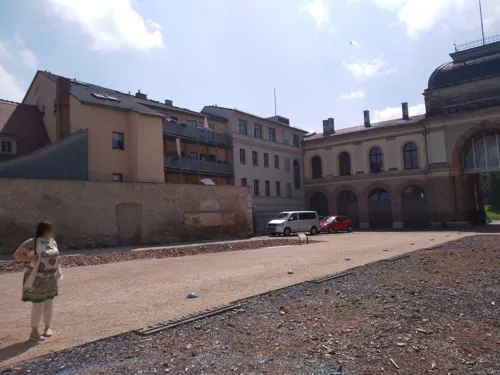
Albert-Schweitzer-Museum
Museum
4 Kegelplatz, Weimar
May-Oct: Mo-Fr 11:00-17:00, Nov-Apr: Mo-Fr 11:00-16:00
165 more on the map.
Parks, trails and playgrounds34



Schwanseebad Freibad
Sports field and stadium · 0.8 km
May-Sep: Mo-Fr 08:00-20:00; May-Sep: Sa,Su 09:00-18:00

Spielpunkt am Zeughof
Playground
Temporärer Spielplatz bis zur Fertigstellung des Zeughofspielplatzes
22 more on the map.
Restaurants and cafes187


Felsenkeller
Restaurant · 1.1 km
37 Humboldtstraße, Weimar
Tu-Th 17:00-22:00; Fr 17:00-23:00; Sa 11:00-24:00; Su 11:00-16:00

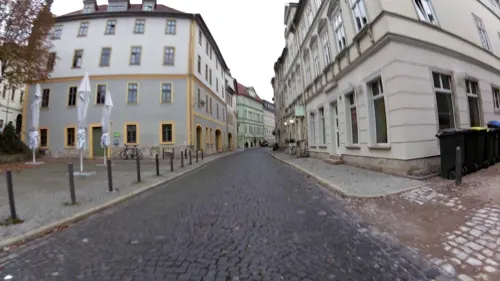
Die Kantine
Restaurant · Mediterranean
3 Vorwerksgasse, Weimar
Mo-Th 11:00-15:00; Fr 11:00-15:00,17:00-21:00; Sa 17:00-21:00; Su off
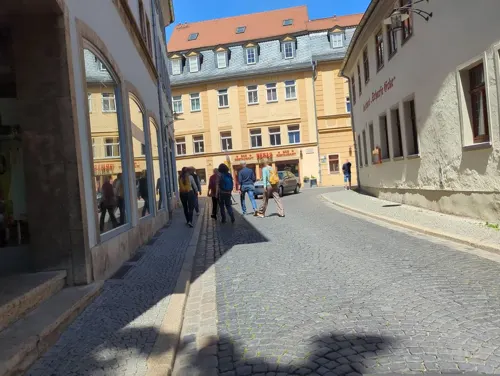
Gasthaus Waldschlösschen Weimar
Restaurant · German, Regional · 1.1 km
56 Jenaer Straße, Weimar
Fr-Tu 11:00-14:30,17:00-23:00

Samocca
Cafe · Bagel, Breakfast, Cake, Ice Cream
Hier gibt es Kaffee, Kuchen, Getränke und Snacks.
4 Platz der Demokratie, Weimar
Mo-Fr 09:00-17:00; Sa 10:00-16:30

12Stern - Pho Weimar
Restaurant · Japanese, Vietnamese, Bubble Tea, Ramen, Udon
2 Wielandplatz, Weimar
Mo-Su,PH 11:00-21:00
Bauhaus.Atelier
Cafe · Coffee Shop · 0.7 km
6a Geschwister-Scholl-Straße, Weimar
Apr-Nov: Mo 11:00-18:00, Apr-Nov: Tu-Fr 09:30-18:00, Apr-Nov:...
Creperie du Palais
Restaurant · French
1 Am Palais, Weimar
Th 11:30-22:00; Fr,Sa 11:30-22:00; Su 11:30-21:00
Hammerschenke
Restaurant · German, Regional · 1.6 km
48 Am Waldschlößchen, Weimar
We-Sa 17:00-22:00, Su 11:00-15:00
175 more on the map.
History
Archaeological finds dating back to the Thuringii epoch (3rd to 6th centuries) show that the Weimar part of the Ilm valley was settled early. A tight network of settlements occupied much of the area of today's city.
The oldest records regarding Weimar date to 899. Its name changed over the centuries from Wimares through Wimari to Wimar and finally Weimar; it is derived from Old High German wīh- (holy) and -mari (standing water, swamp). The place was the seat of the County of Weimar, first mentioned in 949, which was one of the most powerful jurisdictions in early Middle Ages Thuringia. In 1062 it was united with the County of Orlamünde into the new County of Weimar-Orlamünde, which existed until the Thuringian Counts' War in 1346. It fell to the Wettins afterwards.
Read more of the history
The Weimar settlement emerged around the count's wooden castle and two small churches, dedicated to Saint Peter (which later became the main church), and to Saint James, respectively. In 1240, the count founded the dynasty's monastery in Oberweimar, run by Cistercian nuns. Soon after, the counts of Weimar founded the town, which was an independent parish since 1249 and called civitas in 1254. From 1262, the citizens used their own seal. The regional influence of the Weimar counts was declining as the influence of the Wettins in Thuringia increased. Hence, the new small town was relatively marginal in a regional context, also due to the fact that it was located far from relevant trade routes, such as the Via Regia. The settlement around Saint James Church developed into a suburb during the 13th century.
After becoming part of Wettin territory in 1346, urban development improved. The Wettins fostered Weimar by abolishing socage and granting privileges to the citizens. Now Weimar became equal to other Wettinian cities like Weißensee and grew during the 15th century, with the establishment of a town hall and the current main church. In 1438 Weimar acquired trade privileges for woad, a plant from which blue dye was made. The castle and the walls were finished in the 16th century, making Weimar into a full city.
After the Treaty of Leipzig (1485) Weimar became part of the electorate of the Ernestine branch of Wettins with Wittenberg as capital. The Protestant Reformation was introduced in Weimar in 1525; Martin Luther stayed several times in the city. As the Ernestines lost the Schmalkaldic War in 1547, their capital Wittenberg went also to the Albertines, so that they needed a new residence. As the ruler returned from captivity, Weimar became his residence in 1552 and remained as such until the end of the monarchy in 1918. The first Ernestine territorial partition in 1572 was followed by various ones, nevertheless Weimar stayed the capital of different Saxe-Weimar states. The court and its staff brought some wealth to the city, so that it saw a first construction boom in the 16th century. The 17th century brought decline to Weimar, because of changing trade conditions (as in nearby Erfurt). Besides, the territorial partitions led to the loss of political importance of the dukes of Saxe-Weimar and their finances shrunk. The city's polity weakened more and more and lost its privileges, leading to the absolutist reign of the dukes in the early 18th century. On the other hand, this time brought another construction boom to Weimar, and the city got its present appearance, marked by various ducal representation buildings. The city walls were demolished in 1757 and during the following decades, Weimar expanded in all directions. The biggest building constructed in this period was the Schloss as the residence of the dukes (north and east wing: 1789–1803, west wing 1832–1835, south wing: 1913–1914). Between 1708 and 1717 Johann Sebastian Bach worked as the court's organist in Weimar.
The period from the start of the regencies of Anna Amalia (1758–1775) and her son Carl August (1775–1828) through to Goethe's death in 1832 is denoted as the "golden" or the "classical" age because of the high level of cultural activity in Weimar. The city became an important cultural centre of Europe, having been home to literary figures including Goethe, Schiller, Herder, Wieland and Bertuch; and in music the piano virtuoso Hummel. It has been a site of pilgrimage for the German intelligentsia since Goethe first moved to Weimar in 1775. Goethe was also active in civic duties while living there. He served as Privy Councilor to the Grand Duke of Saxe-Weimar-Eisenach for an extended period. The tombs of Goethe and Schiller, as well as their archives, may be found in the city. Goethe's Elective Affinities (1809) is set around the city of Weimar. In comparison to many major German states, the dukes' policy was liberal and tolerant in this period. The liberal Saxe-Weimar constitution was brought into effect in 1816.
The time after Goethe's death is denoted as the "silver" age because Weimar remained an influential cultural centre. The first emphasis was fostering music. In 1842, Franz Liszt moved to Weimar to become the Grand Ducal court conductor. Liszt organized the premiere of Richard Wagner's Lohengrin (1850) as well as the world première of Saint Saëns' opera Samson et Delilah (1877) in the city. The Weimar School of Music was founded in 1872 as Germany's first orchestra school. Richard Strauss worked in Weimar between 1889 and 1894 as second conductor in the acclaimed Staatskapelle Weimar (the court orchestra founded in 1491). Several of his encores for works such as Don Juan and Macbeth were performed by the Staatskapelle Weimar. He also premièred Humperdinck's opera Hänsel and Gretel 1893 in Weimar. Friedrich Nietzsche moved to Weimar in 1897, and died there three years later.
From the History section of Weimar on Wikipedia, under CC BY-SA 4.0.
More about Weimar
Geography
Weimar is situated within the valley of the Ilm river, a tributary of the Saale river on the southern border of the Thuringian Basin, a fertile agricultural area between the Harz mountains 70 km (43 mi) to the north and the Thuringian Forest 50 km (31 mi) to the southwest. The municipal terrain is hilly; the height of the city centre in the Ilm valley is approximately 200 m of elevation. To the north, the terrain rises to Ettersberg, the city's backyard mountain, 482 m in height. The range of hills in the south of Weimar rises up to 370 m and is part of the Ilm Saale Plate Muschelkalk formation. The eastern, central and western parts of the municipal territory are in agricultural use, whereas the Ettersberg and some southern areas are wooded.
Economy
The area around Weimar is relatively fertile and 48% of the municipal surface are used for agricultural production. Most common agricultures are cereals, maize and rapeseed, while famous agricultural products from the Weimar region are potatoes (especially from Heichelheim, 7 km (4.3 mi) to the north) for dishes with Thuringian dumplings (Knödel from potatoes), onions (from Heldrungen and Oldisleben, 45 km (28 mi) to the north), which are sold at Weimar Onion Market in October, and Saale-Unstrut wine from Bad Sulza, 25 km (16 mi) to the north-east.
Arts and culture
The Classical Weimar World Heritage Site consists of 11 sites related to Weimar as a European centre of the Enlightenment during the eighteenth and early nineteenth centuries.
The Bauhaus and its Sites in Weimar, Dessau and Bernau World Heritage Site comprises six separate sites, two in Weimar, which are associated with the Bauhaus art school, which had a revolutionary influence on 20th century architectural and aesthetic thinking and practice.
The Goethe-Nationalmuseum at Frauenplan shows the life of Johann Wolfgang von Goethe in his former residence.
Goethe's garden house in the Park an der Ilm shows an exhibition about Goethe and his connection to nature.
The Schiller-Museum at Schillerstraße shows the life of Friedrich Schiller in his former residence.
The Goethe- und Schiller-Archiv at Hans-Wahl-Straße collects the estate of Goethe, Schiller and other various artists. In 2001, it became a member of the UNESCO Memory of the World Programme.
The Wittumspalais at Theaterplatz shows early-modern court lifestyle with items like furniture and porcelain.
The Liszt-Haus at Marienstraße shows the life of Franz Liszt in his former summer residence.
The Nietzsche-Archiv at Humboldtstraße shows the life and estate of Friedrich Nietzsche.
The Gedenkstätte Buchenwald in former Buchenwald concentration camp commemorates the victims of Nazi terror.
From the Wikipedia article Weimar, under CC BY-SA 4.0.
Notable people from Weimar
 Herbert KroemerGerman-American physics (1928–2024)Photo: Javier Chagoya, Public domain
 Carl ZeissGerman optical physicist (1816–1888)Photo: ZEISS Microscopy from Germany, CC BY-SA 2.0
 Wilhelm Friedemann BachGerman composer, organist, harpsichordist (1710-1784)Photo: Dr. Martin Falck-Leipzig : C. F...., Public domain
 Augusta of Saxe-Weimar-EisenachGerman empress (1811-1890)Photo: Franz Xaver Winterhalter, Public domain
 Charles Augustus, Grand Duke of Saxe-Weimar-EisenachGerman noble (1757-1828)Photo: Heinrich Christoph Kolbe, Public domain
 Carl Friedrich I, Grand Duke of Saxe-Weimar-EisenachMonarch of the Grand Duchy of Saxe-Weimar-Eisenach (1828-1853)Photo: Johann Friedrich August Tischbein, Public domain
 Prince Bernhard of Saxe-Weimar-EisenachGerman noblemanPhoto: Jacob Spoel, Public domain
 Ernest Augustus I, Duke of Saxe-Weimar-EisenachDuke of Saxe-Weimar and Saxe-EisenachPhoto: Unidentified painter, Public domain
- Carl Philipp Emanuel BachGerman composer (1714–1788)
- Ludwig BechsteinGerman writer and fairy tale collector (1801-1860)
- Wilhelm Ernst I, Grand Duke of Saxe-Weimar-EisenachGrand Duke of Saxe-Weimar-Eisenach
- Princess Marie of Saxe-Weimar-Eisenachprincess of Saxe-Wiemar-Eisenach by birth, and by marriage a princess of Prussia
Born in Weimar, according to Wikidata (CC0). Each name links to its Wikipedia article.
Where to stay42
Churches and places of worship16
Evangelisches Gemeindezentrum Paul Schneider
Church · Protestant · 1.6 km
1a Moskauer Straße, Weimar
Neuapostolische Kirche
Church · New Apostolic · 0.7 km
9 Ernst-Thälmann-Straße, Weimar
Shopping50
Gas and EV charging7
Schools, colleges and libraries51
Healthcare10
Map of Weimar
250 places. The map loads OpenStreetMap tiles when you open it.
Getting there and nearby towns
Erfurt-Weimar Airport (ERF) is the nearest airport with scheduled flights listed in OpenStreetMap, 26 km away.
- Apolda 14 km east, about 14 min by car
- Jena 19 km east, about 19 min by car
- Erfurt 21 km west, about 21 min by car
- Lobeda 21 km southeast, about 21 min by car
- Sömmerda 25 km northwest, about 25 min by car
- Rudolstadt 29 km south, about 29 min by car
- Arnstadt 31 km southwest, about 31 min by car
- Saalfeld 37 km south, about 37 min by car
- Pößneck 37 km southeast, about 37 min by car
- Naumburg 39 km northeast, about 39 min by car
Drive times are estimates from straight-line distance, not routes.
Towns near Weimar


Keep exploring
Local news
Headlines from INDB.
Reviews, tips and questions
Loading what members have shared...
Sources and licences
- GeoNames (CC BY 4.0): population, coordinates, regions and time zone
- Mapillary (see each image): photos
- OpenStreetMap contributors (ODbL 1.0): places, airports, map data
- Wikidata (CC0 1.0): elevation, founding date, time zone, website, landmarks and historic places
- Wikimedia Commons (see each image): photos
- Wikipedia (CC BY-SA 4.0): overview and history text
Photo credits
- Stadtansicht Weimar mit Schloss und Herderkirche, Most Curious, CC BY-SA 3.0
- Weimar, Thüringen 32, Christian Alexander Tietgen, CC BY 4.0
- Wurstbude für Weimarer Rostbratwürste, David Herrmann, CC BY-SA 3.0
- Rittergasse in Weimar, Krzysztof Golik, CC BY-SA 4.0
- Weimar, Thüringen 30, Christian Alexander Tietgen, CC BY 4.0
- Weimar, Thüringen 31, Christian Alexander Tietgen, CC BY 4.0
- Weimar, Thüringen 25, Christian Alexander Tietgen, CC BY 4.0
- Weimar, Thüringen 33, Christian Alexander Tietgen, CC BY 4.0
- Weimar, Thüringen 34, Christian Alexander Tietgen, CC BY 4.0
- Weimar - 2016-09-22 - Herderkirche (006), Tsungam, CC BY-SA 4.0
- Weimar, die Rittergasse, Dguendel, CC BY 4.0
- Weimar, Herderplatz bij Stadtkirche Sankt Peter und Paul IMG 7255 2025-05-13 17.29, Michielverbeek, CC BY 4.0
- Rittergasse 3 Weimar 2020-06-05 2, Z thomas, CC BY-SA 4.0
- Rittergasse 3 Weimar 2020-06-05 1, Z thomas, CC BY-SA 4.0
- Thüringen, Weimar, GLAM-Abendessen NIK 9273, Nightflyer, CC BY 4.0
- Weimar WLM Meeting 20015 039, Sebastian Wallroth, CC BY 3.0
- 150830-2 Rathaus Weimar, HasBS, CC BY-SA 4.0
- Saints Peter and Paul church in Weimar (5), Krzysztof Golik, CC BY-SA 4.0
- Weimar, Thüringen 35, Christian Alexander Tietgen, CC BY 4.0
- Marktstraße 11, Weimar, Aschroet, CC0
- Windischenstraße 29, Weimar, Aschroet, CC0
- Herderplatz in Weimar 02, Krzysztof Golik, CC BY-SA 4.0
- Weimar, der Gasthof "Sächsischer Hof", Dguendel, CC BY-SA 4.0
- Weimar, Haus Herderplatz 5, Dguendel, CC BY-SA 4.0
- Wetterfahne Marktstraße 15, Weimar, Aschroet, CC0
- Schlossgasse 4, Weimar 2, Aschroet, CC0
- Weimar WLM Meeting 20015 040, Sebastian Wallroth, CC BY 3.0
- Weimar WLM Meeting 20015 041, Sebastian Wallroth, CC BY 3.0
- Schlossgasse 4, Weimar 1, Aschroet, CC0
- Weimar, Thüringen 42, Christian Alexander Tietgen, CC BY 4.0
- Weimar, Thüringen 28, Christian Alexander Tietgen, CC BY 4.0
- Weimar, Thüringen 26, Christian Alexander Tietgen, CC BY 4.0
- Weimar, Thüringen 27, Christian Alexander Tietgen, CC BY 4.0
- Weimar, Thüringen 29, Christian Alexander Tietgen, CC BY 4.0
- Teichgasse 4 in Weimar, Krzysztof Golik, CC BY-SA 4.0
- Bad Berka, Michael Sander, CC BY-SA 3.0
- Haus am Horn, Luftaufnahme-0030, Raimond Spekking, CC BY-SA 4.0
- GoethehausWeimar, Christian Bohr, CC BY-SA 3.0
- Weimar, Bauhaus-Museum, 2019-09 CN-01, Steffen Schmitz ( more photos ), CC BY-SA 4.0
- Stadtmuseum Weimar im Bertuchhaus, © R.Möhler, CC BY-SA 3.0
- Historischer Friedhof mit Russisch-Orthodoxer Kapelle, © R.Möhler, CC BY-SA 3.0
- Hochschule für Musik Franz Liszt Weimar, Dundak, CC BY-SA 2.5
- Weimar, Herderkirche, 2019-09 CN-03, Steffen Schmitz ( more photos ), CC BY-SA 4.0
- Bauhaus weimar, Ralf Herrmann, CC BY-SA 2.0 de
- Anna amalia bib weimar, Rudolf Klein at de.wikipedia .) Later version(s) were uploaded by Most Curious at de.wikipedia ., CC BY-SA 3.0 de
- Weimar Hotel Elephant, Andreas Trepte, CC BY-SA 2.5
- Weimar Theater, Andreas Trepte, CC BY-SA 2.5
- Schiller Weimar, Andreas Trepte, CC BY-SA 2.5
- Weimar Fürstenhaus 2012, Photo: Andreas Praefcke, CC0
- Goethe-Schiller-Archiv Weimar, Michael Sander, CC BY-SA 3.0
- Weimar Goethegymnasium Amalienstraße@20150930 02, Hajotthu, CC BY-SA 3.0
- Goethes Gartenhaus 2019 10, Geolina163, CC BY-SA 4.0
- WE-RussischerHof-2, SchiDD, CC BY-SA 4.0
- Universitätsbibliothek & Audimax der Bauhaus-Universität Weimar, Most Curious, CC BY-SA 3.0
- Museum für Ur- und Frühgeschichte Thüringens (Westansicht), Most Curious, CC BY-SA 3.0
- Weimar Herz-Jesu-Kirche, H.Helmlechner, CC BY-SA 4.0
- Thüringenkolleg Weimar1, Most Curious, CC BY-SA 3.0
- Hotel Kaiserin Augusta, Weimar, Gerd Fahrenhorst, CC BY 4.0
- Die Jakobskirche in Weimar, © R.Möhler, CC BY-SA 3.0
- Liszthaus in Weimar (Südostansicht), Most Curious, CC BY-SA 3.0
- Weimar, Museum Neues Weimar, Rolf Kranz, CC BY-SA 4.0
- Ilmpark in Weimar - Blick zum Stern, © R.Möhler, CC BY-SA 3.0
- Weimar, Geleitschenke, 2019-09 CN-02, Steffen Schmitz ( more photos ), CC BY-SA 4.0
- Oppelscher Garten 1, Giorno2, CC BY-SA 4.0
- Außenansicht-04, Qtgx9821, CC BY-SA 4.0
- KreuzkircheWeimar2, Ghostwriter123, CC BY-SA 4.0
- Buchenwaldplatz Weimar, Lucas Friese, CC BY-SA 3.0
- WE-TiefurterAllee02c, SchiDD, CC BY-SA 4.0
- Weimarhallenpark mit Weimarhalle-0998, Raimond Spekking, CC BY-SA 4.0
- Gasthaus Schwarzer Bär Weimar, Lucas Friese, CC BY-SA 3.0
- Neuapostolische Kirche Weimar 2012, Jürgen Heimann, CC BY-SA 4.0
- Gemeindezentrum Paul Schneider, Weimar 3, Giorno2, CC BY-SA 4.0
- Marktstraße 2 Weimar 3, Dr. Bernd Gross, CC BY-SA 3.0 de
- Weimar mon ami, Andrzej Otrębski, CC BY-SA 4.0
- Goetheplatz 1 Weimar 1, Dr. Bernd Gross, CC BY-SA 3.0 de
- Advent Haus der Adventgemeinde Weimar - panoramio, © R.Möhler, CC BY-SA 3.0
- WE-Humboldtstr35-37, SchiDD, CC BY-SA 4.0
- Prellerstraße 2 Weimar, Dr. Bernd Gross, CC BY-SA 3.0 de
- WE-Humboldtstr17, SchiDD, CC BY-SA 4.0
- Gauforum Weimar 2012; Innenhof mit Viadukt-Fragment 2, Jürgen Heimann, CC BY-SA 4.0
- Wilhelm-Ernst-Gymnasium Weimar (2003), Most Curious, CC BY-SA 3.0
- Jugendherberge Maxim Gorki in Weimar, Giorno2, CC BY 4.0
- Weimar Stadtkirche Peter Pa, Andreas Trepte, CC BY-SA 2.5
- Gedenktafel Beethovenplatz 3 (Weimar) Franz von Dingelstedt, OTFW , Berlin, CC BY-SA 3.0
- Street-level photo, luisgaxcia, CC BY-SA 4.0
- Street-level photo, xma, CC BY-SA 4.0
- Street-level photo, xma, CC BY-SA 4.0
- Street-level photo, pablopita, CC BY-SA 4.0
- Street-level photo, hotteliene, CC BY-SA 4.0
- Street-level photo, hotteliene, CC BY-SA 4.0
- Street-level photo, xma, CC BY-SA 4.0
- Street-level photo, xma, CC BY-SA 4.0
- Street-level photo, xma, CC BY-SA 4.0
- Street-level photo, xma, CC BY-SA 4.0
- Street-level photo, xma, CC BY-SA 4.0
- Street-level photo, atze02, CC BY-SA 4.0
- Street-level photo, mknight, CC BY-SA 4.0
- Street-level photo, hotteliene, CC BY-SA 4.0
- Street-level photo, miguel_andrade, CC BY-SA 4.0
- Street-level photo, miguel_andrade, CC BY-SA 4.0
- Street-level photo, miguel_andrade, CC BY-SA 4.0


Page built November 9, 2026. Spotted a mistake? Tell us or suggest a place.