


Cardiff, United Kingdom
Cardiff is a regional capital of 372,089 people in Wales, United Kingdom, founded in 1081.
Why visit Cardiff
Townapedia lists 134 museums and landmarks, 68 parks and trails, 127 places to eat, 32 places to stay and 33 attractions in and around town.
Highlights include New Theatre, Sherman Theatre, National Museum Cardiff and Chapter.
Weather in Cardiff
Forecast from MET Norway (CC BY 4.0). Full forecast
About Cardiff
Cardiff is the capital and largest city of Wales. Cardiff had a population of 381,516 in 2025 and forms a principal area officially known as the City and County of Cardiff (Welsh: Dinas a Sir Caerdydd). The city is the eleventh largest in the United Kingdom. Located in the southeast of Wales, the city sits within the Cardiff Capital Region, which consists of 1.5 million people, accounting for roughly half the nation's total population.
From the Wikipedia article Cardiff (this version), under CC BY-SA 4.0.
Travel tips from other travellers: Cardiff on Wikivoyage (CC BY-SA 4.0).
Things to do33


Monkstone Lighthouse
Lighthouse · 5.7 mi
Lighthouse in Vale of Glamorgan, Wales, United Kingdom


Barry Island Pleasure Park
Monument and historic site · 7.4 mi
Amusement park in Glamorgan, Wales


Barry Lighthouse
Lighthouse · 7.0 mi
Lighthouse in Barry, Vale of Glamorgan, Wales
Barry Memorial Hall
Cinema and theater · 6.6 mi
Arts centre, theatre and cinema in Barry, Wales
Cardiff Bay Opera House
Cinema and theater · 1.3 mi
Proposed centre for the performing arts in Cardiff Bay, Cardiff, Wales
Cardiff Bridge
Bridge
Grade II listed building in Cardiff. Bridge in Cardiff, Wales
Empire Theatre
Cinema and theater
Former theatre and cinema in Cardiff, Wales
21 more on the map.
Museums and landmarks134

National Museum Cardiff
Museum · 0.4 mi
Main site of the national museum of Wales, United Kingdom
Museum Avenue, Cardiff
Tu-Su 10:00-17:00


Wales Millennium Centre
Museum · 1.3 mi
Bute Place, Cardiff
Mo-Su 09:00-17:00 "on non performance days"


Cardiff Castle
Monument and historic site
Castle in Cardiff, Wales
Mar-Oct Mo-Fr 10:00-18:00, Sa-Su 09:00-18:00; Nov-Feb Mo-Fr...


122 more on the map.
Parks, trails and playgrounds68


Bute Park
Park · 0.4 mi
Park in Cardiff, Wales
Mo-Su 07:30-(sunset-00:30)



56 more on the map.
Restaurants and cafes127

Cedar Tree Farm
Restaurant · British · 1.8 mi
Ferry Road, Cardiff
Su-Th 08:00-22:00; Fr-Sa 08:00-23:00
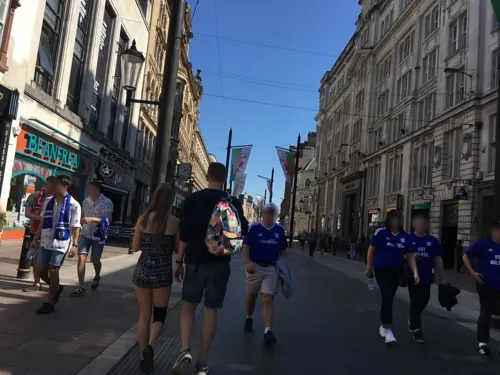
The Head of Steam
Bar and pub · Burger, American, Greek, Mexican
18-19 Church Street, Cardiff
Mo-We 12:00-23:00; Th-Sa 12:00-00:00; Su 12:00-22:30

The Prince Of Wales
Bar and pub
Pub in Cardiff, Wales; formerly a theatre
81-83 Saint Mary Street, Cardiff
Mo-Th 07:00-00:00; Fr 07:00-00:00; Sa 00:00-01:00,07:00-00:00; Su...
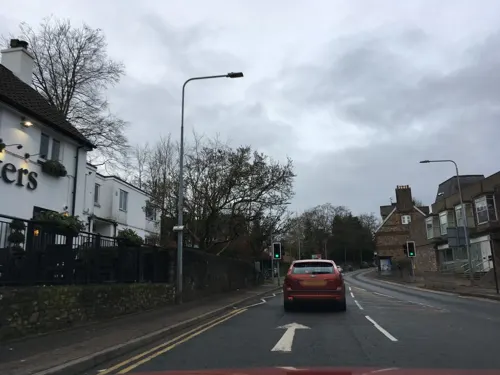

Brewhouse & Kitchen
Bar and pub · 0.6 mi
Sophia Close, Cardiff
Su,Mo 12:00-23:00; Tu-Th 11:00-23:00; Fr,Sa 11:00-00:00

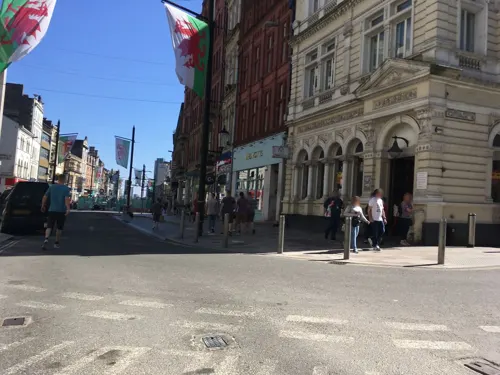

Kongs
Bar and pub
114-116 Saint Mary Street, Cardiff
Mo-Th 16:00-01:00; Fr-Sa 12:00-02:00; Su 12:00-00:00


115 more on the map.
History
Caerdydd (the Welsh name of the city) derives from the Middle Welsh Caerdyf. The change from -dyf to -dydd shows the colloquial alteration of Welsh f [v] and dd [ð] and was perhaps also driven by folk etymology. This sound change probably first occurred in the Middle Ages; both forms were current in the Tudor period. Caerdyf has its origins in post-Roman Brythonic words meaning "the fort of the Taff". The fort probably refers to that established by the Romans. Caer is Welsh for fort and -dyf is a form of Taf (Taff), the river which flows by Cardiff Castle, with the ⟨t⟩ showing consonant mutation to ⟨d⟩, as is normal in compound words, and the vowel showing affection as a result of a (lost) genitive case ending.
The anglicised Cardiff is derived from Caerdyf, with the Welsh f [v] borrowed as ff , as also happens in Taff (from Welsh Taf) and Llandaff (from Welsh Llandaf).
The antiquarian William Camden (1551–1623) suggested that the name Cardiff may derive from *Caer-Didi ("the Fort of Didius"), a name supposedly given in honour of Aulus Didius Gallus, governor of a nearby province at the time when the Roman fort was established. Although some sources repeat this theory, it has been rejected on linguistic grounds by modern scholars such as Professor Gwynedd Pierce.
Read more of the history
Archaeological evidence from sites in and around Cardiff show that people had settled in the area by at least around 6000 BC, during the early Neolithic: about 1,500 years before either Stonehenge or the Great Pyramid of Giza was completed. These include the St Lythans burial chamber near Wenvoe, (approximately four miles or six km west of Cardiff city centre); the Tinkinswood burial chamber, near St. Nicholas (about six miles or ten km west of Cardiff city centre), the Cae'rarfau Chambered Tomb, Creigiau (about six miles or ten km northwest of Cardiff city centre) and the Gwern y Cleppa long barrow, near Coedkernew, Newport (about eight miles or thirteen km northeast of Cardiff city centre). A group of five Bronze Age tumuli is at the summit of the Garth, within the county's northern boundary. Four Iron Age hill fort and enclosure sites have been identified within Cardiff's county boundaries, including Caerau Hillfort, an enclosed area of 5.1 hectares (12+1⁄2 acres).
Until the Roman conquest of Britain, Cardiff was part of the territory of the Silures – a Celtic British tribe that flourished in the Iron Age – whose territory included the areas that would become known as Breconshire, Monmouthshire and Glamorgan. The 3.2 ha (8-acre) fort established by the Romans near the mouth of the River Taff in AD 75, in what would become the north western boundary of the centre of Cardiff, was built over an extensive settlement that had been established by the Romans in the 50s AD. The fort was one of a series of military outposts associated with Isca Augusta (Caerleon) that acted as border defences. The fort may have been abandoned in the early 2nd century as the area had been subdued. However, by this time a civilian settlement, or vicus, was established. It was likely made up of traders who made a living from the fort, ex-soldiers and their families. A Roman villa has been discovered at Ely. Contemporary with the Saxon Shore forts of the 3rd and 4th centuries, a stone fortress was established at Cardiff. Similar to the shore forts, the fortress was built to protect Britannia from raiders. Coins from the reign of Gratian indicate that Cardiff was inhabited until at least the 4th century; the fort was abandoned towards the end of the 4th century, as the last Roman legions left the province of Britannia with Magnus Maximus.
Little is known of the fort and civilian settlement in the period between the Roman departure from Britain and the Norman Conquest. The settlement probably shrank in size and may even have been abandoned. In the absence of Roman rule, Wales was divided into small kingdoms; early on, Meurig ap Tewdrig emerged as the local king in Glywysing (which later became Glamorgan). The area passed through his family until the advent of the Normans in the 11th century.
In 1081 William I, King of England visited Cardiff as part of an armed pilgrimage across South Wales and ordered work to begin on the castle keep within the walls of the old Roman fort. Cardiff Castle has been at the heart of the city ever since. The castle was substantially altered and extended during the Victorian period by John Crichton-Stuart, 3rd Marquess of Bute, and the architect William Burges. Original Roman work can, however, still be distinguished in the wall facings.
A town grew up under the castle, consisting mainly of settlers from England. Cardiff had a population of between 1,500 and 2,000 in the Middle Ages – a normal size for a Welsh town in the period. It was the centre of the Norman Marcher Lordship of Glamorgan. By the end of the 13th century, Cardiff was the only town in Wales with a population exceeding 2,000, although it remained relatively small compared with notable towns in England and continued to be contained within its walls, which were begun as a wooden palisade in the early 12th century. It was of sufficient size and importance to receive a series of charters, notably in 1331 from William La Zouche, Lord of Glamorgan through marriage with the de Clare family, Edward III in 1359, then Henry IV in 1400, and later Henry VI.
From the History section of Cardiff on Wikipedia, under CC BY-SA 4.0.
More about Cardiff
Geography
The centre of Cardiff is relatively flat and bounded by hills to the east, north and west. Its location influenced its development as the world's largest coal port, notably its proximity and easy access to the coalfields of the South Wales Valleys. The highest point in the local authority area is Garth Hill, 307 m (1,007 ft) above sea level.
Economy
As the capital city of Wales, Cardiff is the main engine of growth in the Welsh economy. Though the population of Cardiff is about 10% of the Welsh population, the economy of Cardiff makes up nearly 20% of Welsh GDP and 40% of the city's workforce are daily in-commuters from the surrounding South Wales area.
Industry has played a major part in Cardiff's development for many centuries. The main catalyst for its transformation from a small town into a big city was the demand for coal required in making iron and later steel, brought to sea by packhorse from Merthyr Tydfil. This was first achieved by building a 25-mile (40 km) canal from Merthyr (510 ft or 160 m above sea level) to the Taff Estuary at Cardiff. Eventually the Taff Vale Railway replaced the canal barges and massive marshalling yards sprang up as new docks were developed in Cardiff – all prompted by the soaring worldwide demand for coal from the South Wales valleys.
Arts and culture
Cardiff has many cultural sites varying from the historical Cardiff Castle and out of town Castell Coch to the more modern Wales Millennium Centre and Cardiff Bay. Cardiff was a finalist in the European Capital of Culture 2008. In recent years Cardiff has grown in stature as a tourist destination, with recent accolades including Cardiff being voted the eighth favourite UK city by readers of The Guardian.
The city was also listed as one of the top 10 destinations in the UK on the official British tourist boards website Visit Britain, and US travel guide Frommers have listed Cardiff as one of 13 top destinations worldwide for 2008. Annual events in Cardiff that have become regular appearances in Cardiff's calendar include Sparks in the Park, The Great British Cheese Festival, Pride Cymru (formerly Cardiff Mardi Gras), Cardiff Winter Wonderland, Cardiff Festival and Made in Roath.
Education
Cardiff is home to four major institutions of higher education: Cardiff University, Cardiff Metropolitan University, University of South Wales and the Royal Welsh College of Music & Drama.
Cardiff University was founded by a royal charter in 1883 as the University College of South Wales and Monmouthshire, is a member of the Russell Group of leading research led universities, having most of its campus in Cathays and the city centre. Cardiff Metropolitan University (formerly UWIC) has campuses in the Llandaff, Cyncoed and city centre areas, and is part of the confederal University of Wales. The Royal Welsh College of Music & Drama is a conservatoire established in 1949 and is based in the grounds of Cardiff Castle. The University of South Wales's Cardiff campus, Atrium, is home to the Cardiff School of Creative & Cultural Industries and is located in the city centre.
The total number of higher education students in the city is around 43,900. The city also has two further education colleges: Cardiff and Vale College and St David's College. The former is the result of a merger, completed in August 2011, between Coleg Glan Hafren and Barry College. Further education is also offered at most high schools in the city.
From the Wikipedia article Cardiff, under CC BY-SA 4.0.
Notable people from Cardiff
 Brian David JosephsonWelsh physicistPhoto: Brian Josephson, CC BY 3.0
 Shirley BasseyWelsh singerPhoto: Rob Mieremet, CC BY-SA 3.0 nl
 Craig BellamyWelsh association football managerPhoto: Jon Candy from Cardiff, Wales, CC BY-SA 2.0
 Geraint ThomasWelsh racing cyclistPhoto: Nicola, CC BY-SA 4.0
 Ioan GruffuddWelsh actor (born 1973)Photo: vagueonthehow from Tadcaster, York, England, CC BY 2.0
 Tom EllisWelsh actorPhoto: Kevin Paul, CC BY 4.0
 Joe LedleyWelsh association football player (born 1987)Photo: Steindy ( talk ) 16:17, 10 November..., CC BY-SA 3.0
 Matthew RhysWelsh actorPhoto: PhilipRomano, CC BY-SA 4.0
- Gareth BaleWelsh association football player
- Ryan GiggsWelsh association football player and coach
- Ken FollettBritish novelist (born 1949)
- Rhodri MorganFirst Minister of Wales (1939-2017)
Born in Cardiff, according to Wikidata (CC0). Each name links to its Wikipedia article.
Where to stay32
Churches and places of worship77
Salvation Army Canton Citadel Corps
Church · Salvation Army · 1.3 mi
429 Cowbridge Road East, Cardiff
Shopping62
Gas and EV charging28
Schools, colleges and libraries34
Healthcare31
Map of Cardiff
250 places. The map loads OpenStreetMap tiles when you open it.
Getting there and nearby towns
Cardiff Airport (CWL) is the nearest airport with scheduled flights listed in OpenStreetMap, 9 miles away.
- Penarth 3 mi south, about 5 min by car
- Whitchurch 3 mi northwest, about 5 min by car
- Dinas Powys 3 mi southwest, about 6 min by car
- Newport 11 mi northeast, about 17 min by car
- Bristol 25 mi east, about 41 min by car
- Swansea 34 mi west, about 55 min by car
- Bath 36 mi east, about 58 min by car
- Gloucester 48 mi northeast, about 1 h 15 min by car
- Exeter 54 mi south, about 1 h 30 min by car
- Cheltenham 55 mi northeast, about 1 h 30 min by car
Drive times are estimates from straight-line distance, not routes.
Towns near Cardiff


Keep exploring
Local news
Headlines from INDB.
Reviews, tips and questions
Loading what members have shared...
Sources and licences
- GeoNames (CC BY 4.0): population, coordinates, regions and time zone
- Mapillary (see each image): photos
- OpenStreetMap contributors (ODbL 1.0): places, airports, map data
- Wikidata (CC0 1.0): elevation, founding date, time zone, website, landmarks and historic places
- Wikimedia Commons (see each image): photos
- Wikipedia (CC BY-SA 4.0): overview and history text
Photo credits
- Cardiffmontage3, MichiganCharms, CC BY-SA 3.0
- Monkstone - Fast boat ride, Ben Salter from Wales, CC BY 2.0
- Barry Island main gates, 21stCenturyGreenstuff ( talk ), CC BY 3.0
- Amgueddfa Genedlaethol Caerdydd, Ham II, CC BY-SA 3.0
- Chapter front 1, Chapter Arts Centre, Cardiff, Public domain
- Cardiff Castle - panoramio (1), Tevfik Teker, CC BY 3.0
- Bute Park, Cardiff, Athena's Pix (Back, but give me time!) profile at Flickr website, CC BY 2.0
- Sanatorium Park Entrance, Moonbeam52, CC BY-SA 4.0
- Falk Oberdorf St. John Churchyard Park, Falk Oberdorf, Osterstr. 8, 32312 Lübbecke, CC BY-SA 3.0 de
- Thompson's Park, Cardiff, Unknown author, Public domain
- Prince of Wales Theatre Cardiff Wood St facade B, Verbcatcher, CC BY-SA 4.0
- St Edeyrn's church, Llanedeyrn, Gareth James, CC BY-SA 2.0
- Cardiff City Stadium Pitch, Jon Candy from Cardiff, Wales, CC BY-SA 2.0
- St Fagans Museum Main Building 2018, Sionk, CC BY-SA 4.0
- Castell Coch - exterior, Hchc2009, CC BY-SA 4.0
- Exchange Hotel, Cardiff, Chris Sampson, CC BY 2.0
- St David's Hall by night. 22 October 2014, Vashti Thomas, CC BY-SA 4.0
- Cardiff Library, The Hayes, Cardiff, John Lord, CC BY-SA 2.0
- Cardiff Wetlands Aerial View, Cardiff Harbour Authority, CC BY-SA 3.0
- Cardiff Marriott Hotel, Mx. Granger, CC0
- Copthorne Hotel, Cardiff, John Grayson, CC BY-SA 2.0
- Dyffryn House, Ben Salter, CC BY 2.0
- New Theatre Cardiff (16939562447), Tony Hisgett from Birmingham, UK, CC BY 2.0
- Sherman Cymru, Ham, CC BY-SA 3.0
- The Principal St David's Hotel, Tiia Monto, CC BY-SA 3.0
- Cardiff, Church Street, St. John the Baptist, Allie_Caulfield from Germany, CC BY 2.0
- Cardiff - Techniquest, Tiia Monto, CC BY-SA 3.0
- Castell Sain Ffagan, Caerdydd o'r awyr - Aerial view of Sain Ffagan Castle and grounds, Cardiff, Wales 2023 24, Llywelyn2000, CC BY-SA 4.0
- Cathays Library, Howard Dickins, CC BY 2.0
- Gelynis Farm, John Vigar, CC BY-SA 2.0
- Merthyr Dyfan parish church, John Lord, CC BY-SA 2.0
- Royal Hotel, Cardiff, Sionk, CC BY-SA 3.0
- Cardiff Story entrance (1), Seth Whales, CC BY-SA 3.0
- St John the Evangelist Church, Canton, Cardiff, Sean Kisby, CC BY-SA 3.0
- Duke of Wellington Cardiff - panoramio, cowbridgeguide.co.uk, CC BY 3.0
- Canton Library Cardiff, Welsh leprechaun, Public domain
- Rhiwbina Library Cardiff, Welsh leprechaun, Public domain
- Maldron Hotel, Cardiff (June 2014), Seth Whales, CC BY-SA 3.0
- Y Mochyn Du, Sjaak Kempe from Groningen, The Netherlands, CC BY 2.0
- Cedar Tree Farm Inn, Cardiff, Sionk, CC BY-SA 4.0
- Whitchurch Road Surgery, JenOwen11, CC BY-SA 3.0
- Meddygfa Canna Surgery, Peter Broster, CC BY-SA 4.0
- Oriel Canvas, Glamorgan Street, Cardiff, Sionk, CC BY-SA 4.0
- Llanover Hall Arts Centre (1), Sionk, CC BY-SA 4.0
- The Riverhouse, Frombowen, CC BY-SA 4.0
- Džamija u Cardiffu, August Dominus, CC0
- Wales Millennium Centre September 2023 03, DaHuzyBru, CC BY-SA 4.0
- Insole Court, Cardiff – front façade, TomZelinsky, CC BY 4.0
- Sophia Gardens Coach Station 2, Sionk, CC BY-SA 4.0
- Cardiff Gate services, M4-A4232, David Dixon, CC BY-SA 2.0
- The Old Cross Inn, Newport Road, Rumney, Sionk, CC BY-SA 4.0
- Street-level photo, southglos, CC BY-SA 4.0
- Street-level photo, southglos, CC BY-SA 4.0
- Street-level photo, southglos, CC BY-SA 4.0
- Street-level photo, southglos, CC BY-SA 4.0
- Street-level photo, ris, CC BY-SA 4.0
- Street-level photo, laye, CC BY-SA 4.0
- Street-level photo, miguel_andrade, CC BY-SA 4.0
- Street-level photo, southglos, CC BY-SA 4.0
- Street-level photo, southglos, CC BY-SA 4.0
- Street-level photo, southglos, CC BY-SA 4.0
- Street-level photo, alexanderar, CC BY-SA 4.0
- Street-level photo, southglos, CC BY-SA 4.0
- Street-level photo, southglos, CC BY-SA 4.0
- Street-level photo, southglos, CC BY-SA 4.0
- Street-level photo, southglos, CC BY-SA 4.0
- Street-level photo, miguel_andrade, CC BY-SA 4.0
- Street-level photo, southglos, CC BY-SA 4.0


Page built November 10, 2026. Spotted a mistake? Tell us or suggest a place.