


Why visit Lincoln
Townapedia lists 63 museums and landmarks, 36 parks and trails, 197 places to eat, 28 places to stay and 8 attractions in and around town.
Highlights include High Bridge, Lincoln, The Lawn, Lincoln, High Street and Lincoln Museum.
Weather in Lincoln
Forecast from MET Norway (CC BY 4.0). Full forecast
About Lincoln
Lincoln () is a cathedral city and district in Lincolnshire, England, of which it is the county town. In the 2021 census, the city's district had a population of 103,813. The 2021 census gave the urban area of Lincoln, including Bracebridge Heath, North Hykeham, South Hykeham and Waddington, a recorded population of 127,540.
From the Wikipedia article Lincoln, England (this version), under CC BY-SA 4.0.
Travel tips from other travellers: Lincoln on Wikivoyage (CC BY-SA 4.0).
Things to do8

High Bridge, Lincoln
Bridge
Grade I listed bridge in Lincoln, England

The Lawn, Lincoln
Cinema and theater · 0.6 mi
Building in Lincoln, UK

New Theatre Royal, Lincoln
Cinema and theater
Theatre in Lincoln, England
Museums and landmarks63
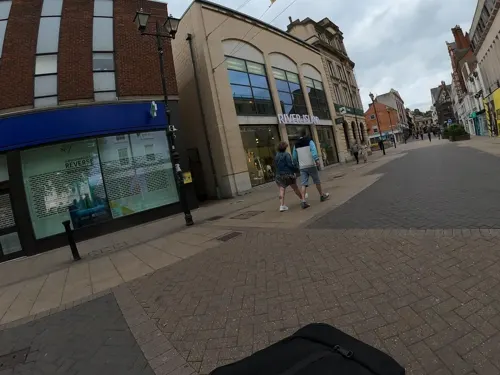

Lincoln Museum
Museum
Museum and gallery in Lincoln, England, United Kingdom
1 Danes Terrace, Lincoln
Mo-Su 10:00-16:00; Tu off; We off

Lincoln Castle
Monument and historic site · 0.6 mi
Grade I listed building in Lincolnshire, England, UK
Mar 29-Oct 27 10:00-17:00; Oct 28-Apr 04 10:00-16:00; Dec 24-26...


Doddington Hall
Museum · 4.8 mi
Country house in Lincolnshire, England, UK

Lindum Colonia
Monument and historic site · 0.5 mi
Roman settlement in Lincoln, United Kingdom



Museum of Lincolnshire Life
Museum · 0.8 mi
Museum in Lincoln, United Kingdom
Lincoln Medieval Bishop's Palace
Museum · 0.5 mi
Grade I listed building and scheduled monument in Lincoln, England
51 more on the map.
Parks, trails and playgrounds36


Ancient Church Yard Of St. Swithin's
Park
Placed in the care of Lincoln Corporation 1956.

24 more on the map.
Restaurants and cafes197
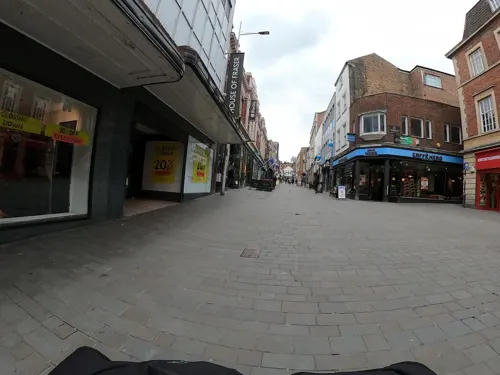
Caffè Nero
Cafe · Coffee Shop
292-293 High Street, Lincoln
Mo-Th 07:00-18:30; Fr 07:00-19:00; Sa 07:30-19:00; Su 08:30-18:00
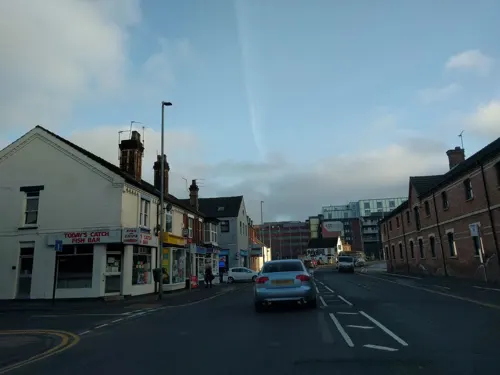
Carholme Chippy
Restaurant · Fish And Chips · 0.6 mi
47 Carholme Road, Lincoln
Mo-Sa 16:30-21:00; Su 16:00-20:30
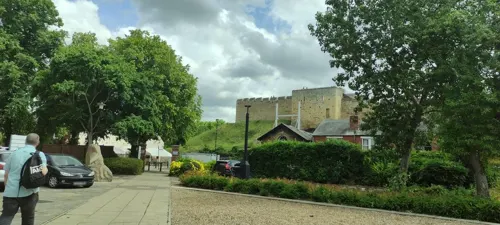
Olé Olé Tapas Bar & Restaurant
Restaurant · Spanish, Mediterranean, Seafood, Tapas, Fish, Coffee Shop · 0.6 mi
3 Ingleman Place, Lincoln
Mo-Th 12:00-14:30, 17:30-22:00; Fr 12:00-14:30, 17:00-22:00; Sa...
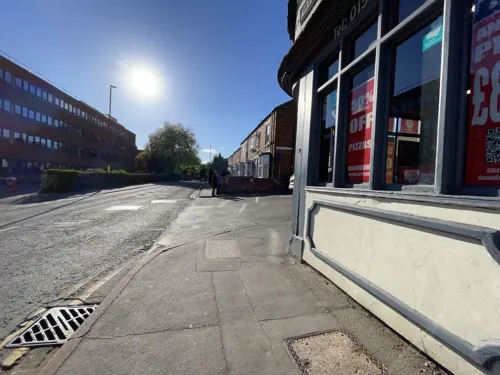
Pizza Hut
Restaurant · Pizza · 0.4 mi
68-70 West Parade, Lincoln
Mo-Th 12:00-23:00; Fr-Sa 11:00-23:00; Su 12:00-23:00
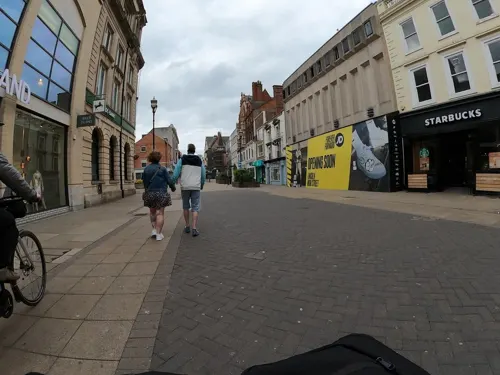
The Ferry Boat
Restaurant · Burger, Fries, Fish And Chips, Chicken, Pork, Sausage, Cake, Crumble, Brownies, Sticky Toffee Pudding, Pies, Ciabattas, Soup, Roasts, Beef · 2.6 mi
High Street, Lincoln
Mo-Sa 12:00-23:00, Su 12:00-22:30


185 more on the map.
History
The earliest origins of Lincoln can be traced to remains of an Iron Age settlement of round wooden dwellings, discovered by archaeologists in 1972, which have been dated to the 1st century BCE. It was built by Brayford Pool on the River Witham at the foot of a large hill, on which the Normans later built Lincoln Cathedral and Lincoln Castle.
The Romans conquered this part of Britain in 48 CE and soon built a legionary fortress high on a hill overlooking the natural lake, Brayford Pool, formed by the widening of the River Witham, and the northern end of the Fosse Way Roman road (A46). Celtic Lindon was later Latinised to Lindum and the title Colonia added when it became settled by army veterans.
The conversion to a colonia occurred when the legion moved on to York (Eboracum) in 71 CE. Lindum colonia or more fully, Colonia Domitiana Lindensium, after the then Emperor Domitian, was set up within the walls of the hilltop fortress by extending it with about an equal area, down the hillside to the waterside.
Read more of the history
It became a flourishing settlement accessible from the sea through the River Trent and through the River Witham. On the basis of a patently corrupt list of British bishops said to have attended the 314 Council of Arles, the city is often seen as having been the capital of the province of Flavia Caesariensis, formed during the late 3rd-century Diocletian Reforms. Subsequently, the town and its waterways declined. By the close of the 5th century, it was largely deserted, although some occupation continued under a Praefectus Civitatis – Saint Paulinus visited a man holding this office in Lincoln in 629 CE.
Germanic tribes from the North Sea area settled Lincolnshire in the 5th to 6th centuries. The Latin Lindum Colonia shrank in Old English to Lindocolina, then to Lincylene.
After the first Viking raids, the city again rose to some importance with overseas trading ties. In Viking times Lincoln had its own mint, by far the most important in Lincolnshire and by the end of the 10th century, comparable in output to that of York. After establishment of the Danelaw in 886, Lincoln became one of the Five East Midland Boroughs. Excavations at Flaxengate reveal that an area deserted since Roman times received timber-framed buildings fronting a new street system in about 900. Lincoln underwent an economic explosion with the settlement of the Danes. Like York, the Upper City seems to have had purely administrative functions up to 850 or so, while the Lower City, down the hill towards the River Witham, may have been largely deserted. By 950, however, the Witham banks were developed, the Lower City resettled and the suburb of Wigford emerging as a trading centre. In 1068, two years after the Norman conquest of England, William I ordered Lincoln Castle to be built on the site of the old Roman settlement, for the same strategic reasons and controlling the same road, the Fosse Way.
During the Anarchy, in 1141 Lincoln was the site of a battle between King Stephen and the forces of Empress Matilda, led by her illegitimate half-brother Robert, 1st Earl of Gloucester. After fierce fighting in the city streets, Stephen's forces were defeated and Stephen himself captured and taken to Bristol.
By 1150, Lincoln was among the wealthiest towns in England, based economically on cloth and wool exported to Flanders; Lincoln weavers had set up a weavers' guild in 1130 to produce Lincoln Cloth, especially the fine dyed "scarlet" and "green", whose reputation was later enhanced by the legendary Robin Hood wearing woollens of Lincoln green. In the Guildhall, surmounting the city gate called the Stonebow, the ancient Council Chamber contains Lincoln's civic insignia, a fine collection of civic regalia.
Outside the precincts of cathedral and castle, the old quarter clustered round the Bailgate and down Steep Hill to the High Street and High Bridge, whose half-timbered housing juts out over the river. There are three ancient churches: St Mary le Wigford and St Peter at Gowts, both 11th century in origin, and St Mary Magdalene, from the late 13th century. The last is an unusual English dedication to a saint whose cult was coming into vogue on the European continent at the time.
Lincoln was home to one of five main Jewish communities in England, well established before it was officially noted in 1154. In 1190, anti-Semitic riots that started in King's Lynn, Norfolk, spread to Lincoln; the Jewish community took refuge with royal officials, but their homes were plundered. The so-called House of Aaron has a two-storey street frontage that is essentially 12th century and the nearby Jew's House likewise bears witness to the Jewish population. In 1255, the affair called "The Libel of Lincoln" in which prominent Lincoln Jews, accused of ritual murder of a Christian boy (Little Saint Hugh of Lincoln in medieval folklore) were sent to the Tower of London and 18 executed. The Jews were all expelled in 1290.
Thirteenth-century Lincoln was England's third largest city and a favourite of more than one king. In the First Barons' War, it was caught in the strife between the king and rebel barons allied with the French. Here and at Dover the French and Rebel army was defeated. Thereafter the town was pillaged for having sided with Prince Louis. In the Second Barons' War, of 1266, the disinherited rebels attacked the Jews of Lincoln, ransacked the synagogue and burned the records that registered debts.
From the History section of Lincoln, England on Wikipedia, under CC BY-SA 4.0.
More about Lincoln
Geography
The city is 55 miles (89 km) southwest of Hull, 32 miles (51 km) north-east of Nottingham, 47 miles (76 km) north of Peterborough, 73 miles (117 km) southeast of Leeds and 40 miles (64 km) east south-east of Sheffield.
Lincoln is divided informally into two zones: uphill and downhill.
The uphill zone lies at an altitude of 67 ft (20.4 m) up to 246 ft (75.0 m) on Castle Hill, part of the Lincoln Cliff escarpment, which runs north and south through Central Lincolnshire. The downhill zone lies on the River Witham, which flows through the Lincoln Gap in that escarpment.
The uphill area comprises the northern part of the city and includes the historical quarter, including Lincoln Cathedral, Lincoln Castle and the Medieval Bishop's Palace, known locally as The Bail (though described in tourist literature as the Cathedral Quarter). It also has residential suburbs to the north and north-east. The downhill area comprises the city centre and suburbs to the south and south-west. Steep Hill is a narrow, pedestrian street directly connecting the two. It passes through an archway known as the Stonebow.
Economy
34 per cent of Lincoln's workforce are in public administration, education and health; distribution, restaurants and hotels account for 25 per cent.
Industrial relics like Ruston (now Siemens) remain, with empty industrial warehouse buildings becoming multi-use units, with the likes of the University of Lincoln, local Lincs FM radio station (in the Titanic Works) and gyms using some of the space. The old Corn Exchange, completed in 1848, is now used as a shopping arcade, and the newer Corn Exchange, completed in 1879, is now used as a restaurant and shops.
Like many other cities, Lincoln has a growing IT economy, with many e-commerce mail order companies. Two electronics firms are e2V and Dynex Semiconductor. Bifrangi, an Italian maker of crankshafts for off-road vehicles using a screw press, is based at the former Tower Works owned by Smith-Clayton Forge Ltd.
Education
The older of Lincoln's two higher education institutions, Lincoln Bishop University, was started as a teacher training college linked to the Anglican Church in 1862. During the 1990s it branched out into other subject areas with a focus on the arts and drama. It became a university college in 2006 with degree powers taken over from the University of Leicester. It gained university status in 2012. An annual graduation celebration takes place in Lincoln Cathedral.
The larger University of Lincoln started as the University of Lincolnshire and Humberside in 1996, when the University of Humberside opened a Lincoln campus next to Brayford Pool. Lincoln School of Art and Design (which was Lincolnshire's main outlet for higher education) and Riseholme Agricultural College, previously part of De Montfort University in Leicester, were absorbed into the University of Lincoln in 2001, and subsequently the Lincoln campus took priority over the Hull campus.
The name changed to the University of Lincoln in September 2002. In the 2021–2022 academic year, a total of 18,705 university students studied in the city.
From the Wikipedia article Lincoln, England, under CC BY-SA 4.0.
Notable people from Lincoln
 George BooleEnglish mathematician, philosopher and logician (1815–1864)Photo: Unknown author Unknown author, Public domain
 Neville MarrinerBritish conductor and violinist (1924–2016)Photo: Minnesota Orchestra, Public domain
 Anna SoubryBritish politicianPhoto: Chris McAndrew, CC BY 3.0
 Boz BurrellBritish singer and bassist (1946–2006)Photo: Jim Summaria, CC BY-SA 3.0
 Georgie TwiggBritish field hockey playerPhoto: fourthandfifteen, CC BY 2.0
 Sam LowesBritish motorcycle racerPhoto: Jearle, CC BY-SA 4.0
 Robert TobinBritish athletePhoto: Erik van Leeuwen, GFDL
 Nigel HuddlestonBritish politician (born 1970)Photo: ©House of Commons / Laurie Noble, CC BY 3.0
 Alex LowesBritish motorcycle riderPhoto: Jearle, CC BY-SA 4.0
- Penelope FitzgeraldBritish writer and poet (1916–2000)
- Nonso AnozieBritish actor
- Charlotte ScottEnglish mathematician (1858–1931)
Born in Lincoln, according to Wikidata (CC0). Each name links to its Wikipedia article.
Where to stay28
Churches and places of worship78
Central Methodist Church
Church · Methodist · 0.4 mi
123 High Street, Lincoln
Shopping68
Gas and EV charging8
Schools, colleges and libraries51
St Faith and St Martin Church of England Junior School
School · Anglican · 0.7 mi
Hampton Street, Lincoln
St Peter and St Paul, Catholic Voluntary Academy
School · Roman Catholic · 1.5 mi
Western Avenue, Lincoln
The Lincoln Bishop King Church of England Primary School
School · Anglican · 0.6 mi
Kingsway, Lincoln
The Nettleham Church of England Voluntary Aided Junior School
School · Anglican · 3.3 mi
Mill Hill, Lincoln
Healthcare22
Map of Lincoln
250 places. The map loads OpenStreetMap tiles when you open it.
Getting there and nearby towns
RAF Waddington (WTN) is the nearest airport with scheduled flights listed in OpenStreetMap, 4 miles away.
- Bracebridge Heath 2 mi south, about 3 min by car
- Washingborough 3 mi east, about 4 min by car
- Burton 3 mi northwest, about 5 min by car
- Mansfield 28 mi west, about 45 min by car
- Nottingham 32 mi southwest, about 51 min by car
- Rotherham 37 mi northwest, about 59 min by car
- Sheffield 40 mi west, about 1 h by car
- Peterborough 47 mi south, about 1 h 15 min by car
- Wakefield 51 mi northwest, about 1 h 15 min by car
- York 55 mi northwest, about 1 h 30 min by car
Drive times are estimates from straight-line distance, not routes.
Towns near Lincoln


Keep exploring
Local news
Headlines from INDB.
Reviews, tips and questions
Loading what members have shared...
Sources and licences
- GeoNames (CC BY 4.0): population, coordinates, regions and time zone
- Mapillary (see each image): photos
- OpenStreetMap contributors (ODbL 1.0): places, airports, map data
- Wikidata (CC0 1.0): elevation, founding date, time zone, website, landmarks and historic places
- Wikimedia Commons (see each image): photos
- Wikipedia (CC BY-SA 4.0): overview and history text
Photo credits
- Lincoln-BrayfordPool, Chris McKenna ( user:Thryduulf ), CC BY-SA 4.0
- High Bridge, High Street, Lincoln, Brian from UK, CC BY-SA 2.0
- The Collection, Lincoln (51407522170), John Lord from Edinburgh, Scotland, CC BY 2.0
- Lincoln, UK - panoramio (49), Dmitrij M, CC BY 3.0
- Newport Arch, Marek69, CC BY-SA 4.0
- Lincoln, St John the Baptist church (23973779674), Jules & Jenny from Lincoln, UK, CC BY 2.0
- Lincoln Cathedral viewed from Lincoln Castle, DrMoschi, CC BY-SA 4.0
- Lincoln v Boston 002, Differentgravy at English Wikipedia, CC BY-SA 3.0
- Lincoln Arboretum, Rodw, CC0
- Steep Hill, The original uploader was Daviddariusbijan at English Wikipedia ., CC BY 2.0
- 6 Eastgate, Lincoln, July 2026, No Swan So Fine, CC BY-SA 4.0
- Entrance to the Lincoln Central Library, Michael Rowe, CC BY-SA 4.0
- Whisby Nature Park, Rodw, CC0
- The Lawn, Lincoln (112813775), Brian from Lincoln, UK, CC BY-SA 2.0
- Garden at Doddington Hall - panoramio, PJMarriott, CC BY 3.0
- Newport Arch (8062281076), Peter Broster, CC BY 2.0
- Street-level photo, gness, CC BY-SA 4.0
- Street-level photo, gness, CC BY-SA 4.0
- Street-level photo, adam2, CC BY-SA 4.0
- Street-level photo, christhecat, CC BY-SA 4.0
- Street-level photo, jethro10, CC BY-SA 4.0
- Street-level photo, adam2, CC BY-SA 4.0
- Street-level photo, adam2, CC BY-SA 4.0
- Street-level photo, gness, CC BY-SA 4.0
- Street-level photo, gness, CC BY-SA 4.0
- Street-level photo, gness, CC BY-SA 4.0
- Street-level photo, adam2, CC BY-SA 4.0


Page built November 10, 2026. Spotted a mistake? Tell us or suggest a place.