


Why visit Ripon
Townapedia lists 41 museums and landmarks, 15 parks and trails, 59 places to eat, 8 places to stay and 4 attractions in and around town.
Highlights include Lightwater Valley, North Bridge, The Courthouse Museum and Fountains Abbey.
Weather in Ripon
Forecast from MET Norway (CC BY 4.0). Full forecast
About Ripon
Ripon () is a cathedral city and civil parish in North Yorkshire, England. It is located at the confluence of two tributaries of the River Ure, the Laver and Skell.
From the Wikipedia article Ripon (this version), under CC BY-SA 4.0.
Travel tips from other travellers: Ripon on Wikivoyage (CC BY-SA 4.0).
Photos of Ripon

Things to do4

Lightwater Valley
Monument and historic site · 3.3 mi
Amusement park in England
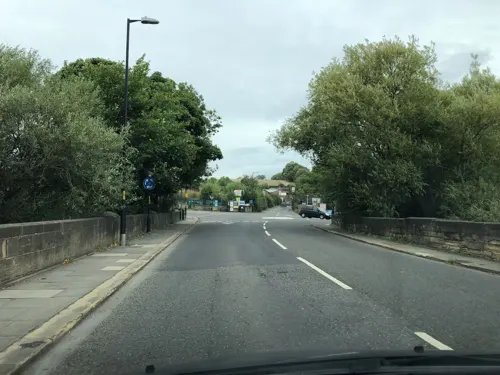
North Bridge
Bridge · 0.7 mi
Bridge in Ripon, Harrogate, North Yorkshire, England, UK
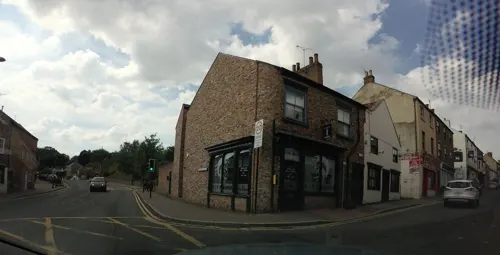
Opera House
Cinema and theater
Former theatre and cinema in Ripon, Harrogate, England, demolished with only the foyer surviving which is used as a shop

Museums and landmarks41


Fountains Abbey
Monument and historic site · 2.8 mi
Ruined Cistercian abbey in Yorkshire, England, UK

Fountains Hall
Museum · 3.0 mi
Grade I listed historic house museum in Lindrick with Studley Royal and Fountains, Harrogate, North Yorkshire, England, UK

Markenfield Hall
Museum · 2.6 mi
Historic house near Harrogate, North Yorkshire, England, UK

Newby Hall
Museum · 3.3 mi
Grade I listed country house in North Yorkshire, England, UK
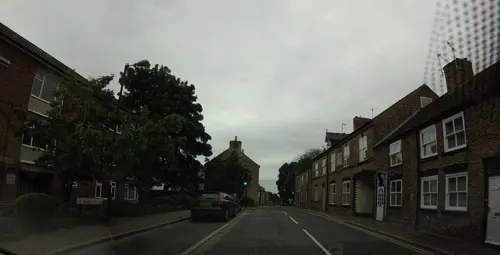
Prison and Police Museum
Museum · 0.4 mi
Museum in Ripon, United Kingdom

Ripon Obelisk
Monument and historic site
Grade I listed obelisk in Ripon, North Yorkshire, England, UK
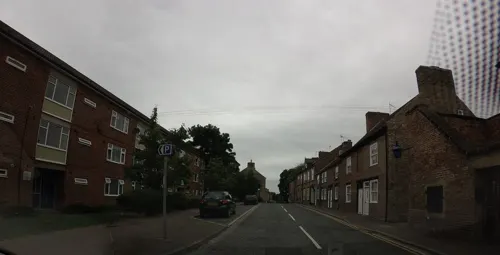
Ripon Prison and Police Museum
Museum · 0.4 mi
St. Marygate, Ripon


The Obelisk Approximately 80 Metres West Of Church Of St Mary
Monument and historic site · 2.5 mi
Obelisk in Lindrick with Studley Royal and Fountains, Harrogate, North Yorkshire, England, UK
29 more on the map.
Parks, trails and playgrounds15




Hell Wath Local Nature Reserve
Hiking and trails · 0.7 mi
Grassland and scrub adjacent to the River Skell.


3 more on the map.
Restaurants and cafes59

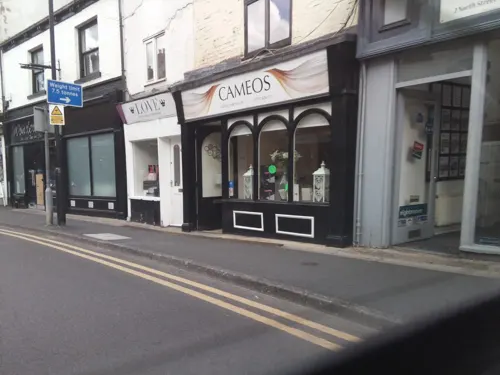

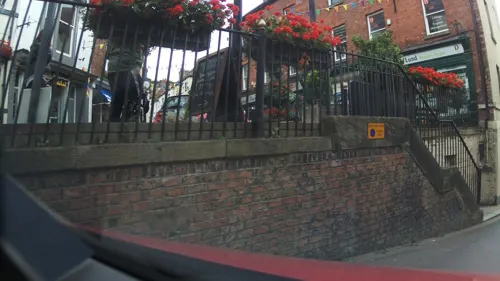
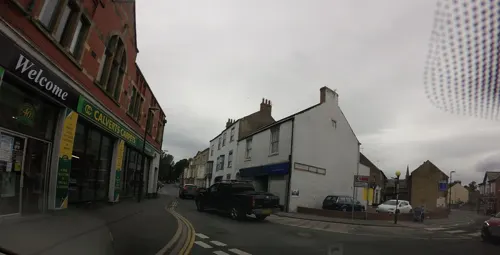


One Eyed Rat
Bar and pub · 0.4 mi
51 Allhallowgate
Mo,Tu 16:00-22:00; We 16:00-22:30; Th 16:00-23:00; Fr 14:00-23:00;...
47 more on the map.
History
During its prehistory the area which later became Ripon was under the control of the Brigantes, a Brythonic tribe. Three miles (5 km) north at Hutton Moor there is a large circular earthwork created by them. The Romans did not settle Ripon, but they had a military outpost around 5 miles (8 km) away at North Stainley. Solid evidence for the origins of Ripon can be traced back to the 7th century, the time of the Anglian kingdom of Northumbria. The first structure built in the area, known at the time as Inhrypum, was a Christian church dedicated to St Peter, with the settlement originating in 658. This was founded by Wilfrid, a Northumbrian nobleman, who later became Archbishop of York; he was granted the land by King Alhfrith.
Read more of the history
The earliest settlers were stonemasons, glaziers and plasterers that Wilfrid brought over to help construct the Ripon monastery, from Lyon in Francia and Rome, which was then under Byzantine rule. The years following the death of Wilfrid are obscure in Ripon's history. After the invasion of the Great Heathen Army of Norse Vikings in Northumbria, the Danelaw was established and the Kingdom of Jórvík was founded in the Yorkshire area. In 937, Athelstan, then King of England, granted the privilege of sanctuary to Ripon, for a mile around the church. One of his successors was less well-disposed: after the Northumbrians rebelled against English rule in 948, King Edred had the buildings at Ripon burned. Prosperity was restored by the end of the 10th century, as the body of Saint Cuthbert was moved to Ripon for a while, due to the threat of Danish raids.
After the Norman conquest, much of the north rebelled in 1069, even trying to bring back Danish rule; the suppression that followed was the Harrying of the North, which resulted in the death of approximately one-third of the population of the North of England. Ripon is thought to have shrunk to a small community around the church following the suppression. The lands of the church were transferred to St Peter's Church at York as the Liberty of Ripon and it was during this time that a grand Collegiate Church was built on top of the ruins of Wilfrid's building. Eventually developed in the Gothic style, the project owed much to the work of Roger de Pont L'Evêque and Walter de Gray, two Archbishops of York during the Plantagenet era. During the 12th century Ripon built up a booming wool trade, attracting Italian trade merchants, especially Florentines, who bought and exported large quantities.
Ripon's proximity to Fountains Abbey, where the Cistercians had a long tradition of sheep farming and owned much grazing land, was a considerable advantage. After English people were forbidden from wearing foreign cloth in 1326, Ripon developed a cloth industry which was third in size in Yorkshire after York and Halifax. Due to conflict with Scotland, political emphasis was on the North during the time of Edward I and Edward II, as Scottish invaders attacked numerous northern English towns. Ripon had a wakeman to make sure the residents were safely home by curfew and law and order was maintained; however, it was forced to pay 1,000 marks to the Scots to prevent them from burning down the town on one occasion.
Ripon, which relied heavily on its religious institutions, was badly affected by the English Reformation under the Tudor king Henry VIII. The Abbot of Fountains, William Thirske, was expelled by Henry and replaced; Thirske went on to become one of the leaders of the Pilgrimage of Grace popular rising. The people of Northern England were quite traditional in their beliefs and were unhappy about Henry's intention to break with Rome; the Pilgrimage of Grace was the manifestation of this sentiment. The revolt failed and Henry followed through with the break from Rome and the Dissolution of the Monasteries, which included Fountains Abbey.
After Mary, Queen of Scots, fled Scotland to Northern England she stayed at Ripon on her journey. The mainly Catholic North supported her, and there was another popular rising known as the Rising of the North; this began six miles (10 km) away at Topcliffe and was led by Thomas Percy, the 7th Earl of Northumberland and Charles Neville, the 6th Earl of Westmorland. The rebels stayed at Ripon on 18 November 1569, but the rising eventually failed resulting in 600 people being executed, 300 of whom were hanged at Gallows Hill in Ripon during January 1570.
Plans were drawn up to make Ripon a centre of education, a University of the North, to rival Oxford and Cambridge. Although chief advisers Lord Burghley and Archbishop Sandys supported the idea, Elizabeth I did not follow it through. The scheme was revived in 1604 by Sandys' widow Cicely, under the patronage of Anne of Denmark and Bess of Hardwick without success.
Ripon replaced its old textiles industry with one for the manufacture of spurs during the 16th century. They were so widely known that they gave rise to the proverb "as true steel as Ripon Rowels". At the time, spurs did not just serve as functional riding accessories, they were also fashionable; an expensive pair was made for King James I when he stayed at Ripon in 1617. It was James who granted Ripon a Royal Charter in 1604 and created the first Mayor of Ripon. After the Bishops' Wars in Scotland, a treaty was signed at Ripon in 1640 to stop the conflict between Charles I and the Scottish Covenanters. Although Ripon was not in the main line of fighting which was to the east, it remained loyal and royalist during the English Civil War. There was an incident in 1643, when parliamentarian forces under Thomas Mauleverer entered Ripon and damaged the Minster, but John Mallory and the royalist forces soon settled the matter after a skirmish in the Market Place. The royalists were eventually defeated in the Civil War and Charles I spent two nights as a prisoner in Ripon. Oliver Cromwell visited the city twice on his way to battle, once on the way to the Preston and also on the way to the Battle of Worcester.
From the History section of Ripon on Wikipedia, under CC BY-SA 4.0.
More about Ripon
Geography
Ripon lies at the confluence of the rivers Laver and the Skell, which meet in the west of the city. As they flow through the city, the Skell feeds water into the basin of Ripon Canal. East of the city, the Skell meets the River Ure, and both the Ure and canal head south-eastwards towards Boroughbridge. The Ure was the traditional boundary between the old West and North Ridings of Yorkshire.
As the city is at the meeting point of three rivers, it has flooded often in the 20th and 21st centuries; notable floods have occurred in 1982, 1991, 1995, 2000, 2005 and 2007. This prompted spending over £14 million on the building of flood defences for the city and a storage area upstream of the city which can hold 53,000,000 cubic feet (1,500,000 m3) of water.
Much of the districts geology consists of magnesian limestone, part of the Permian rock belt that extends southwards from Darlington to Wetherby. The area has pockets of gypsum underlying the surface soils. Water has dissolved the gypsum, leaving the area prone to sinkholes, especially north of the city and on the northern side of the Ure.
The climate data below is for Topcliffe, which is 8.1 miles (13 km) to the north-east.
Arts and culture
Market day is held on a Thursday, and there are 120 stalls. In celebration of the city's founder the Wilfrid Procession is held every year; it originated in 1108 when King Henry I granted the privilege of holding a fair for him. At the procession there are various decorated floats which make their way through the city with locals in costume. Part of the tradition represents the return of Wilfrid to Ripon, a decorated dummy (sometimes a man in costume instead) dressed as Wilfrid is sat on a horse, accompanied by two musicians with another man carrying St Wilfrid's hat around. Ripon also has dancing traditions such as the Long Sword dance and Morris dance.
The market square is the site of the Ripon Obelisk, erected in 1702 by John Aislabie and designed by Nicholas Hawksmoor. It stands 80 ft (24 m) in height and is capped with a weathervane bearing a representation of the wakeman's horn. It is Grade I listed and reputed to be the oldest in England.
Education
Ripon is home to Ripon Grammar School which is a selective intake, state secondary school. The school claims to take roots from the school which was attached to the Collegiate Church, founded during the time of the Angle kingdom of Northumbria by Saint Wilfrid. The refoundation date for the school was during the reign of Queen Mary I in 1555. The school has several notable alumni, known as Old Riponians, including theologian Bishop Beilby Porteus, historian Bishop William Stubbs, fashion designer Bruce Oldfield and television presenter Richard Hammond. In the modern day the school hosts around 800 pupils, gaining engineering status in 2006, it receives favourable reports from the Ofsted, being either good or outstanding. Opposite Ripon Grammar on Clotherholme Road is the non-selective Outwood Academy Ripon (formerly Ripon College, a secondary modern school), which was also known as Ripon City School until 1999. It has around 630 pupils and is exceeding the national average of GCSE results.
From the Wikipedia article Ripon, under CC BY-SA 4.0.
Notable people from Ripon
 Frederick Orpen BowerBritish botanist (1855–1948)Photo: Bain News Service, Public domain
 Richard BartleBritish writer, video game designer and computer scientist (born 1960)Photo: J. G. Bartle, CC BY-SA 3.0
 Billie MartenBritish singer-songwriterPhoto: Hangonz92, CC BY-SA 4.0
 Charles HudsonAnglican chaplain, British mountain climber (1828–1865)Photo: Edward Whymper (1840-1911), Public domain
 Naomi JacobBritish writer and actress (1884-1964)Photo: Unknown author Unknown author, Public domain
 Edward James GlaveEnglish travel writerPhoto: Valerian Gribayedoff, Public domain
- Derek KevanEnglish footballer (1935-2013)
- Simon GraysonEnglish footballer and manager (born 1969)
- David George KendallBritish statistician (1918–2007)
- George NicholsonEnglish botanist and horticulturist (1847–1908)
- Nick ChesterBritish engineer
- Michael Jopling, Baron JoplingBritish politician (born 1930)
Born in Ripon, according to Wikidata (CC0). Each name links to its Wikipedia article.
Where to stay8
Churches and places of worship22
Shopping19
Gas and EV charging2
Schools, colleges and libraries11
Healthcare3
Map of Ripon
184 places. The map loads OpenStreetMap tiles when you open it.
Getting there and nearby towns
Leeds Bradford Airport (LBA) is the nearest airport with scheduled flights listed in OpenStreetMap, 19 miles away.
- Wetherby 15 mi south, about 25 min by car
- York 22 mi southeast, about 35 min by car
- Leeds 23 mi south, about 38 min by car
- Shipley 23 mi southwest, about 37 min by car
- Skipton 23 mi southwest, about 37 min by car
- Bradford 25 mi south, about 41 min by car
- Yarm 26 mi north, about 42 min by car
- Thornaby-on-Tees 29 mi north, about 47 min by car
- Wakefield 31 mi south, about 50 min by car
- Middlesbrough 33 mi north, about 53 min by car
Drive times are estimates from straight-line distance, not routes.
Towns near Ripon


Keep exploring
Local news
Headlines from INDB.
Reviews, tips and questions
Loading what members have shared...
Sources and licences
- GeoNames (CC BY 4.0): population, coordinates, regions and time zone
- Mapillary (see each image): photos
- OpenStreetMap contributors (ODbL 1.0): places, airports, map data
- Wikidata (CC0 1.0): elevation, founding date, time zone, website, landmarks and historic places
- Wikimedia Commons (see each image): photos
- Wikipedia (CC BY-SA 4.0): overview and history text
Photo credits
- Ripon Cathedral, North Yorkshire, England, Alastair Moore, CC BY-SA 2.0
- EaglesClaw Lightwater, Stefan Scheer, CC BY-SA 3.0
- The Courthouse, Ripon (7537768452), Tim Green from Bradford, CC BY 2.0
- Fountains Abbey view02 2005-08-27, User:Klaus with K, CC BY-SA 3.0
- Studley Royal Park - Fountains Hall - 03, Benjamin Smith, CC BY-SA 4.0
- MarkenfieldHall(DennisLovett)Jun2004, Dennis Lovett, CC BY-SA 2.0
- NewbyHall(LynneGlazzard)Sep2003, Lynne Glazzard, CC BY-SA 2.0
- St Mary's Church, Madmedea, CC BY-SA 2.5
- Ripon workhouse, Redvers, CC BY 3.0
- Ripon Cathedral Exterior, Nth Yorkshire, UK - Diliff, Diliff, CC BY-SA 3.0
- The Deanery, Ripon (7563917556), Tim Green from Bradford, CC BY 2.0
- Unicorn Hotel, Ripon (7645092406), Tim Green from Bradford, CC BY 2.0
- Black Swan, Westgate, Ripon (24th October 2020), Mtaylor848, CC BY-SA 4.0
- RiponUnicornHotelPlaque, Richard Collier, CC BY-SA 4.0
- Quarry Moor (52), Storye book, CC BY-SA 4.0
- Evening light on the Ripon Obelisk - panoramio, Keith Ruffles, CC BY 3.0
- Street-level photo, hobgoblin, CC BY-SA 4.0
- Street-level photo, hobgoblin, CC BY-SA 4.0
- Street-level photo, southglos, CC BY-SA 4.0
- Street-level photo, hobgoblin, CC BY-SA 4.0
- Street-level photo, southglos, CC BY-SA 4.0
- Street-level photo, southglos, CC BY-SA 4.0
- Street-level photo, hobgoblin, CC BY-SA 4.0
- Street-level photo, hobgoblin, CC BY-SA 4.0
- Street-level photo, southglos, CC BY-SA 4.0
- Street-level photo, hobgoblin, CC BY-SA 4.0
- Street-level photo, hobgoblin, CC BY-SA 4.0
- Street-level photo, hobgoblin, CC BY-SA 4.0
- Street-level photo, hobgoblin, CC BY-SA 4.0
- Street-level photo, locator, CC BY-SA 4.0
- Street-level photo, southglos, CC BY-SA 4.0
- Street-level photo, hobgoblin, CC BY-SA 4.0
- Street-level photo, hobgoblin, CC BY-SA 4.0


Page built November 10, 2026. Spotted a mistake? Tell us or suggest a place.