

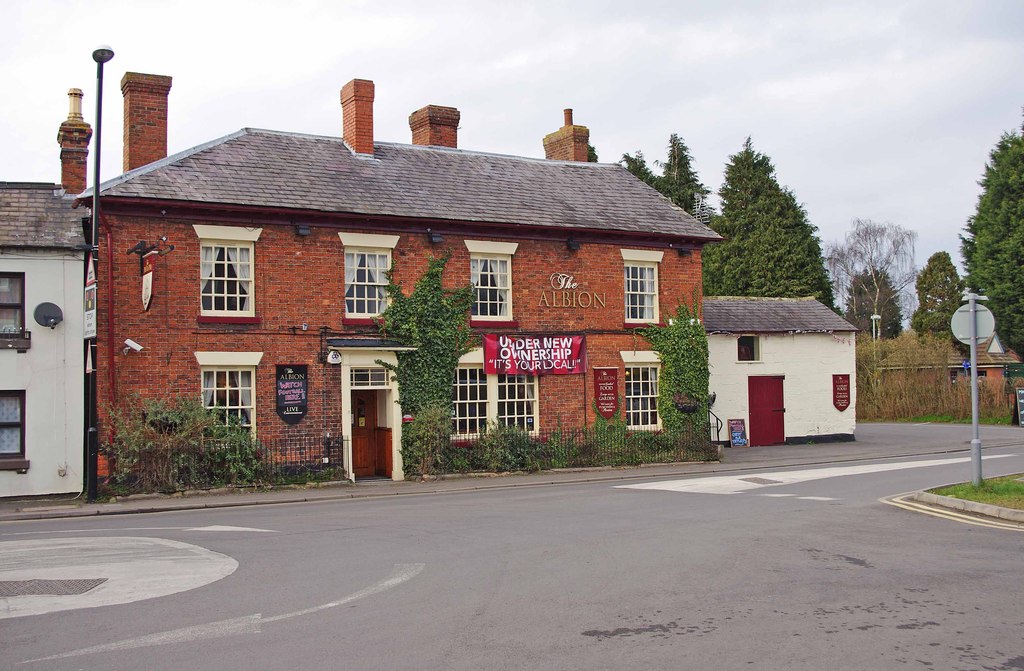


Why visit Wem
Townapedia lists 4 museums and landmarks, 6 parks and trails, 17 places to eat, 5 places to stay and 1 attraction in and around town.
Highlights include Wem Castle Motte, Wem Town Hall, Wem Millennium Green and Wem Recreation Ground.
Weather in Wem
Forecast from MET Norway (CC BY 4.0). Full forecast
About Wem
Wem is a market town in the civil parish of Wem Urban, in Shropshire, England, 9 miles (14 km) north of Shrewsbury and 9 miles (14 km) south of Whitchurch.
From the Wikipedia article Wem (this version), under CC BY-SA 4.0.
Travel tips from other travellers: Wem on Wikivoyage (CC BY-SA 4.0).
Things to do1
Museums and landmarks4

William Hazlitt
Monument and historic site
In this house lived the Rev William Hazlitt from 1787 to 1813 and his son William Hazlitt essayist and critic from 1787 to 1799.


Parks, trails and playgrounds6


Restaurants and cafes17

Paradise Lounge
Restaurant · Indian · 0.4 mi
62 High Street, Wem
Su-Th 17:00-23:00; Fr,Sa 17:00-24:00






5 more on the map.
History
The area now known as Wem is believed to have been settled prior to the Roman Conquest of Britain, by the Cornovii, Celtic Iron Age settlers: there is an Iron Age hillfort at nearby Bury Walls occupied over into the Roman period, and the Roman Road from Uriconium to Deva Victrix ran close by to the east at Soulton.
It is understood a lost Roman camp may have been in the area, called Rutunium.
The Wem Hoard, a collection of coins deposited in the post-Roman period, was found in land in the Wem area in 2019.
The Arden family owned the manor of Wem prior to the Conquest.
Weme was an Anglo-Saxon estate, which transitioned into a planned Norman castle-town established after the conquest, with motte-and-bailey castle, parish church and burgage plots. The town is recorded in the Domesday Book of 1086 as consisting of four manors in the hundred of Hodnet.
Land and resources: ploughland: 8 ploughlands. 1 lord's plough teams. 1 men's plough teams.
with an annual value to lord: 2 pounds in 1086; up to 1 pound 7 shillings in 1066.
The Domesday Book records that Wem was held by William Pantulf (Guillaume Pantol in French) and is its first known Lord. Orderic Vitalis described Pantulf as:
kind to the poor, to whom he was liberal in alms, he was firm in prosperity and adversity, put down all his enemies, and exercised great power through his wealth and possessions.
Read more of the history
Stafford Castle and Wem were granted to him with a further 28 manors in the area bounded by Clive, Ellesmere, Tilley and Cresswell, with some of the manors within this area belonging to other lords (Prees to the Bishop of Lichfield, and Soulton to the King's Chapel in Shrewsbury Castle, for example).
Pantulf refused to participate in an 1102 rebellion against King Henry I led by Robert de Belesme and assisted the crown defeating it, by marching with the king on Shrewsbury, during which the roads in the area were found to be bad, thickly wooded, providing cover for archers: 6000 foot soldiers cut down the woods and opened up the roads. Hugo Pantulf, a descendant of William, was Baron of Wem in the mid 1100s: he attended the court of Richard the Lion Heart, was Sheriff of Shropshire, and likely attended the Crusades with the king, certainly paying scutage to towards his ransom.In 1986, the BBC's national celebrations for the 900th anniversary of the Domesday Book focused on the town of Wem. This was because Wem was unique in having direct, unbroken male-line descendants of both its pre- and post-Conquest Manorial Lords: Pierre de Panthou and Dr. George Arden. The respective heirs were brought to the town for a special event, which was recorded for television and presented by historian Michael Wood.
The Norman town was probably enclosed by an earthwork: there is a record from the lord's steward of repairs to the town's enclosure in 1410, in which year the town had been "totally burnt and wasted by the Welsh rebels". There is some speculation that the town had walls by the 1400s, as Samuel Garbet recorded an annotation to Fabyan's Chronicle that Wem "was totally burnt to the ground, with its walls and castle" in the reign of Henry VI.
The supposed route of the walls or earthworks follows Noble Street, Wem Brook, the Roden and crossing the High Street between Leek Street and Chapel Street.
There were bars at the three entrances to the town, and a 1514 record exists of four men being employed to keep the bars on market days.
There is some thought that a market was held from the days of Pantuf, but King John certainly granted a charter in 1202. Initially, the permission was for a Sunday market. This was subsequently revised, in 1351, to a Thursday: this followed a decree of the Archbishop of Canterbury, Simon Islip in the reign of Edward III that Sunday markets were banned. Wem's market day remains Thursday to this day.
The manor was held by some of the great baronial families: including the Earls of Arundel, and the Lords Dacre, Bradford and Barnard and, after the 14th century the lord of the manor was not resident.
During the course of 1483, Henry Stafford, 2nd Duke of Buckingham (linked by some historians with the murder of the Princes in the Tower), was engaged in rebellion against Richard III with Henry Tudor. By October of that year Buckingham's army were in the Hereford area, and fighting for survival and the campaign was unravelling in deteriorating weather; Buckingham's army deserted. Disguised as a simple labourer he fled north to Shropshire and went into hiding at Lacon Hall, the house of a local retainer, Ralph Bannister who betrayed him for £1000.
"he was disguised and digging a ditch at the time of his arrest; and on the approach of Thomas Mytton the sheriff, who came to apprehend him, he knelt down in the orchard wherein he was taken, and solemnly imprecated vengeance upon the traitor and his posterity, which curses are said to have been signally fulfilled...shortlie after [Bannister] had betrayed the duke his master, his sonne and heyre waxed mad, and so dyed in a bore's stye: his eldest daughter, of excellent beautie, was sodainly stricken with a foule leperye; his second sonne very marvellously deformed of his limmes and made decrepit; his younger sonne in a small puddel was strangled and drowned; and he, being of extreme age, arraigned and found gyltie of a murder, and by his clergye saved: And as for his thousand pounds, kyng Richard gave him not one farthing, howbeit some say he had a small office or a ferme to stop his mouth."
Buckingham was subsequently tried, convicted and executed for treason at Salisbury.
This incident is referred to by William Shakespeare in the play Richard III, in Act IV, scene iv:
From the History section of Wem on Wikipedia, under CC BY-SA 4.0.
More about Wem
Economy
The pre-modern economy of the town was based on agriculture and forestry and the processing of its output. Brewing, initially a cottage industry, was carried out in Wem as early as 1700, when Richard Gough wrote of a contemporary in his History of Myddle a Latin aphorism he translated: Let slaves admire base things, but my friend still/My cup and can with Wem's stoute ale shall fill.
By 1900 a Shrewsbury and Wem Brewery Company traded on a widespread scale after acquiring the brewery in Noble Street previously run by Charles Henry Kynaston. The company was taken over in turn by Greenall Whitley & Co Ltd but the brewery was closed in 1988. From 1986 to 1988 the brewery was the shirt sponsor for Shrewsbury Town FC.
A new brewing company, Hanby was founded in December 1988 by Peter Simmonds and Jack Hanby, who had previously worked for the Greenall Whitley brewery in Wem. Initially located in rented accommodation in Aston Park, the company began brewing their own ales in Easter 1989 once they had suitable premises. The brewery was taken over in late 2008, following Hanby Ales going into receivership, to be renamed as Wem Brewing Company but that in turn ceased trading in 2010.
There is a mid-sized industrial estate to the east of the town.
Arts and culture
The town and wider community has held cultural programming and Midsummer events to celebrate its association with William Shakespeare; this has also included charity openings of normally private woodlands and drama.
There is said to have been a tunnel from the cellars under the castle mound to the building formerly known as "The Moathouse", and then on under Mill Street to Roden House, the former rectory, and there are blocked doorways in the cellars of both of these houses.
Some time around 1660, some people of Wem suspected that they had found a witch. In the event the suspected witch was brought before Thomas Hill of Soulton, as justice of the district. They were spared any judicial processing as a witch and the case was disposed of mildly by the harsh standards of the time.
In 1995 an amateur photographer photographed a blaze which destroyed Wem Town Hall; the photo appeared to show the ghostly figure of a young female in a window of the burning building, dressed in 'old-fashioned' clothes.
Although the photographer (who died in 2005) denied forgery, after his death it was suggested that the girl in his photo bore a 'striking similarity' to one in a postcard of the town from 1922.
Education
Thomas Adams School is a state-funded secondary school, established in 1650. This was an independent grammar school until 1976, at which point it merged with Wem Modern School to form a comprehensive school. It also has a Sixth Form College on site.
A number of private schools have operated in Wem over the centuries. William Hazlitt's father ran a 'model crammer for the dissenting rationalist' in the town, the 'Mrs Swanswick's School' ran from the late 1700s to the 1840s and one of its headmasters, Joseph Pattison, took a leading role in founding British Schools to educate children from less advantaged families. A further six private schools operated out of Wem over time.
From the Wikipedia article Wem, under CC BY-SA 4.0.
Notable people from Wem
 John AstleyBritish artist (1720-1787)Photo: Unknown author, Public domain
- Peter VaughanBritish actor (1923–2016)
- Peter JonesEnglish actor, screenwriter and broadcaster (1920–2000)
- Reg RevansBritish long jumper and academic (1907-2003)
- Edward Whalley-TookerEnglish cricketer (1863-1940)
- Donald CourtBritish academic
- Barry Davies(1944-2016)
Born in Wem, according to Wikidata (CC0). Each name links to its Wikipedia article.
Where to stay5
Churches and places of worship5
Shopping11
Gas and EV charging1
Schools, colleges and libraries4
Healthcare2
Map of Wem
56 places. The map loads OpenStreetMap tiles when you open it.
Getting there and nearby towns
Hawarden Airport (CEG) is the nearest airport with scheduled flights listed in OpenStreetMap, 25 miles away.
- Shawbury 5 mi southeast, about 8 min by car
- Baschurch 7 mi southwest, about 12 min by car
- Whitchurch 8 mi north, about 12 min by car
- Ruyton-XI-Towns 9 mi southwest, about 14 min by car
- Shrewsbury 10 mi south, about 17 min by car
- Market Drayton 10 mi east, about 16 min by car
- Malpas 11 mi north, about 18 min by car
- Whittington 12 mi west, about 19 min by car
- Wellington 14 mi southeast, about 22 min by car
- Oswestry 14 mi west, about 23 min by car
Drive times are estimates from straight-line distance, not routes.
Towns near Wem


Keep exploring
Local news
Headlines from INDB.
Reviews, tips and questions
Loading what members have shared...
Sources and licences
- GeoNames (CC BY 4.0): population, coordinates, regions and time zone
- Mapillary (see each image): photos
- OpenStreetMap contributors (ODbL 1.0): places, airports, map data
- Wikidata (CC0 1.0): elevation, founding date, time zone, website, landmarks and historic places
- Wikimedia Commons (see each image): photos
- Wikipedia (CC BY-SA 4.0): overview and history text
Photo credits
- Wem Shropshire High Street, Thxapproved, CC BY-SA 4.0
- The Albion, Wem, P L Chadwick, CC BY-SA 2.0
- Church of St Peter and St Paul, Wem, Peter Wood, CC BY-SA 2.0
- Site of Wem Castle Mound, Jennymutual, CC BY-SA 4.0
- Castle Hotel, Wem, Jaggery, CC BY-SA 2.0
- 62 High Street, Wem, Jaggery, CC BY-SA 2.0
- White Lion, Wem, Jaggery, CC BY-SA 2.0
- 19-23 High Street, Wem, Jaggery, CC BY-SA 2.0
- 27 High Street, Wem, Jaggery, CC BY-SA 2.0
- Street-level photo, trigpoint, CC BY-SA 4.0
- Street-level photo, trigpoint, CC BY-SA 4.0
- Street-level photo, trigpoint, CC BY-SA 4.0
- Street-level photo, trigpoint, CC BY-SA 4.0
- Street-level photo, trigpoint, CC BY-SA 4.0
- Street-level photo, trigpoint, CC BY-SA 4.0
- Street-level photo, trigpoint, CC BY-SA 4.0
- Street-level photo, trigpoint, CC BY-SA 4.0
- Street-level photo, trigpoint, CC BY-SA 4.0
- Street-level photo, trigpoint, CC BY-SA 4.0
- Street-level photo, trigpoint, CC BY-SA 4.0
- Street-level photo, trigpoint, CC BY-SA 4.0
- Street-level photo, trigpoint, CC BY-SA 4.0
- Street-level photo, trigpoint, CC BY-SA 4.0
- Street-level photo, trigpoint, CC BY-SA 4.0
- Street-level photo, trigpoint, CC BY-SA 4.0
- Street-level photo, trigpoint, CC BY-SA 4.0
- Street-level photo, trigpoint, CC BY-SA 4.0
- Street-level photo, trigpoint, CC BY-SA 4.0
- Street-level photo, trigpoint, CC BY-SA 4.0
- Street-level photo, trigpoint, CC BY-SA 4.0
- Street-level photo, trigpoint, CC BY-SA 4.0
- Street-level photo, trigpoint, CC BY-SA 4.0
- Street-level photo, trigpoint, CC BY-SA 4.0
- Street-level photo, trigpoint, CC BY-SA 4.0
- Street-level photo, trigpoint, CC BY-SA 4.0

Page built November 10, 2026. Spotted a mistake? Tell us or suggest a place.