


Wemyss Bay, United Kingdom
Wemyss Bay is a town of 2,580 people in Scotland, United Kingdom.
Why visit Wemyss Bay
Townapedia lists 3 museums and landmarks, 2 parks and trails, 6 places to eat, 1 place to stay and 1 attraction in and around town.
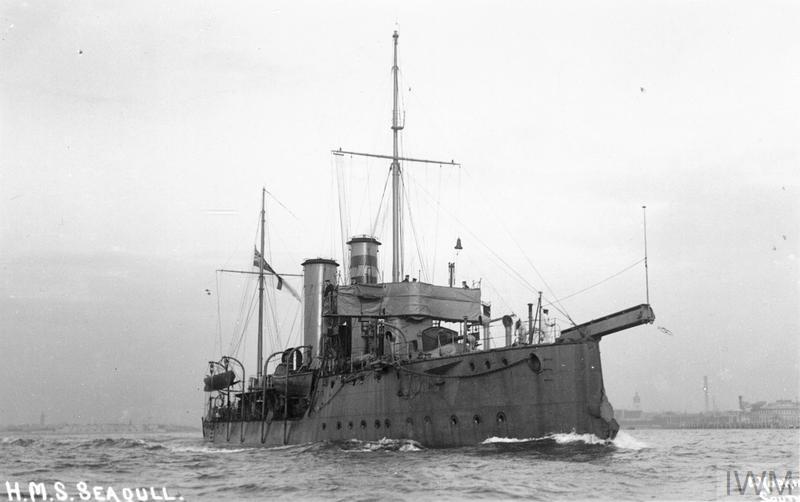
Highlights include HMS Seagull and Skelmorlie Golf Club.
Weather in Wemyss Bay
Forecast from MET Norway (CC BY 4.0). Full forecast
About Wemyss Bay
Wemyss Bay is a village on the coast of the Firth of Clyde in Inverclyde in the west central Lowlands of Scotland. It is in the traditional county of Renfrewshire. It is adjacent to Skelmorlie, North Ayrshire. The town and villages have always been in separate counties, divided by the Kelly Burn.
From the Wikipedia article Wemyss Bay (this version), under CC BY-SA 4.0.
Things to do1

Museums and landmarks3

HMS Seagull
Monument and historic site · 2.4 mi
1889 Sharpshooter-class torpedo gunboat


Parks, trails and playgrounds2


Restaurants and cafes6
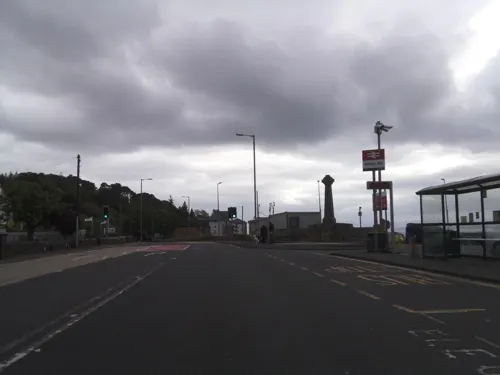
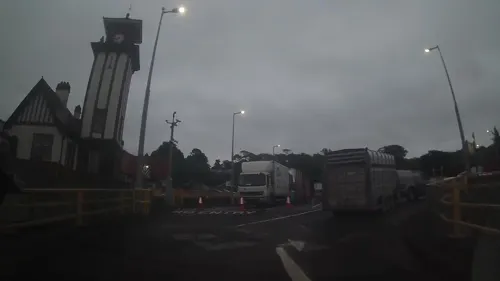
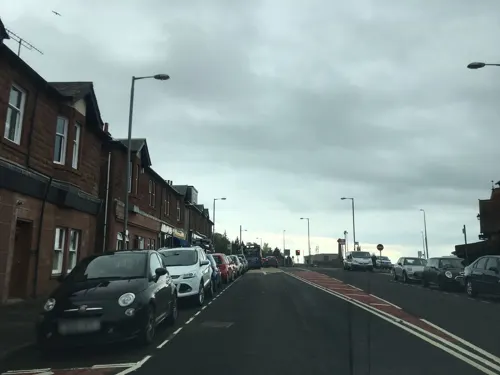
Macari's
Fast food · Fish And Chips
5C Shore Road, Wemyss Bay
Su-Th 12:00-20:00; Fr-Sa 12:00-20:30



History
The Kelly Burn flows west down the hillside in a ravine and into the bay, which at one time was called Kelly Bay or White Week. The lands of Kelly, to the north of the burn, were granted in the late 15th century by King James III of Scotland to the Bannatyne family, descendants of the Bannatynes of Kames on Bute. Their Kelly Castle stood on a cliff edge on the north side of the ravine, about 500m upstream from the sea, and was the setting for the song "The Carle of Kellyburn Braes" collected by Robert Burns. The castle burnt down in 1740, and was not rebuilt.
The land on the north side of the bay to the west of what became the turnpike road, identified as Lower Finnock, was part of the adjoining Shaw Stewart Ardgowan Estate. This densely wooded area had valuable salmon fishing rights, the only dwelling was "Wemyss Cottage" occupied by a fisherman. In the late 18th century, ihe Ardgowan Estate feued an area for houses to Mr. Orkney of Rothesay, who built four identical villas facing the bay, off an access road (Wemyss Bay Road) extending west from the main road; they are shown in John Ainslie's 1796 survey which also records the names Wemyss Bay and Wemyss Point. These villas, the only houses in the bay for many years, were let to Glasgow merchants and came to be known as New Glasgow.
Read more of the history
In 1792 the Glasgow merchant John Wallace, owner of extensive estates in Jamaica with sugar plantations and slaves, bought the Kelly Estate. In 1793 he had a red sandstone mansion called Kelly House built on the hillside up from the road, looking over the bay (this was later painted white). About this time the Wemyss Bay Hotel was built on the east side of the main road, near the junction to the road serving the villas; a building is shown there on Ainslie's map.
In 1803 his son Robert Wallace of Kelly inherited the Kelly Estate, and began major improvements, including a large picture-gallery extension to Kelly House. In 1814 he exchanged his land at North Finnock with Shaw Stewart of Ardgowan to gain the Lower Finnock area adjoining Wemyss Bay, so that his estate boundary on both sides of the road was on a line immediately north of what became Ardgowan Road. He also bought land which he exchanged with the Earl of Eglinton to extend the Kelly Estate across the Kelly Burn into Ayrshire, incorporating the Auchindarroch area of upper Skelmorlie. In 1832 Wallace became Greenock's first MP, and he played a significant part in introduction of the Uniform Penny Post. He had a row of houses built on the west side of the turnpike road between Inverkip and Wemyss Bay, and named the development Forbes Place after his wife's maiden name, Forbes, of Craigievar.
Wallace planned the expansion of Wemyss Bay into a "Marine Village" of 200 villas, with facilities including three churches, hotel, Academy, hot baths, reading room and billiards room, terraced walks featuring a fountain and grass promenade, bowling green, curling pond, and quoiting ground. His plans included a harbour and a steamboat quay. In 1846 the Jamaican estates Wallace had inherited were devalued, and he lost his wealth. He resigned as MP, and sold the Kelly Estate to an Australian merchant named James Alexander.
An 1847 guide book described how "in passing Wemyss Point, we come upon Wemyss Bay or New Glasgow, which from its sheltered situation, the number of beautiful localities admirably adapted for building sites, and which indeed we understand had been purchased of Mr. Wallace by Mr. Alexander, with the view of building villas thereon, will no doubt become an important rival to its neighbouring watering places. There is already a row of neat villas and cottages stretching from the port, and occasionally an elegant mansion. We are now within sight of Kelly House, the seat of R. Wallace, Esq., M.P.".
Whiting Bay pier was constructed to the west of the original villas. Alexander went bankrupt after only a few years, and in 1850 his creditors sold the estate in two roughly equal portions; Kelly went to James Scott of Glasgow, Wemyss Bay to Charles Wilsone Brown.
Charles Wilsone Brown did a great deal to develop the bay, selling ground for feuing. By 1855 there were 36 villas, and he got Castle Wemyss, designed by Robert William Billings, built on the hillside above Wemyss Point. In 1860 he sold his estate on to George Burns, recently retired as a partner in the Cunard Line. Burns had Wemyss House, designed by James Salmon built (near Undercliff) near the north end of the bay. His son John Burns took over Castle Wemyss and had it dramatically enlarged to a design by Billings.
In November 1862 work began on the Greenock and Wemyss Bay Railway. The original plan was for a station in the grounds of the "Clutha" villa at the start of Undercliffe Road, with a short walk along to Whiting Bay pier, but objections were raised by the Burns family. James Scott sold ground from the Kelly Estate to the railway, and the line crossed a bridge over the road to extend down the coast over a beach which Wallace's 1845 plan had identified as "Bathing Bay". The railway opened in May 1865 with its stone-built terminus station at a new pier near the Kelly Burn. The Whiting Bay pier had been repaired after damage by a hurricane in February 1856, it was finally wrecked by a storm at the end of 1865.
Further development introduced bigger, more complex, houses. Of the four original villas, two were taken down as the site for a larger house, one replaced by a villa which may have been designed by Billings and was later remodelled by John Honeyman. Only one still shows something of the original design and scale. In 1887 George Burns had the episcopal Inverclyde Church built at Undercliffe Road in memory of his wife. This church was designed by J.J. Burnet.
From the History section of Wemyss Bay on Wikipedia, under CC BY-SA 4.0.
Notable people from Wemyss Bay
- Jimmy HallidayScottish author, historian and politician
Born in Wemyss Bay, according to Wikidata (CC0). Each name links to its Wikipedia article.
Where to stay1
Churches and places of worship2
Shopping2
Gas and EV charging1
Schools, colleges and libraries2
Healthcare1
Map of Wemyss Bay
21 places. The map loads OpenStreetMap tiles when you open it.
Getting there and nearby towns
Glasgow Airport (GLA) is the nearest airport with scheduled flights listed in OpenStreetMap, 17 miles away.
- Largs 6 mi south, about 9 min by car
- Greenock 7 mi northeast, about 11 min by car
- Gourock 7 mi northeast, about 10 min by car
- Port Bannatyne 7 mi west, about 11 min by car
- Sandbank 8 mi north, about 12 min by car
- Kilcreggan 8 mi north, about 13 min by car
- Fairlie 8 mi south, about 14 min by car
- Port Glasgow 9 mi northeast, about 14 min by car
- Millport 9 mi south, about 14 min by car
- Helensburgh 11 mi northeast, about 18 min by car
Drive times are estimates from straight-line distance, not routes.
Towns near Wemyss Bay


Keep exploring
Local news
Headlines from INDB.
Reviews, tips and questions
Loading what members have shared...
Sources and licences
- GeoNames (CC BY 4.0): population, coordinates, regions and time zone
- Mapillary (see each image): photos
- OpenStreetMap contributors (ODbL 1.0): places, airports, map data
- Wikidata (CC0 1.0): elevation, founding date, time zone, website, landmarks and historic places
- Wikimedia Commons (see each image): photos
- Wikipedia (CC BY-SA 4.0): overview and history text
Photo credits
- 20140311 Wemyss Bay from Cliff Terrace Rd, dave souza, CC BY-SA 3.0
- Wemyss Bay station (35895368441), Alex Liivet from Chester, United Kingdom, CC0
- Wemyss Bay station (36029296995), Alex Liivet from Chester, United Kingdom, CC0
- Wemyss Bay station (36029288075), Alex Liivet from Chester, United Kingdom, CC0
- 380105 , Wemyss Bay (7753775372), Phil Sangwell from United Kingdom, CC BY 2.0
- Torpedo gunboat HMS Seagull - IWM Q 75435, Ernest Hopkins, Public domain
- Wemyss Bay War Memorial (36339259075), Reading Tom from Reading, UK, CC BY 2.0
- 01947 Skelmorlie & Wemyss Bay Parish Church, Skelmorlie 026, WeeHolly, CC BY-SA 4.0
- Street-level photo, ccbb7766, CC BY-SA 4.0
- Street-level photo, southglos, CC BY-SA 4.0
- Street-level photo, southglos, CC BY-SA 4.0
- Street-level photo, trigpoint, CC BY-SA 4.0
- Street-level photo, southglos, CC BY-SA 4.0
- Street-level photo, toho, CC BY-SA 4.0

Page built November 10, 2026. Spotted a mistake? Tell us or suggest a place.