


King's Lynn, United Kingdom
King's Lynn is a town of 46,093 people in England, United Kingdom.
Why visit King's Lynn
Townapedia lists 37 museums and landmarks, 39 parks and trails, 144 places to eat, 11 places to stay and 3 attractions in and around town.
Highlights include King's Lynn Arts Centre, Majestic Cinema, Castle Rising Castle and Middleton Mount.
Weather in King's Lynn
Forecast from MET Norway (CC BY 4.0). Full forecast
About King's Lynn
King's Lynn, known until 1537 as Bishop's Lynn and colloquially as Lynn, is a port and market town in the borough of King's Lynn and West Norfolk in the county of Norfolk, England. It is 36 miles (58 km) north-east of Peterborough, 44 miles (71 km) north-north-east of Cambridge, 44 miles (71 km) west of Norwich, and about 5 miles (8 km) inland from The Wash estuary. In 2021 it had a population of 47,610.
From the Wikipedia article King's Lynn (this version), under CC BY-SA 4.0.
Travel tips from other travellers: King's Lynn on Wikivoyage (CC BY-SA 4.0).
Photos of King's Lynn

Things to do3
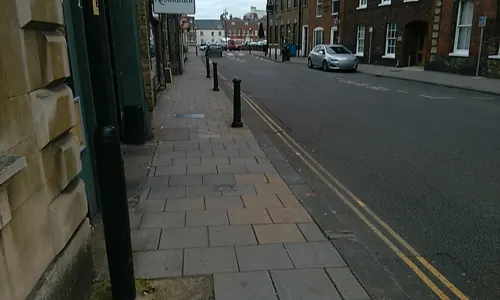
King's Lynn Arts Centre
Cinema and theater
Arts centre and theatre in King's Lynn, England, formerly St. George's Guildhall
29 King Street, King's Lynn


Museums and landmarks37

Castle Rising Castle
Monument and historic site · 4.2 mi
Castle in Castle Rising, Norfolk, England, UK

Middleton Mount
Monument and historic site · 3.4 mi
Motte-and-bailey castle in Middleton, King's Lynn and West Norfolk, England, UK

True's Yard Museum
Museum · 0.5 mi
Social history museum in King's Lynn, Norfolk



Red Mount Chapel
Monument and historic site · Catholic · 0.4 mi
2017 May 13-Sep 09 We,Sa,Su 13:00-16:00; 2017 Sep 10 10:00-16:00
The Old Blubber House
Monument and historic site · 0.4 mi
This is the site of the old Blubber House built In 1775. Horses towed the ships up the Nar to this site where the blubber house was....
25 more on the map.
Parks, trails and playgrounds39

The Walks
Park · 0.4 mi
Park in King's Lynn, Norfolk, England, United Kingdom


27 more on the map.
Restaurants and cafes144
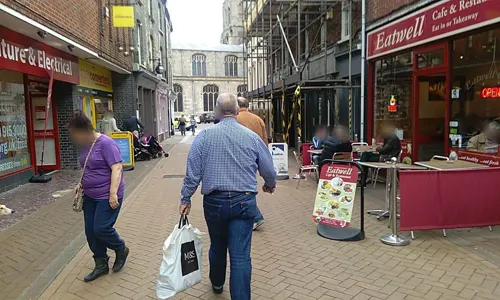
Tipsy Teapot
Restaurant · Burger, Coffee Shop, Sandwich, Chicken, American, Ice Cream
Quirky restaurant and Cocktails with upstairs party bar for dancing
9 High Street, King's Lynn
Mo-Th 12:00-23:00; Fr-Sa 12:00-24:00; Su 12:00-18:00
Pizza Hut
Restaurant · Pizza · 1.3 mi
Campbell's Meadow, King's Lynn
Su-Th 11:00-22:00; Fr-Sa 11:00-23:00

Pearl River
Restaurant · Chinese · 0.4 mi
John Kennedy Road, King's Lynn
Su-Th 12:00-14:00,17:30-23:00; Fr-Sa 12:00-14:00,17:30-23:30


Encore
Bar and pub
105 Norfolk Street, King's Lynn
We-Th 17:00-23:00, Fr-Sa 12:00-01:00, Su 12:00-20:00
Ferry Lane Social Club
Bar and pub
Ferry Lane, King's Lynn
Th-Sa 12:00-23:00; We 16:00-20:00; Su 12:00-20:00
Nip and Growler Ale House
Bar and pub
68 High Street, King's Lynn
Mo-Th 16:00-22:00; Fr,Sa 12:00-23:00; Su 12:00-19:00
132 more on the map.
History
The etymology of King's Lynn is uncertain. The name Lynn may signify a body of water near the town – the Welsh word llyn means a lake; but the name is plausibly of Anglo-Saxon origin, from lean meaning a tenure in fee or farm. The 1086 Domesday Book records it as Lun and Lenn, and ascribes it to the Bishop of Elmham and the Archbishop of Canterbury. The Domesday Book also mentions saltings at Lena (Lynn); an area of partitioned pools may have existed there at the time. The presence of salt, which was relatively rare and expensive in the early medieval period, may have added to the interest of Herbert de Losinga and other prominent Normans in the modest parish.
The town was named Len Episcopi (Bishop's Lynn) while under the temporal and spiritual jurisdiction of the Bishop of Norwich, but in the reign of Henry VIII it was surrendered to the crown and took the name Lenne Regis or King's Lynn. However, the town is generally known locally as Lynn.
Other places with Lynn in the name include Dublin, Ireland, with An Dubh Linn meaning "the Black Pool." The city of Lynn, Massachusetts, north of Boston, was named in 1637 in honour of its first official minister of religion, Reverend Samuel Whiting Sr, who arrived there from Lynn, Norfolk. Lynnhaven, Virginia is also named after King's Lynn having been named by Captain Adam Thoroughgood who hailed from King's Lynn.
Read more of the history
Lynn originated on a constricted site south of where the River Great Ouse now discharges into the Wash. Development began in the early 10th century, but the place was not recorded until the early 11th century. Until the early 13th century, the Great Ouse emptied via the Wellstream at Wisbech. After its redirection, Lynn and its port gained significance and prosperity.
In 1101, Bishop Herbert de Losinga of Thetford began to build the first medieval town between the rivers Purfleet to the north and Mill Fleet to the south. He commissioned St Margaret's Church and authorised a market to be held on Saturday. Trade built up along the waterways that stretched inland; the town expanded between the two rivers.
Lynn's 12th-century Jewish community was wiped out in the widespread massacres of 1189.
During the 14th century, Lynn ranked as England's most important port. It was seen to be as vital to England in the Middle Ages as Liverpool was during the Industrial Revolution. Sea trade with Europe was dominated by the Hanseatic League of ports; the transatlantic trade and the rise of England's western ports began only in the 17th century. The Trinity Guildhall was rebuilt in 1421 after a fire. Walls entered by the South Gate and East Gate were erected to protect the town. It retains two former Hanseatic League warehouses: Hanse House of 1475 and Marriott's Warehouse, in use between the 15th and 17th centuries. These are the only remaining buildings of the Hanseatic League in England. The town was designated a Royal Port by King John.
In the first decade of the 16th century, Thoresby College was built in Lynn by Thomas Thoresby to house priests of the Guild of the Holy Trinity. It had been incorporated in 1453 under a petition of its alderman, chaplain, four brethren and four sisters, who were licensed to found a chantry of chaplains for the altar of Holy Trinity in Wisbech. Lands were granted in mortmain. Lynn was granted a mayor and corporate status in 1524, formalising its municipal governance. In 1537, the town passed from episcopal control to the Crown, becoming known as King's Lynn. In the same century, the town's two annual fairs were reduced to one. In 1534, a grammar school was founded; four years later Henry VIII closed the Benedictine priory and the three friaries.
A piped water supply was created in the 16th century, although many could not afford to connect to the elm pipes carrying water under the streets. Lynn suffered from outbreaks of plague, notably in 1516, 1587, 1597, 1636 and finally in 1665. Fire was another hazard – in 1572, thatched roofs were banned to reduce the risk. In the English Civil War, King's Lynn supported Roundheads (Parliament), but in August 1643 it was in Cavalier (Royalist) hands. It changed sides again after Parliament sent an army, and the town was besieged for three weeks. Valentine Walton, brother-in-law of Oliver Cromwell, was appointed governor.
A carved heart on a wall in Tuesday Market Place is traditionally associated with the execution of an alleged witch in the late 16th or early 17th century. One version of the legend names Margaret Read, who was reportedly burned at the stake in 1590, during which her heart is said to have burst from her chest and struck the wall. Other accounts attribute the tale to Mary Smith, who was hanged for witchcraft in 1616.
The Tuesday Market Place had a long-standing role as a site of public executions, including both hangings and burnings, during the early modern period. Burning at the stake was particularly associated with women convicted of witchcraft, reflecting broader judicial practices in England at the time.
In 1683, the architect Henry Bell, once the town's mayor, designed the Custom House. He also designed the Duke's Head Inn, North Runcton Church and Stanhoe Hall, having gained ideas while on travel in Europe as a young man.
During the 16th and 17th centuries, the town's principal export was grain. While no longer a major international port, King's Lynn continued to import goods such as iron and timber. The discovery of the Americas shifted trade patterns in favour of ports on England's west coast, to Lynn's detriment. The town was further eclipsed by the rapid growth of London.
In the late 17th century, imports of wine from Spain, Portugal, and France flourished, and coastal trade remained active. At the time, water transport was significantly cheaper than moving goods by road. Large shipments of coal arrived from the north-east of England.
From the History section of King's Lynn on Wikipedia, under CC BY-SA 4.0.
More about King's Lynn
Geography
King's Lynn is the northernmost settlement on the River Great Ouse, lying 97 miles (156 km) north of London and 44 miles (71 km) west of Norwich. The town lies about 5 miles (8 km) south of the Wash, a fourfold estuary subject to dangerous tides and shifting sandbanks, on the north-west margin of East Anglia. King's Lynn has an area of 11 square miles (28 km2).
The Great Ouse at Lynn is about 200 metres (660 ft) wide and the outfall for much of the Fens' drainage system. The much smaller Gaywood River also flows through the town, joining the Great Ouse at the southern end of South Quay, close to the town centre. A small section known as West Lynn lies on the west bank, linked to the town centre by one of the oldest ferries in the country. Other districts of King's Lynn include the town centre, North Lynn, South Lynn, and Gaywood.
King's Lynn has a temperate oceanic climate (Köppen: Cfb). The annual mean daytime temperature is around 14 °C (57 °F). January is the coldest month with mean minimum temperatures between 0 to 1 °C (32.0 to 33.8 °F). July and August are the warmest, with mean daily maximum temperatures of some 21 °C (70 °F).
There are two Met Office weather stations close to King's Lynn: Terrington St Clement, about 4 miles (6 km) to the west and RAF Marham, about 10 miles (16 km) to the south-east.
Economy
King's Lynn has always been a centre for fishing and seafood (especially inshore prawns, shrimps and cockles). There have also been glass-making and small-scale engineering works – many fairground and steam engines were built here. It still contains much farm-related industry, including food processing. There are several chemical factories and the town retains a role as an import centre. In general, it is a regional centre for a still sparsely populated part of England.
King's Lynn was the fastest growing port in Great Britain in 2008. Department for Transport figures show that through-put increased by 33 per cent.
In 2008, the German Palm Group began to erect one of the world's largest paper machines, constructed by Voith Paper. With a web speed of up to 2000 metres a minute and a web width of 10.63 metres, it can produce 400,000 tons a year of newsprint paper, based on 100-per-cent recycled paper. The start-up was on 21 August 2009.
The Port of King's Lynn has facilities for dry bulk cargo such as cereals and liquid bulk products such as petroleum products for Pace Petroleum. It also handles timber imported from Scandinavia and the Baltics and has handling sheds for steel imports.
Arts and culture
The Guild of St George was founded in 1376 and acquired land for the Guildhall of St George in 1406, which was in use by 1428. It offered plays in the Guildhall, the first known being a nativity play in January 1445. This makes it the UK's oldest working theatre.
The Guildhall was used for meetings, dinners and performance until 1547, when King Edward VI dissolved the Guilds. It then became the property of Lynn Corporation and known as the Common Town Hall. Research by the University of East Anglia confirms as probable the oral history of King's Lynn that William Shakespeare performed in the Guildhall in 1593. This is the only still-working theatre in the world that can credibly claim to have hosted Shakespeare. In 1766, Guildhall shows were so popular that a new interior was built inside the present structure, probably on the earlier footprint. By 1945, the Guildhall was almost derelict and in danger of demolition. It was bought by Alexander Penrose, who gave it to the National Trust in 1951. The Pilgrim Trust, Arts Council and public subscription led to conversion into an Arts Centre. Queen Elizabeth the Queen Mother opened it in July 1951 and launched the King's Lynn Festival.
Education
Three of King's Lynn four secondary schools are located in the town: King Edward VII School, the King's Lynn Academy and Springwood High School. The fourth, St Clements High School, is in the nearby village of Terrington St Clement. The first is known for its physical education department, King's Lynn Academy for its maths and IT specialities, and Springwood for performing arts and drama. The nearest independent school is Wisbech Grammar School in Cambridgeshire.
The town's further education college, the College of West Anglia, was founded in 1894 as King's Lynn Technical School. In 1973, it was renamed Norfolk College of Arts and Technology, and, in 1998, merged with Cambridgeshire College of Agriculture and Horticulture, which added campuses in Wisbech (now closed) and Milton; it changed the name to the College of West Anglia. It retained this name in April 2006, when it merged with the Isle College in Wisbech.
From the Wikipedia article King's Lynn, under CC BY-SA 4.0.
Notable people from King's Lynn
 George VancouverEnglish naval explorer (1757–1798)Photo: anonymous, Public domain
 George RussellBritish racing driver (born 1998)Photo: Raph_PH, CC BY 2.0
 Frances BurneyEnglish satirical novelist, diarist, playwright (1752-1840)Photo: Edward Francis Burney, Public domain
 Jack HustonBritish actorPhoto: Gage Skidmore from Peoria, AZ,..., CC BY-SA 2.0
 Martin BrundleBritish racecar driverPhoto: United Autosports, CC BY-SA 2.0
 George NorthWelsh rugby union playerPhoto: Liamwarrender, CC BY-SA 3.0
 Joseph DinesEnglish footballer (1886–1918)Photo: Unknown author Unknown author, Public domain
 Alex Brundleracing driver, 2013-2015 World Endurance Championship driver, 2014 European Le Mans Series driverPhoto: United Autosports, CC BY-SA 2.0
- Margery KempeBritish Christian mystic and author
- Thomas BainesBritish expedition artist (1820-1875)
- Jane Fellowes, Baroness Felloweselder sister of Diana, Princess of Wales
- Gerry ConwayEnglish folk and rock drummer/percussionist (1947–2024)
Born in King's Lynn, according to Wikidata (CC0). Each name links to its Wikipedia article.
Where to stay11
Churches and places of worship23
Shopping40
Gas and EV charging11
Schools, colleges and libraries25
Healthcare8
Map of King's Lynn
250 places. The map loads OpenStreetMap tiles when you open it.
Getting there and nearby towns
RAF Marham (KNF) is the nearest airport with scheduled flights listed in OpenStreetMap, 10 miles away.
- Downham Market 10 mi south, about 16 min by car
- Wisbech 12 mi southwest, about 19 min by car
- March 19 mi southwest, about 30 min by car
- Spalding 23 mi west, about 37 min by car
- East Dereham 23 mi east, about 37 min by car
- Ely 25 mi south, about 40 min by car
- Chatteris 25 mi southwest, about 40 min by car
- Whittlesey 26 mi southwest, about 41 min by car
- Skegness 27 mi north, about 44 min by car
- Peterborough 30 mi southwest, about 48 min by car
Drive times are estimates from straight-line distance, not routes.
Towns near King's Lynn


Keep exploring
Local news
Headlines from INDB.
Reviews, tips and questions
Loading what members have shared...
Sources and licences
- GeoNames (CC BY 4.0): population, coordinates, regions and time zone
- Mapillary (see each image): photos
- OpenStreetMap contributors (ODbL 1.0): places, airports, map data
- Wikidata (CC0 1.0): elevation, founding date, time zone, website, landmarks and historic places
- Wikimedia Commons (see each image): photos
- Wikipedia (CC BY-SA 4.0): overview and history text
Photo credits
- Kings-lynn-customs-house, Alienturnedhuman at English Wikipedia, Public domain
- CastleRising-WyrdLight-Wiki, Antony McCallum: Who is the uploader, photographer, full copyright owner and proprietor of WyrdLight.com, CC BY-SA 4.0
- Middleton Mount, Martin Pearman, CC BY-SA 2.0
- True's Yard King's Lynn, Alienturnedhuman ( talk ), Public domain
- Kings-lynn-cinema, Alienturnedhuman at English Wikipedia, Public domain
- NorfolkArena, Dalags, CC BY-SA 3.0
- Kings-lynn-greyfriars, Original uploader was Alienturnedhuman at en.wikipedia, Public domain
- King's Lynn, St Nicholas' chapel (32523511143), Jules & Jenny from Lincoln, UK, CC BY 2.0
- King's Lynn and West Norfolk - The Church of St John the Evangelist - 20220613151604, FromMorningToMidnight, CC BY-SA 4.0
- Kings-lynn-walks-and-red-mount, Alienturnedhuman at English Wikipedia, Public domain
- St Margarets Church (3281986730), Reading Tom from Reading, UK, CC BY 2.0
- Street-level photo, sk53_quint, CC BY-SA 4.0
- Street-level photo, sk53_quint, CC BY-SA 4.0
- Street-level photo, sk53_quint, CC BY-SA 4.0
- Street-level photo, jammerland, CC BY-SA 4.0
- Street-level photo, jammerland, CC BY-SA 4.0
- Street-level photo, sk53_quint, CC BY-SA 4.0
- Street-level photo, sk53_quint, CC BY-SA 4.0
- Street-level photo, jammerland, CC BY-SA 4.0
- Street-level photo, sk53_quint, CC BY-SA 4.0


Page built November 10, 2026. Spotted a mistake? Tell us or suggest a place.