


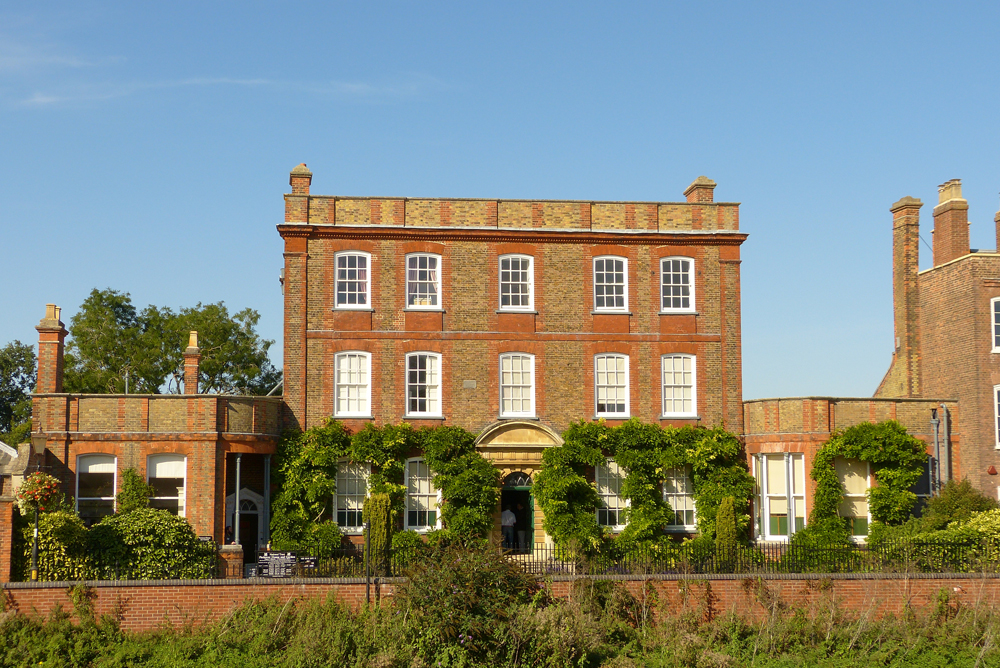


Why visit Wisbech
Townapedia lists 18 museums and landmarks, 9 parks and trails, 72 places to eat, 7 places to stay and 7 attractions in and around town.
Highlights include Angles Theatre, Light Cinema, Peckover House & Gardens and Clarkson Memorial.
Weather in Wisbech
Forecast from MET Norway (CC BY 4.0). Full forecast
About Wisbech
Wisbech is a market town, inland port and civil parish in the Fenland district in Cambridgeshire, England. In 2011 it had a population of 31,573. The town lies in the far north-east of Cambridgeshire, bordering Norfolk and only 5 miles (8 km) south of Lincolnshire. The tidal River Nene running through the town is spanned by two road bridges.
From the Wikipedia article Wisbech (this version), under CC BY-SA 4.0.
Travel tips from other travellers: Wisbech on Wikivoyage (CC BY-SA 4.0).
Things to do7

Angles Theatre
Cinema and theater
Theatre in Wisbech, Cambridgeshire, England, UK



Museums and landmarks18


Clarkson Memorial
Monument and historic site
Monument in Wisbech, United Kingdom
Peckover House and Garden
Museum
Historic house museum in Wisbech, Cambridgeshire, England, UK

Wisbech and Fenland Museum
Museum
Museum in Cambridgeshire, England, United Kingdom

6 more on the map.
Parks, trails and playgrounds9



Restaurants and cafes72
China Rose
Restaurant · 1.6 mi
106 Elm High Road, Wisbech
Tu-Su 16:30-22:00




60 more on the map.
History
The place name "Wisbech" is first attested in the Anglo-Saxon Chronicle (post-Conquest Peterborough insertion to manuscript E) for the year 656, where it appears as Wisbeach. It is recorded in the 1086 Domesday Book as Wisbeach. The name Wisbech is popularly believed to mean "on the back of the (River) Ouse", Ouse being a common Celtic word relating to water and the name of a river that once flowed through the town. A more scholarly opinion is that the first element derives from the River Wissey, which used to run to Wisbech, and that the name means 'the valley of the river Wissey'.
A wide range of spellings is found on trade tokens in the Wisbech & Fenland Museum and in newspapers, books, maps and other documents, e.g. Wisbece, Wisebece, Wisbbece, Wysbeche, Wisbeche, Wissebeche, Wysebeche, Wysbech, Wyxbech, Wyssebeche, Wisbidge, Wisbich and Wisbitch,
until the spelling of the name of the town was fixed by the local council in the 19th century.
During the Iron Age, the area where Wisbech would develop lay in the west of the Brythonic Iceni tribe's territory. Icenian coins have been found in both March and Wisbech. A reference, in the Red Book of Thorney, to "a settlement in the middle of a vast wood," may have been Wisbech's earliest incarnation.
Like the rest of Cambridgeshire, Wisbech was part of the Anglo-Saxon Kingdom of East Anglia. It served as a port on The Wash.
Read more of the history
The earliest authentic references to Wisbech occur in charters. in 657 it appeared in a charter of the Mercian King Wulfere, and in another dated 664 granting the Abbey at Medeshamstede (now Peterborough) land in Wisbech and in 1000, when Oswy and Leoflede, on the admission of their son Aelfwin as a monk, gave the vill to the monastery of Ely.
The folktale of Tom Hickathrift or Wisbech Giant is sometimes set about the time of the Norman Invasion.
In 1086, when Wisbech was held by the abbot, there may have been some 65 to 70 families, or about 300 to 350 persons, in Wisbech manor. However, Wisbech (which is the only one of the Marshland vills of the Isle to be mentioned in the Domesday Book) probably comprised the whole area from Tydd Gote down to the far end of Upwell at Welney.
A castle was built by William I to fortify the site. At the time of Domesday (1086) the population was that of a large village. Some were farmers and others were fishermen.
Richard I gave Wisbech a charter exempting the residents from paying tolls at markets across England. King John of England visited the castle on 12 October 1216 as he came from Bishop's Lynn. Tradition has it that his baggage train was lost to the incoming tide of The Wash. Treasure hunters still seek the lost royal treasure.
On 12 November 1236 the village of Wisbech was inundated by the sea. Hundreds were drowned, entire flocks of sheep and herds of cattle were destroyed, trees felled and ships lost. The castle was "utterly destroyed" but was rebuilt by 1246 when the constable or keeper was William Justice.
In 1333–4 the kiln in the town was producing 120,000 bricks. There were several fisheries belonging to the manor of Wisbech and in the 1350s the reeves of Walton and Leverington each sent a porpoise to Wisbech Castle, and the reeve of Terrington a swordfish.
Wisbech Grammar School dates back to 1379 or earlier. The register of Bishop John Fordham of Ely records the appointment of a Master of the Grammar Scholars in 1407.
In 1549, after the important Holy Trinity Guild was dissolved with other religious guilds, Wisbech was incorporated as a borough under a charter from Edward VI. In the same year, William Bellman gave a plot of land for the Wisbech Grammar School schoolhouse.
During the reigns of Elizabeth I, James I, and Charles I, there was a state ecclesiastical prison in Wisbech for Catholics, many of whom died there owing to the insanitary conditions.
A dispute arising amongst the Catholic prisoners was widely known as the Wisbech Stirs. In 1588 it is claimed that Robert Catesby and Francis Tresham were committed to Wisbech Castle on the approach of the Spanish Armada. Among those held there was John Feckenham, the last Abbot of Westminster.
The palace was demolished and replaced with John Thurloe's mansion in the mid-17th century, and Thurloe's mansion demolished in 1816 by Joseph Medworth, who also developed The Circus comprising The Crescent, Union Place and Ely Place with Museum Square and Castle Square familiar as the settings in numerous costume dramas.
In 1620 former Wisbech residents William White and Dorothea Bradford (née May) sailed on the Mayflower to the New World with her husband William Bradford, later to be Governor Bradford.
Across the Eastern Counties, Oliver Cromwell's powerful Eastern Association was eventually dominant. However, to begin with, there had been an element of Royalist sympathy within Wisbech. Bishop Matthew Wren was a staunch supporter of Charles I but even in 1640 was unpopular in Wisbech, after discovering his absence from a 'Commission of Sewers' meeting at the Castle, a crowd of soldiers plundered shops of some of his supporters. The town was near the frontier of the Parliamentary and Royalist forces in 1643. The Castle and town were put into a state of readiness and reinforced. A troop of horse was raised. Locally based troops took part in the Siege of Crowland in 1642. The town controlled the route from Lincolnshire to Norfolk particularly during the Siege of King's Lynn in 1643 as it prevented reinforcements by land of the Royalists holding the Norfolk port.
In 1656 the bishop's palace was replaced by Thurloe's mansion however after the Restoration the property reverted to the Bishops of Ely.
Soap was taxed and manufacturers such as the Wisbech Soap Company required a licence. Based in an Old Market property facing the river, they were able to receive oil from the blubber yards of King's Lynn as well as coal, wood for casks and olive oil used in making the coarse, sweet and grey (speckled) soaps they produced from 1716 to about 1770.
From the History section of Wisbech on Wikipedia, under CC BY-SA 4.0.
More about Wisbech
Economy
Before the draining of the Fens was completed, livestock was grazed on the common land and were marked to identify their owners; this was also the case with swans, which were usually marked on their bills. The riverside location and fertile soils surrounding Wisbech allowed the town to flourish.
A thriving pipe-making business was being carried out in the town by Amy White in the 1740s. Soap-making was also taking place in the 1740s.
A number of breweries existed in the town; the last one remaining is Elgood's on the North Brink. Established in 1795 and remaining a family-owned business, the brewery and gardens are a popular location for tourists to visit.
Arts and culture
The Georgian theatre, Deadman's Lane (now the Angles Theatre on Alexandra Rd) was built c1790 as part of the Lincoln circuit. This is now used by community theatre groups and touring companies. The theatre is run by the Wisbech Angles Theatre Council, a registered charity. The Wisbech Players (now The Wisbech Theatre Players) formed in 1953, are now an integral part of the theatre.
Wisbech & Fenland Museum, Museum Square opened on its current site in 1847. The Friends of Wisbech and Fenland Museum supports the museum with Grants for acquisitions, and assists with research programmes, conservation, publishing and new technologies throughout the Museum. The Castle was donated to the Isle of Ely County Council by the family of the former education director and is now run by the town council. It is used as a community asset and hosts educational and other activities. The contents include furnishings, books and other items of interest. Octavia Hill Birthplace House opened with the purpose of housing items linked to the various philanthropic activities of Octavia Hill and her family. The Wisbech Working Men's Institute and Social club's origins date to 1864.
Education
An infant school for two to six-year olds was established in the great hall of the workhouse in 1839. Primary schools in Wisbech include: Clarkson Infant and Nursery School, St Peters Church of England Junior School, Orchards Church of England Academy, Peckover Primary School, The Nene Infant School, Ramnoth Junior School and Elm Road Primary School. There are also specialist schools, Meadowgate Academy, Cambian Wisbech School, The County School & Trinity School.
Wisbech has two secondary schools: the private Wisbech Grammar School, which was founded in 1379, making it one of the oldest schools in the United Kingdom, and the state-funded Thomas Clarkson Academy. There is also a further education centre: the College of West Anglia, formerly the Isle College.
From the Wikipedia article Wisbech, under CC BY-SA 4.0.
Notable people from Wisbech
 William GodwinEnglish journalist, political philosopher and novelist (1756–1836)Photo: Henry William Pickersgill, Public domain
 Harry KrotoBritish chemist (1939-2016)Photo: Janwikifoto, CC BY-SA 3.0
 Joe PerryEnglish snooker playerPhoto: Benutzer:Bill da Flute, CC BY-SA 3.0
 Thomas ClarksonEnglish abolitionist (1760-1846)Photo: Carl Frederik von Breda, Public domain
 Anton RodgersBritish actor (1933-2007)Photo: episode screenshot (ABC), Public domain
 Jody CundyEnglish racing cyclistPhoto: Jim Thurston from London, UK, CC BY-SA 2.0
- Octavia HillEnglish social reformer (1838-1912)
- Mike BaileyEnglish footballer and manager (1942–2026)
- Priscilla Hannah PeckoverEnglish pacifist
- Cyril HornBritish speed skater
- Maurice Crouchcricketer (1917-2001)
- Mike StevensBritish musician
Born in Wisbech, according to Wikidata (CC0). Each name links to its Wikipedia article.
Where to stay7
Churches and places of worship17
Shopping24
Gas and EV charging4
Schools, colleges and libraries23
Healthcare6
Map of Wisbech
187 places. The map loads OpenStreetMap tiles when you open it.
Getting there and nearby towns
RAF Marham (KNF) is the nearest airport with scheduled flights listed in OpenStreetMap, 17 miles away.
- West Walton 2 mi north, about 4 min by car
- Emneth 3 mi southeast, about 4 min by car
- Outwell 5 mi southeast, about 8 min by car
- Upwell 5 mi southeast, about 8 min by car
- Peterborough 18 mi west, about 29 min by car
- Cambridge 32 mi south, about 52 min by car
- Bedford 45 mi southwest, about 1 h 15 min by car
- Norwich 48 mi east, about 1 h 15 min by car
- Lincoln 48 mi northwest, about 1 h 15 min by car
- Northampton 52 mi southwest, about 1 h 30 min by car
Drive times are estimates from straight-line distance, not routes.
Towns near Wisbech


Keep exploring
Local news
Headlines from INDB.
Reviews, tips and questions
Loading what members have shared...
Sources and licences
- GeoNames (CC BY 4.0): population, coordinates, regions and time zone
- Mapillary (see each image): photos
- OpenStreetMap contributors (ODbL 1.0): places, airports, map data
- Wikidata (CC0 1.0): elevation, founding date, time zone, website, landmarks and historic places
- Wikimedia Commons (see each image): photos
- Wikipedia (CC BY-SA 4.0): overview and history text
Photo credits
- North brink wisbech, Jim Linwood, CC BY 2.0
- Angles Theatre, Wisbech, Bearas, CC BY-SA 4.0
- Peckover-house-wisbech, Theyellowtulip, CC BY-SA 3.0
- Šv. Petro bažnyčia Visbičas (Wisbech), Bearas, CC BY-SA 4.0
- Wisbech Grammar School North Brink, Rob enwiki, CC BY-SA 3.0
- St Mary's church West Walton, Chris Stafford, CC BY-SA 2.0
- St Edmund, Emneth, Norfolk, John Salmon, CC BY-SA 2.0
- Visbičo Mergelės ir Šv. Čiarlzo Boromeo bažnyčia, Bearas, CC BY-SA 4.0
- Tesco Extra and The Light, Visbičas, Bearas, CC BY-SA 4.0
- Wisbech-clarkson-memorial--, Theyellowtulip, CC BY-SA 3.0
- Street-level photo, adam2, CC BY-SA 4.0


Page built November 10, 2026. Spotted a mistake? Tell us or suggest a place.