


Washington, United Kingdom
Washington is a town of 67,085 people in England, United Kingdom.
Why visit Washington
Townapedia lists 8 museums and landmarks, 15 parks and trails, 96 places to eat and 10 attractions in and around town.
Highlights include Chartershaugh Bridge, Chester New Bridge, Washington Old Hall and Penshaw Monument.
Weather in Washington
Forecast from MET Norway (CC BY 4.0). Full forecast
About Washington
Washington is a town in the Sunderland district, in Tyne and Wear, England. Historically part of County Durham, it is the ancestral settlement of the local Washington family, from which the first president of the United States, George Washington, descended. It has a population of 67,085.
From the Wikipedia article Washington, Tyne and Wear (this version), under CC BY-SA 4.0.
Travel tips from other travellers: Washington on Wikivoyage (CC BY-SA 4.0).
Photos of Washington

Things to do10
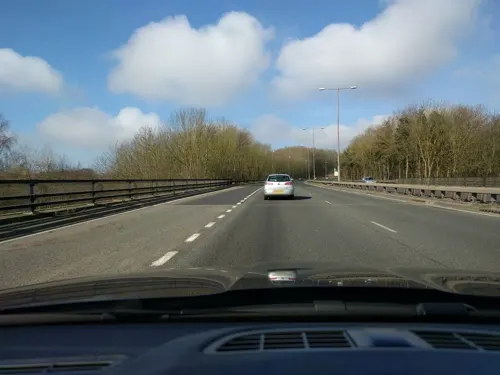
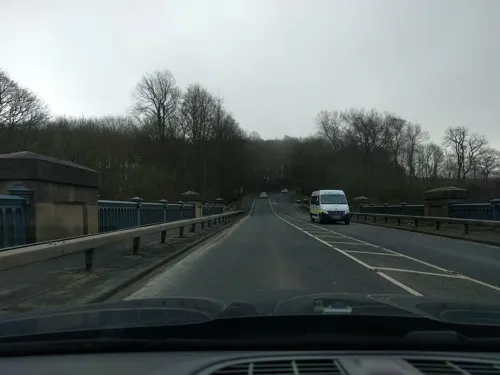
Chester New Bridge
Bridge · 3.0 mi
Bridge in Bournmoor, County Durham, England, UK


Victoria Viaduct
Bridge · 1.2 mi
Rail viaduct spanning the River Wear in North East England

Museums and landmarks8

Washington Old Hall
Museum
Manor house associated with the family of George Washington
The Avenue, Washington

Penshaw Monument
Monument and historic site · 1.8 mi
Monument in Sunderland, England

Bowes Railway
Museum · 2.3 mi
British preserved standard gauge cable railway system (built 1826)
North East Land, Sea and Air Museums
Museum · 2.5 mi
Aviation museum in Tyne and Wear, United Kingdom

Parks, trails and playgrounds15

Herrington Country Park
Park · 2.4 mi
Country park in Sunderland, England




3 more on the map.
Restaurants and cafes96
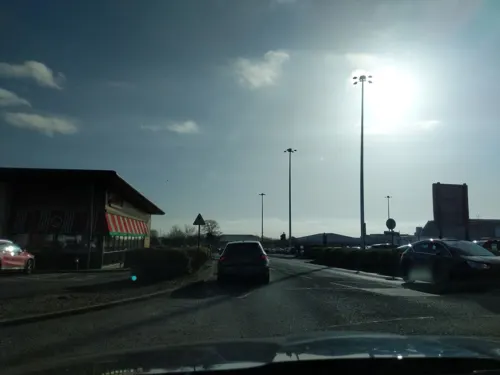
Tim Hortons
Cafe · Coffee Shop · 0.5 mi
The Galleries Retail Park, Washington
Mo-Su 06:00-00:00

Cafe K9
Cafe · Coffee Shop · 0.8 mi
Spout Lane, Washington
Mo-Fr 09:00-15:00, Sa-Su 09:00-16:00


Ristorante Fiume And River Bar
Restaurant · 1.4 mi
16 Bonemill Lane, Washington
11:00 - 00:00
The Forge
Restaurant · International
Glebe Crescent, Washington
84 more on the map.
History
Early references appear around 1096 in Old English as Wasindone. The etymological origin is disputed and there are several proposed theories for how the name Washington came about. Early interpretations included Wasindone ("people of the hill by the stream", 1096), or Wassyngtona ("settlement of Wassa's people", 1183).
The origins of the name Washington are not fully known. The most supported theory (especially amongst local historians) is that Washington is derived from Anglo-Saxon Hwæsingatūn, which roughly means "estate of the descendants (family) of Hwæsa". Hwæsa (usually rendered Wassa or Wossa in modern English) is an Old English name meaning "wheat sheaf".
Due to the evolution of English grammar, modern English lacks the Germanic grammatical features that permeated Anglo-Saxon English. This causes confusion for many in regard to the name Hwæsingatūn. It is essentially composed of three main (albeit grammatically altered) elements:
"Hwæsa" – most likely the name of a local Anglo-Saxon chieftain or farmer.
"ing" – a Germanic component that has lost its original context in English: ing means roughly "[derived] of/from". In the name Hwæsingatūn, "ing" is conjugated to "inga" in accordance with the genitive plural declension of OE.
Read more of the history
"tūn" – root of the modern English "town", and is a cognate of German Zaun (fence), Dutch tuin (garden) and Icelandic tún (paddock). The word means "fenced off estate" or more accurately "estate with defined boundaries".
The combined elements (with all correct conjugations in place) therefore create the name Hwæsingatūn with a full and technical meaning of "the estate of the descendants of Hwæsa".
However, there has been no evidence found of any chieftain/land owner/farmer in the area by the name of Hwæsa, although any such records from the time would likely have been long lost by now.
Another popular origin theory is that Washington is derived from the Old English verb wascan and the noun dūn meaning "hill"; thus making the name Wascandūn, meaning "washing hill". This theory likely originates from the proximity of the river Wear to the actual Anglo-Saxon hall at the time (most likely where Washington Old Hall stands today).
This idea is not backed by linguistic evidence. Combining the two Old English words "wascan" and "dūn" would actually have meant "washed hill" and not "washing hill". Also, the Old English "dūn" meant a range of gently rolling hills, as evidenced by the naming of the North and South Downs in southern England.
The Old Hall may have been built by William de Hertburn, who moved to the area in 1183. As was the custom, he took the name of his new estates (Wessyngtonlands), and became William de Wessyngton. By 1539, when the family moved to Sulgrave Manor in Northamptonshire, the spelling "Washington" had been adopted.
The present Hall is an early 17th-century small English manor house of sandstone. Only the foundations and the arches between the Kitchen and the Great Hall remain of the original house.
William de Wessyngton (originally William Bayard, later de Hertburne) was a forebear of George Washington, the first president of the United States, after whom the US capital, a state and many other places in the United States are named. Though George Washington's great-grandfather John Washington left for Virginia from Northamptonshire, Washington Old Hall was the family home of George Washington's ancestors. The present structure incorporates small parts of the medieval home in which they lived. American Independence Day is marked each year by a ceremony at Washington Old Hall.
Sir Isaac Lowthian Bell and his wife Margaret, grandparents of Gertrude Bell, lived in Washington New Hall on The Avenue. After Margaret's death in 1871, Sir Isaac set up an orphanage in the house, named Dame Margaret Home in his late wife's honour. It later became a Dr Barnardo's home until World War II. After the war, it was taken over by the National Coal Board as a training centre, and then a children's home again. It is now a number of private apartments.
Washington's design was developed through the New Towns concept aiming to achieve sustainable socio-economic growth. The new town is divided into 18 residential "villages". It was originally also divided into the 15 numbered districts, which confused many visitors to the area. The numbered districts were abolished in 1983 though survived for a while on road signs and in postal addresses.
Land in the south west of the area designated for the town was purchased from the Lambton family, the Earls of Durham. Their estate of the same name includes their ancestral home, Lambton Castle.
In 1970, Washington hosted the English Schools Athletic Association (ESAA) annual National Championships, attended by the then Lord Lieutenant of County Durham. On 15 November 1977, the very first SavaCentre hypermarket (a Sainsbury's and British Home Stores joint venture) opened at The Galleries. By 2005, however, it had been rebranded as a traditional Sainsbury's as the SavaCentre brand was phased out.
From the History section of Washington, Tyne and Wear on Wikipedia, under CC BY-SA 4.0.
More about Washington
Geography
The town is made up of villages and includes the five ancient townships of Washington. Its villages are:
Mount Pleasant (which is south of the River Wear and shares the DH4 Postcode with Houghton le Spring)
Usworth (previously Great or High Usworth, an ancient township)
Washington Village (the original township and location of the Old Hall).
The town also has ten industrial estates, some of which are named after famous northern engineers, such as Parsons, Armstrong, Stephenson, Phineas Crowther, Pattinson, Swan and Emerson.
Education
There are several primary, secondary schools and colleges in the villages of Washington.
The North East of England Japanese Saturday School (北東イングランド補習授業校 Hokutō Ingurando Hoshū Jugyō Kō), a Japanese weekend supplementary school, held its classes in the Oxclose Community School in Oxclose.
From the Wikipedia article Washington, Tyne and Wear, under CC BY-SA 4.0.
Notable people from Washington
 Jordan PickfordEnglish footballer (born 1994)Photo: Bryan Berlin, CC BY-SA 4.0
 Gertrude BellBritish traveller, writer, mountaineer, politician, archaeologist and spy (1868–1926)Photo: Unknown author Unknown author, Public domain
 Bryan FerryBritish singer (born 1945)Photo: Raph_PH, CC BY 2.0
 Bob GlendenningEnglish footballer and manager (1888-1940)Photo: Unknown author Unknown author, Public domain
 Jimmy HaganFootballer; Football manager (1918-1998)Photo: Hans Peters for Anefo, CC BY-SA 3.0 nl
 Mark Prudhoeprofessional footballer (born 1963)Photo: Mattythewhite, CC BY-SA 4.0
 Paul ThirlwellEnglish footballer (born 1979)Photo: en:user:TuborgLight, CC BY-SA 3.0
 John BrandEnglish clergyman, antiquarian, and club secretary (1744–1806)Photo: no image credit, Public domain
- Rebecca WelchEnglish football referee
- David LilleyEnglish snooker player
- Charlie SpencerEnglish footballer (1899–1953)
- Jack AtkinsonEnglish footballer and manager (1913-1977)
Born in Washington, according to Wikidata (CC0). Each name links to its Wikipedia article.
Churches and places of worship11
St Michael's and All Angels Church
Church · Anglican · 1.1 mi
Manor Road, Washington
Shopping23
Gas and EV charging2
Schools, colleges and libraries23
St Robert of Newminster Catholic School and Sixth Form College
School · Roman Catholic · 0.9 mi
Biddick Lane, Washington
Healthcare6
Map of Washington
194 places. The map loads OpenStreetMap tiles when you open it.
Getting there and nearby towns
Newcastle International Airport (NCL) is the nearest airport with scheduled flights listed in OpenStreetMap, 12 miles away.
- The Boldons 4 mi northeast, about 6 min by car
- Sunderland 5 mi east, about 9 min by car
- Hebburn 5 mi north, about 8 min by car
- Newcastle upon Tyne 6 mi northwest, about 10 min by car
- Jarrow 6 mi north, about 9 min by car
- Ryhope 6 mi east, about 10 min by car
- Hetton-Le-Hole 6 mi southeast, about 10 min by car
- Whickham 7 mi northwest, about 11 min by car
- Stanley 8 mi west, about 12 min by car
- Gosforth 8 mi northwest, about 13 min by car
Drive times are estimates from straight-line distance, not routes.
Towns near Washington


Keep exploring
Local news
Headlines from INDB.
Reviews, tips and questions
Loading what members have shared...
Sources and licences
- GeoNames (CC BY 4.0): population, coordinates, regions and time zone
- Mapillary (see each image): photos
- OpenStreetMap contributors (ODbL 1.0): places, airports, map data
- Wikidata (CC0 1.0): elevation, founding date, time zone, website, landmarks and historic places
- Wikimedia Commons (see each image): photos
- Wikipedia (CC BY-SA 4.0): overview and history text
Photo credits
- Washington, John Ferguson ( John_the_mackem ), CC BY-SA 2.5
- Washington Hall - panoramio (3), PJMarriott, CC BY 3.0
- Washington Hall - panoramio, PJMarriott, CC BY 3.0
- Washington Old Hall, Chris McLean, CC BY-SA 2.0
- Washington Hall - panoramio (1), PJMarriott, CC BY 3.0
- Washington Hall - panoramio (2), PJMarriott, CC BY 3.0
- Coxgreen Footbridge, Craigy ( talk ), CC BY-SA 3.0
- River Wear 20070702 Hylton Viaduct 01, PeterGHughes, CC BY 2.5
- Penshaw Bridge, Martin Le Roy, CC BY-SA 4.0
- Penshaw from Herrington Park, Ajguy94, CC BY-SA 4.0
- Washington Wildfowl Centre, Washington, Tyne and Wear, Stanley Howe, CC BY-SA 2.0
- The Galleries shopping centre, Washington, Tyne and Wear, Brian Abbott, CC BY-SA 2.0
- The Pantaloons Treasure Island, Chrisblobguitar, CC BY-SA 4.0
- Penshaw Monument In The Summer, Cwhitehouse, CC BY-SA 4.0
- Street-level photo, floatingboater, CC BY-SA 4.0
- Street-level photo, floatingboater, CC BY-SA 4.0
- Street-level photo, floatingboater, CC BY-SA 4.0
- Street-level photo, hristoamazon, CC BY-SA 4.0
- Street-level photo, floatingboater, CC BY-SA 4.0

Page built November 10, 2026. Spotted a mistake? Tell us or suggest a place.