
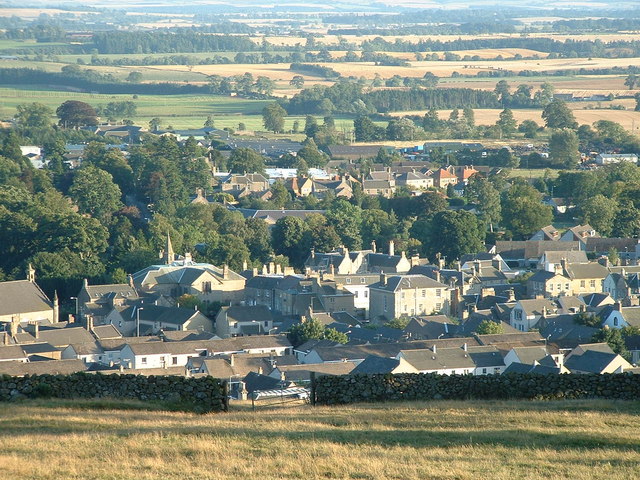


Why visit Duns
Townapedia lists 8 museums and landmarks, 3 parks and trails, 10 places to eat, 1 place to stay and 1 attraction in and around town.
Highlights include Jim Clark Motorsport Museum, Duns Castle and Duns Castle nature reserve.
Weather in Duns
Forecast from MET Norway (CC BY 4.0). Full forecast
About Duns
Duns is a historic market town in the Scottish Borders, Scotland. Historically the county town of the historic county of Berwickshire, it acts as a local commercial and service centre for the surrounding rural and agricultural area. It had a population of 3,127 in 2022.
From the Wikipedia article Duns, Scottish Borders (this version), under CC BY-SA 4.0.
Things to do1

Museums and landmarks8

Jim Clark Motorsport Museum
Museum
44 Newtown Street, Duns
Mar,Nov Th-Tu 11:00-15:00; Apr-Oct Th-Tu 10:00-16:30; Dec-Feb closed


Parks, trails and playgrounds3


Restaurants and cafes10



History
Duns Law, the original site of the town of Duns, has the remains of an Iron Age hillfort at its summit. Similar structures nearby, such as the structure at Edin's Hall Broch, suggest the area's domestic and defensive use at a very early stage.
Despite the town most likely dating its origins back to the 1000s, the first written mention of Duns is prior to 1179, when a 'Hugo de Duns' witnessed a charter of Roger d'Eu, of a grant of the benefice of the church of Langton to Kelso Abbey. The town is further mentioned when a "Robert of Douns" signed the Ragman Roll in 1296. The early settlement was sited on the slopes of Duns Law, close to the original Duns Castle built in 1320 by the Earl of Moray, nephew of Robert the Bruce. The town was frequently attacked by the English in border raids and as they headed north to the Lothians. In 1318 at Duns Park, the Earl of Dunbar, Sir James Douglas, and Sir Thomas Randolph met with their respective forces, prior to the retaking of Berwick by the Scots. In 1333 the Guardian of Scotland, Sir Archibald Douglas, mustered an army in Duns to march on Berwick, which at that time was under siege by the English. The Scots troops were heavily defeated at the Battle of Halidon Hill.
Read more of the history
1377 saw the Earl of Northumberland invade Scotland. Camped at Duns, his army's horses were alarmed at night by the rattles used by the inhabitants to scare birds from their crops. The disarrayed English force was routed by the townsmen. The event is known as the Battle of Duns, and is the source of the town's motto, "Duns Dings A!"
In 1513, some 6 miles (10 km) to the north of the town at Ellemford, James IV of Scotland mustered his army, prior to his campaign that would lead to the disastrous Battle of Flodden.
The town was created a Burgh of Barony in 1490 by James IV heritably for John and George Hume of Ayton, and the townsfolk were given the right to hold a market every Wednesday, and to hold a week-long annual fair between Pentecost and Trinity Sunday. Duns suffered badly in cross-border raiding and feuding, and was burned to the ground three times within 14 years, in 1544, 1545 and 1558 during the war of the Rough Wooing.
By 1588, the town had relocated from the top of Duns Law to its present location at its foot. The burgh's ruined original location has since been known as the Bruntons (a corruption of Burnt-town).
In the autumn of 1517, Duns Market Cross was also the destination of the head of the Sieur de la Bastie, the French Ambassador and Warden of the Eastern March, following his murder at Preston, by Home of Wedderburn.
"Bautie, tha heidet, and in the toun of Dunce his heid affixt on a staik, that all men mycht se it, September xix."
In 1630, Duns was home to a Margaret Lumsden, who was supposedly the victim of demonic possession. She was brought to Edinburgh to be investigated by John Maitland, 1st Earl of Lauderdale and the Privy Council of Scotland, and arrangements were made to have her and her immediate family lodged in the Canongate Tolbooth. Lauderdale's son John Maitland, 1st Duke of Lauderdale recounted the story in a letter to Richard Baxter which he published in his work, The certainty of the World of Spirits. Margaret Lumsden was said to be a poor uneducated woman, yet when spoken to in Latin by the local minister, John Weemes, she is said to have replied in better Latin than he had himself.
In 1639, during the First Bishops' War, Duns became the mustering point for the Covenanting army led by General Leslie, gathered there to face King Charles I's English host encamped at Berwick. Leslie took up residence in the Castle and ordered a redoubt to be constructed on Duns Law. The opposing armies did not engage but on 18 June, the Pacification of Berwick was signed. The remains of Leslie's fortifications are still evident on top of Duns Law.
Oliver Cromwell put a garrison into the town after the Battle of Dunbar on 3 September 1650.
By 1670, the town and the estate were bought by Sir John Cockburn of Cockburn from the Homes of Ayton, who had a regrant of the Burgh charter. The estate was then sold in 1696 to John Hay, 1st Marquess of Tweeddale who granted to his son the Lord William Hay following his marriage to Elizabeth Seton, a daughter of Alexander Seton, 1st Viscount of Kingston.
In the peace following the end of the Jacobite rebellion in 1746, Duns began to expand and many of the administrative functions of Berwickshire were carried out in the town. In 1903, a bill first introduced by the Secretary for Scotland in 1900 was passed confirming Duns as the county town of Berwickshire when nearby Greenlaw lost that status the following year.
Within living memory, Duns had a tolbooth or town hall on its Market Square. This was used for the administration of the burgh and for dealing with malefactors: the first such structure was built in 1328, presumably in the old town at Duns Law; the second was built following Cockburn's rechartering of the burgh in 1680. The 1680 building was badly damaged by fire in 1795, and was replaced by a third building designed by the architect James Gillespie Graham in 1816. The structure was demolished in 1966.
After Berwickshire's original county town of Berwick-upon-Tweed was finally ceded to English control in 1482, Duns and Lauder initially shared the role of county town between them (principally hosting the sheriff court), until 1596 when Greenlaw was declared the county town. Duns was made county town again by the Duns Act 1661 (c. 136), but lost the role back to Greenlaw in 1696. By the mid-nineteenth century it was felt that Duns was the more important town than Greenlaw, which remained a small village. The Berwickshire Courts Act 1853 (16 & 17 Vict. c. 27) was passed allowing the courts and meetings of the county's Commissioners of Supply to be held at Duns as well as at the County Hall in Greenlaw. County Buildings was subsequently built at 8 Newtown Street in Duns in 1856.
From the History section of Duns, Scottish Borders on Wikipedia, under CC BY-SA 4.0.
More about Duns
Education
Duns primary school, previously located near the town centre in a Victorian building, moved to refurbished premises in the old Berwickshire High School in 2017. The new Berwickshire High School opened in 2009 and is located to the west of the town on the A6105 and provides higher education not only for pupils from Duns but also the many surrounding villages and wider rural community. Borders College also has a small campus in the town.
From the Wikipedia article Duns, Scottish Borders, under CC BY-SA 4.0.
Notable people from Duns
 John Duns Scotuspriest, friar, philosopher, theologian, college teacherPhoto: Justus van Gent / Pedro Berruguete, Public domain
 Thomas BostonScottish church leader, theologian and philosopherPhoto: Unknown author Unknown author, Public domain
 John BlackBritish journalist and newspaper editor; (1783-1855)Photo: William Henry Worthington, Public domain
 Thomas M'CrieScottish historian, writer, and preacher; (1772-1835)Photo: Sir John Watson Gordon, Public domain
 Robert Ainsliewriter (1766-1838)Photo: Professor Wilson. 1874, Public domain
 Mary Greig CampbellLibrarian, QuakerPhoto: Massey University, CC BY 3.0
- Alexander HislopFree Church of Scotland minister (1807–1865)
- George Riddell, 1st Baron RiddellBritish lawyer, newspaper proprietor and public servant. (1865-1934)
- Abraham RobertsonBritish mathematician
- Alexander WilsonScottish photographer (-1922)
- Stephen HislopBritish geologist (1817–1863)
- Tom LockieFootballer; football manager (1906-1977)
Born in Duns, according to Wikidata (CC0). Each name links to its Wikipedia article.
Where to stay1
Churches and places of worship3
Shopping4
Gas and EV charging2
Schools, colleges and libraries3
Healthcare2
Map of Duns
37 places. The map loads OpenStreetMap tiles when you open it.
Getting there and nearby towns
Edinburgh Airport (EDI) is the nearest airport with scheduled flights listed in OpenStreetMap, 41 miles away.
- Allanton 5 mi east, about 8 min by car
- Eyemouth 12 mi northeast, about 19 min by car
- Berwick-Upon-Tweed 13 mi east, about 21 min by car
- Kelso 13 mi south, about 21 min by car
- Earlston 16 mi southwest, about 26 min by car
- Dunbar 17 mi northwest, about 27 min by car
- Saint Boswells 18 mi southwest, about 29 min by car
- Melrose 19 mi southwest, about 31 min by car
- Haddington 21 mi northwest, about 34 min by car
- Galashiels 21 mi southwest, about 34 min by car
Drive times are estimates from straight-line distance, not routes.
Towns near Duns


Keep exploring
Local news
Headlines from INDB.
Reviews, tips and questions
Loading what members have shared...
Sources and licences
- GeoNames (CC BY 4.0): population, coordinates, regions and time zone
- Mapillary (see each image): photos
- OpenStreetMap contributors (ODbL 1.0): places, airports, map data
- Wikidata (CC0 1.0): elevation, founding date, time zone, website, landmarks and historic places
- Wikimedia Commons (see each image): photos
- Wikipedia (CC BY-SA 4.0): overview and history text
Photo credits
- Duns from Duns Law, Brian Turner, CC BY-SA 2.0
- Duns, 35 South Street, Victuallers, CC BY-SA 4.0
- Parish Kirk at Polwarh, James Denham, Public domain
- Duns Castle, Rich Tea, CC BY-SA 2.0
- Duns Library, Victuallers, CC BY-SA 4.0
- Duns, 44 Newtown Street, Westwood from entrance to the Jim Clark Motor Museum, Victuallers, CC BY-SA 4.0
- Street-level photo, hobgoblin, CC BY-SA 4.0
- Street-level photo, victuallers, CC BY-SA 4.0
- Street-level photo, rudolfmayer, CC BY-SA 4.0
- Street-level photo, hobgoblin, CC BY-SA 4.0
- Street-level photo, victuallers, CC BY-SA 4.0
- Street-level photo, victuallers, CC BY-SA 4.0
- Street-level photo, rudolfmayer, CC BY-SA 4.0
- Street-level photo, rudolfmayer, CC BY-SA 4.0
- Street-level photo, victuallers, CC BY-SA 4.0
- Street-level photo, hobgoblin, CC BY-SA 4.0
- Street-level photo, victuallers, CC BY-SA 4.0
- Street-level photo, victuallers, CC BY-SA 4.0
Page built November 10, 2026. Spotted a mistake? Tell us or suggest a place.