


Leominster, United Kingdom
Leominster is a town of 10,938 people in England, United Kingdom.
Why visit Leominster
Townapedia lists 6 museums and landmarks, 5 parks and trails, 28 places to eat and 2 places to stay in and around town.
Highlights include Leominster Museum, Berrington Hall and Marlbrook.
Weather in Leominster
Forecast from MET Norway (CC BY 4.0). Full forecast
About Leominster
Leominster is a market town in Herefordshire, England; it is located at the confluence of the River Lugg and its tributary the River Kenwater. The town is 12 miles (19 kilometres) north of Hereford and 7 miles (11 kilometres) south of Ludlow in Shropshire. With a population of 11,959 in 2021, Leominster is the largest of the five towns in the county; the others being Ross-on-Wye, Ledbury, Bromyard and Kington.
From the Wikipedia article Leominster (this version), under CC BY-SA 4.0.
Travel tips from other travellers: Leominster on Wikivoyage (CC BY-SA 4.0).
Museums and landmarks6

Leominster Museum
Museum
Independent museum in Herefordshire, England, United Kingdom

Berrington Hall
Museum · 3.2 mi
Grade I listed historic house museum in Herefordshire, England, UK

Parks, trails and playgrounds5

Marlbrook
Park · 2.9 mi
Settlement and Industrial and business park in Herefordshire, England, UK


Restaurants and cafes28
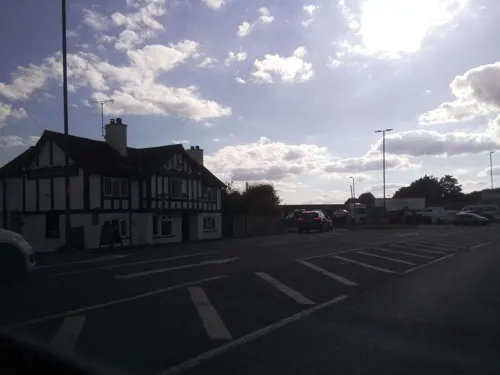



16 more on the map.
Where to stay2

History
During the Early Middle Ages, Leominster was home to Æthelmod of Leominster, an English saint known to history mainly through the hagiography of the Secgan Manuscript. He is reputedly buried in Leominster.
During the 8th and 9th Century, Danes (or Vikings) frequently raided the area. In 2015, two individuals (operating without landowner permission), using metal detectors, found a large hoard near Leominster (the Herefordshire hoard) consisting primarily of Saxon jewellery and silver ingots but also coins; the latter date to around 879 AD. According to a news report, "experts believe it was buried by a Viking during a series of raids", while Wessex was ruled by Alfred the Great and Mercia by Ceolwulf II of Mercia.
According to the Anglo-Saxon Chronicle, a raid by Gruffudd ap Llywelyn on Leominster in 1052 resulted in the Battle of Llanllieni, between the Welsh and a combined force of Normans (mercenaries) and English Saxons.
Henry I bestowed the minster and its estates on Reading Abbey, which founded a priory at Leominster in 1121, although there was one here from Saxon times. Its Priory Church of St. Peter and St. Paul, which now serves as the parish church, is the remaining part of this 12th-century Benedictine monastery. Quatrefoil piers were inserted between 1872–79 by Sir George Gilbert Scott.
Read more of the history
The priory was ransacked by the Welsh forces of Owain Glyndŵr after their victory at the Battle of Bryn Glas near Pilleth in 1402, along with several local manor houses.
Investigations to the north of the priory in 2005 located the position of the cloister, although most of the stone had been stolen following the Dissolution. Discarded animal bones found on the site when submitted to carbon dating showed that the area was occupied in the 7th century. This agrees with the date of 660 AD associated with the founding myth, which suggests a Christian community was established here by a monk, St. Eadfrith, originally from Lindisfarne in Northumbria.
Leominster is also the historical home of Ryeland sheep, a breed once famed for its wool, known as 'Lemster ore'. This wool was prized above all other English wool in trade with the continent of Europe in the Middle Ages. It was the income and prosperity from this wool trade that established the town and the minster and attracted the envy of the Welsh and other regions.
From approximately 1748 to 1754, Pinsley Mill in Leominster was home to one of the Paul-Wyatt cotton mills, the first four cotton mills in the world, employing the spinning machines of Lewis Paul and John Wyatt. The mill was financed by Lancashire native Daniel Bourn, and was partly owned by other men from Lancashire. Bourn introduced his own version of the carding engine to work at this mill, and of the four Paul-Wyatt mills, it may have been the most successful, as shortly after the fire that destroyed the mill, it was reported that the cotton works "had been viewed with great pleasure and admiration by travellers and all who had seen them."
One of the last ordeals by ducking stool took place in Leominster in 1809, with Jenny Pipes as the final incumbent. The ducking stool is on public display in Leominster Priory; a mechanised depiction of it is featured on the town clock.
From the History section of Leominster on Wikipedia, under CC BY-SA 4.0.
Notable people from Leominster
 Albert LeeEnglish musician (born 1943)Photo: Toglenn, CC BY-SA 4.0
 George NewmanBritish doctor (1870-1948)Photo: Unknown author Unknown author, CC BY 4.0
 Philip HobyEnglish politician; (1505–1558)Photo: Hans Holbein the Younger, Public domain
 Theodore Goldsmith JoslinAmerican politician (1890–1944)Photo: Unknown author, Public domain
- Jarrod BowenEnglish association football player (born 1996)
- Mary RudgeBritish chess player (1842-1919)
- John Scarlett DavisEnglish painter (1804-1845)
- Arthur PeppercornEnglish railway engineer (1889–1951)
- Len Beelfootballer, cricketer (born 1945)
- John CravenBritish businessman
- Edwin Barnettcricketer (1870-?)
- Paddie O'NeilBritish actor and singer (1926–2010)
Born in Leominster, according to Wikidata (CC0). Each name links to its Wikipedia article.
Churches and places of worship9
The Priory Church of St. Peter & St. Paul Leominster
Church · Anglican · 0.5 mi
Shopping18
Gas and EV charging3
Schools, colleges and libraries5
Healthcare2
Map of Leominster
78 places. The map loads OpenStreetMap tiles when you open it.
Getting there and nearby towns
Gloucestershire Airport (GLO) is the nearest airport with scheduled flights listed in OpenStreetMap, 34 miles away.
- Ludlow 10 mi north, about 17 min by car
- Stourport-on-Severn 21 mi east, about 34 min by car
- Worcester 22 mi east, about 36 min by car
- Ross on Wye 23 mi south, about 36 min by car
- Tewkesbury 30 mi southeast, about 48 min by car
- Gloucester 33 mi southeast, about 53 min by car
- Dudley 34 mi northeast, about 54 min by car
- Telford 34 mi north, about 54 min by car
- Wolverhampton 36 mi northeast, about 58 min by car
- Birmingham 40 mi northeast, about 1 h by car
Drive times are estimates from straight-line distance, not routes.
Towns near Leominster


Keep exploring
Local news
Headlines from INDB.
Reviews, tips and questions
Loading what members have shared...
Sources and licences
- GeoNames (CC BY 4.0): population, coordinates, regions and time zone
- Mapillary (see each image): photos
- OpenStreetMap contributors (ODbL 1.0): places, airports, map data
- Wikidata (CC0 1.0): elevation, founding date, time zone, website, landmarks and historic places
- Wikimedia Commons (see each image): photos
- Wikipedia (CC BY-SA 4.0): overview and history text
Photo credits
- Leominster Priory Church (St. Peter and St. Paul), hugh llewelyn, CC BY-SA 2.0
- Leominster Priory Church (St. Peter and St. Paul) - 49908800373, hugh llewelyn, CC BY-SA 2.0
- Leominster Priory Church (St. Peter and St. Paul) - 49909616512, hugh llewelyn, CC BY-SA 2.0
- Leominster Museum - 2014-07-11 - Andy Mabbett - 28, Andy Mabbett, CC BY-SA 3.0
- Berrington Hall, Leominster, Herefordshire, Vauxford, CC BY-SA 4.0
- MarlbrookCadbury, Raymond Perry, CC BY-SA 2.0
- Leominster Priory, Tony Grist, Public domain
- Street-level photo, laye, CC BY-SA 4.0
- Street-level photo, southglos, CC BY-SA 4.0
- Street-level photo, southglos, CC BY-SA 4.0
- Street-level photo, southglos, CC BY-SA 4.0
- Street-level photo, southglos, CC BY-SA 4.0
- Street-level photo, southglos, CC BY-SA 4.0
- Street-level photo, southglos, CC BY-SA 4.0

Page built November 10, 2026. Spotted a mistake? Tell us or suggest a place.