


Stratford-upon-Avon, United Kingdom
Stratford-upon-Avon is a town of 30,495 people in England, United Kingdom, founded in 1196.
Why visit Stratford-upon-Avon
Townapedia lists 45 museums and landmarks, 15 parks and trails, 148 places to eat, 76 places to stay and 11 attractions in and around town.
Highlights include Swan Theatre, The Other Place, Anne Hathaway's Cottage and Shakespeare's Birthplace.
Weather in Stratford-upon-Avon
Forecast from MET Norway (CC BY 4.0). Full forecast
About Stratford-upon-Avon
Stratford-upon-Avon ( ... AY-vən), also known simply as Stratford, is a market town and civil parish in the Stratford-on-Avon District, in the county of Warwickshire, in the West Midlands region of England. It is situated on the River Avon, 91 miles (146 km) north-west of London, 22 miles (35 km) south-east of Birmingham and 8 miles (13 km) south-west of Warwick. The town is the southernmost point of the Arden area at the northern extremity of the Cotswolds.
From the Wikipedia article Stratford-upon-Avon (this version), under CC BY-SA 4.0.
Travel tips from other travellers: Stratford-upon-Avon on Wikivoyage (CC BY-SA 4.0).
Photos of Stratford-upon-Avon


Things to do11

Swan Theatre
Cinema and theater
Theatre in Stratford-upon-Avon, England
Waterside, Stratford-upon-Avon

The Other Place
Cinema and theater
Theatre in Stratford-upon-Avon, England
Southern Lane, Stratford-upon-Avon

Clopton Bridge
Bridge
Bridge in Stratford-upon-Avon, Warwickshire, England
Courtyard Theatre
Cinema and theater
Former theatre in Stratford-upon-Avon, England

Old Tramway Bridge
Bridge
Bridge in Stratford-upon-Avon, Stratford-on-Avon, Warwickshire, England, UK


Hampton Lucy bridge
Bridge · 3.8 mi
Bridge in Hampton Lucy, Stratford-on-Avon, Warwickshire, England, UK
Waterside Theatre
Cinema and theater
Theatre in Stratford-upon-Avon, England, formerly independent, later used as Waterside Space by the Royal Shakespeare Theatre, now used...

Museums and landmarks45

Anne Hathaway's Cottage
Monument and historic site · 1.0 mi
House museum, associated with William Shakespeare in Stratford-upon-Avon, Stratford-on-Avon, Warwickshire, England, UK
Cottage Lane
Feb 10-Mar 15,Oct 28-Nov 03 10:00-16:00; Mar 16-Oct 27 10:00-17:00

Shakespeare's Birthplace
Monument and historic site
Grade I listed birth house in Stratford-upon-Avon, United Kingdom
Henley Street, Stratford-upon-Avon
Mo-Su 10:00-16:00
The MAD (Mechanical Art and Design) Museum
Museum
4-5 Henley Street, Stratford-upon-Avon
Mo-Fr 10:00-17:00; Sa-Su 10:00-17:30


Royal Shakespeare Theatre
Museum
Theatre building in Stratford-upon-Avon, England
Waterside, Stratford-upon-Avon


Shakespeare's New Place
Museum
Former building in Stratford-upon-Avon, Warwickshire, United Kingdom
22 Chapel Street, Stratford-upon-Avon


Charlecote Park
Museum · 4.0 mi
Country house near Stratford-on-Avon, Warwickshire, England, UK

Gower Monument
Monument and historic site
Monument in Stratford-upon-Avon, United Kingdom
33 more on the map.
Parks, trails and playgrounds15





3 more on the map.
Restaurants and cafes148


Bella Italia
Restaurant · Italian
32 Wood Street, Stratford-upon-Avon
Mo-Th 12:00-21:30; Fr-Sa 12:00-22:00; Su 12:00-21:30
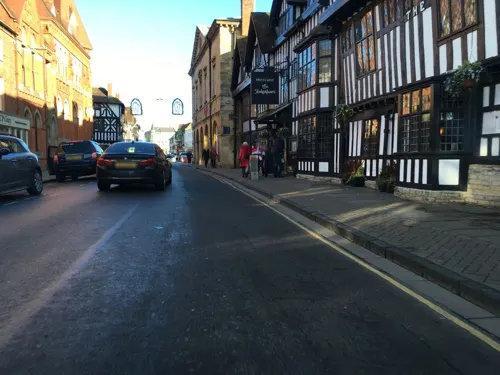
Edward Moon
Restaurant
9 Chapel Street, Stratford-upon-Avon
Mo-Th 12:00-14:30,17:00-21:30; Fr 12:00-14:30,17:00-22:00; Su 12:00-21:30
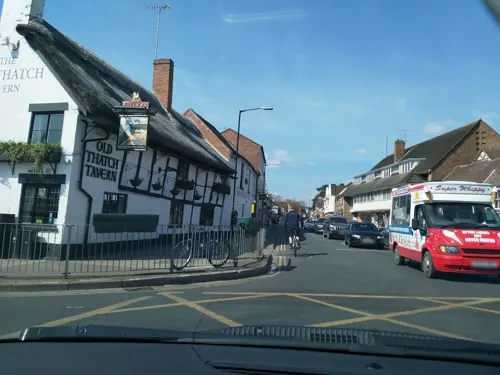
Lily's Waffles and Crêpes
Cafe · Waffle, Crepe
18-19 Rother Street, Stratford-upon-Avon
Th-Mo 11:00-17:00
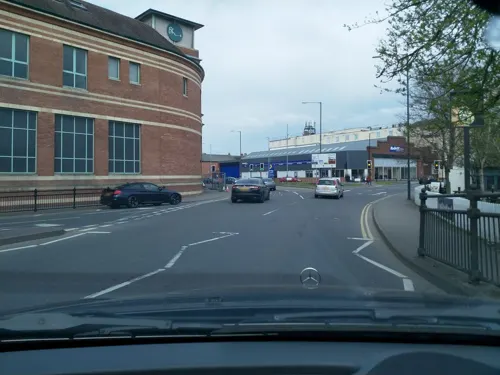

The Encore
Bar and pub · Regional
1 Bridge Street, Stratford-upon-Avon
Mo-Th 12:00-23:00; Fr 12:00-24:00; Sa 09:00-24:00; Su 09:00-22:30


136 more on the map.
History
The Stratford area was settled during the Roman period as the area was crossed by a Roman road: archaeological remains of a small Roman town have been found, about 1 mile (1.6 km) northeast of Stratford town centre at Tiddington, now part of Stratford, which was occupied from the 1st to the 5th century AD. The remains of two further probable Roman settlements have been found within a few miles of modern-day Stratford.
Oftfor, bishop of Worcester from 691 to 693, preached to the Hwicca tribe who inhabited south Warwickshire (then Mercia), and it has been argued that it was during this mission that a monastery was founded at Stratford. The earliest reference to the monastery comes from a charter in which Egwin (third bishop of Worcester) acquired a religious house at Aet-Stratford, which may have been on the site of the Church of the Holy Trinity. The rights of the bishops of Worcester to Stratford were confirmed by Offa in 781.
The monastery was likely destroyed by Viking invaders in 1015. The land remained in the ownership of the bishops of Worcester until the 16th century. The area around Holy Trinity Church is still known as Old Town as it was the original area of settlement around the monastery. The focus of the settlement at Stratford was later moved north, closer to the river crossing, which was better positioned for trade.
Read more of the history
Stratford, then referred to as strete ford, remained a village until the late 12th century when it was developed into a town by the lord of the manor, Bishop John of Coutances. He laid out a new town in 1196 around 1⁄2 mile (0.80 km) north of the original settlement, based on a grid system to expand Stratford and allow people to rent property in order to trade within the town. Coutances granted his new tenants the right to rent property and transmit it at death; this was called burgage tenure. Each development plot or "burgage" consisted of around 0.25 acres (0.10 hectares). A charter was granted to Stratford by King Richard I in 1196 which allowed a weekly market to be held in the town, giving it its status as a market town. These two charters, which formed the foundations of Stratford's transformation from a village to a town, make the town of Stratford over 800 years old: the town celebrated its 800th anniversary in 1996.
John of Coutances' plans to develop Stratford into a town meant it became a place of work for tradesmen and merchants. By 1252 the town had approximately 240 burgages (town rental properties owned by a king or lord), as well as shops, stalls and other buildings. Stratford's tradesmen established the Guild of the Holy Cross for their business and religious requirements. The guild developed into the town's main institution of local government, and included the most important townsmen, who elected officials to oversee local affairs. They built a Guild Chapel in the 13th century, and a Guildhall and almshouses on Church Street in around 1417. The guild established an educational institution in the late 13th century.
Many of the town's earliest and most important buildings are along what is known as Stratford's Historic Spine, which was once the main route from the town centre to the parish church. The route of the Historic Spine begins at Shakespeare's Birthplace in Henley Street. It continues through Henley Street to the top end of Bridge Street and into the High Street where many Elizabethan buildings are found, including Harvard House. The route carries on through Chapel Street past Nash's House and New Place. Opposite New Place was The Falcon Hotel (now Hotel Indigo), at the corner of Scholars Lane. It is a timber-framed house with nearly 100-ft frontage to the street and dating perhaps from the end of the 15th century. The Historic Spine continues along Church Street where there are Guild buildings from the 15th century, as well as 18th- and 19th-century properties. The route finishes in the Old Town, which includes Hall's Croft and the Holy Trinity Church.
During Stratford's early expansion into a town, the only access across the River Avon into and out of the town was over a wooden bridge, which was first mentioned in 1235. The bridge could not be crossed at times due to the river rising and was described by antiquarian John Leland as "a poor bridge of timber and no causeway to it, whereby many poor folks and other refused to come to Stratford when the Avon was up, or coming thither stood in jeopardy of life." In 1484, a masonry arch bridge was built to replace it called Clopton Bridge, named after Hugh Clopton, a wealthy local man who paid for its construction and later became Lord Mayor of London. The new bridge made it easier for people to trade within Stratford and for passing travellers to stay in the town.
The medieval structures of local governance underwent significant changes during the Tudor period: The Guild of the Holy Cross was abolished in 1547 under King Edward VI's suppression of religious guilds, and the inhabitants of Stratford petitioned the Crown for a charter of incorporation as a borough, which they received in 1553. This allowed the formation a new Town Council which inherited the property and responsibilities of the abolished guild. The Charter of Incorporation refounded Stratford's school as the King Edward VI School.
The Cotswolds, located close to Stratford, was a major sheep-producing area up until the latter part of the 19th century, with Stratford one of its main centres for the processing, marketing, and distribution of sheep and wool. Consequently, Stratford became a centre for tanning during the 15th–17th centuries. Glove making was an important industry, which was at its zenith in the 15th and 16th centuries. As was malting, the processing of grain to turn it into malt.
From the History section of Stratford-upon-Avon on Wikipedia, under CC BY-SA 4.0.
More about Stratford-upon-Avon
Geography
Stratford is 22 miles (35 km) south-east of Birmingham. It is close to the northern edge of the Cotswolds, with Chipping Campden 10 miles (16 km) to the south. Stratford is around 6 miles (9.7 km) to the north-east of the borders with both Worcestershire and Gloucestershire. Other than those already mentioned, significant towns and villages nearby include Alcester, Wellesbourne, Evesham, Redditch and Henley-in-Arden.
Stratford is divided by the River Avon, with the majority of the town being on the west side of the river, its riverside location means it is susceptible to flooding, including flash floods.
Stratford has several suburbs: The town's urban area encompasses the contiguous sub-villages of Alveston, Shottery and Tiddington, which were formerly independent, but now form part of the civil parish of Stratford, other distinct suburbs of the town include Bishopton, Bridge Town, Clopton and Old Town.
Economy
Tourism is a major employer, especially in the hotel, hospitality industry and catering sectors. Other industries in the town include boat building and maintenance, bicycles, mechanical and electrical engineering, food manufacture, Information Technology, call centre and service sector activities, a large motor sales sector, industrial plant hire, building suppliers, market gardening, farming, storage and transport logistics, finance and insurance, and a large retail sector.
Major employers in the town include the NFU Mutual Insurance Company (and Avon Insurance), Amec Foster Wheeler, Sitel, Tesco, Morrisons, Marks & Spencer, B&Q and Pashley Cycles. There are three theatres run by the prestigious Royal Shakespeare Company, which attract large audiences and income for the town.
Arts and culture
The first real theatre in Stratford was a temporary wooden affair built in 1769 by the actor David Garrick for his Shakespeare Jubilee celebrations of that year to mark William Shakespeare's birthday. The theatre, built not far from the site of the present Royal Shakespeare Theatre, was almost washed away in two days of torrential rain that resulted in terrible flooding. To celebrate the 300th anniversary of Shakespeare's birth in 1864, brewer Charles Edward Flower instigated the building of a temporary wooden theatre, known as the Tercentenary Theatre, which was built in a part of the brewer's large gardens on what is today the site of the new, and temporary, Courtyard Theatre. After three months the Tercentenary Theatre was dismantled, with the timber used for housebuilding purposes.
In the early 1870s, Flower gave several acres of riverside land to the local council on the understanding that a permanent theatre be built in honour of Shakespeare's memory, and by 1879 the first Shakespeare Memorial Theatre had been completed. It proved to be a huge success, and by the early 20th century it was effectively being run by the actor/manager Frank Benson. The theatre burned down in 1926, with the then artistic director, William Bridges-Adams, moving all productions to the local cinema.
Education
Stratford is also home to several institutions set up for the study of Shakespeare, including the Shakespeare Birthplace Trust, which holds books and documents related to the playwright, and the Shakespeare Institute. William Shakespeare is believed to have studied at King Edward VI School. Previously an all-boys school, from September 2013 it admitted girls into the sixth form for the first time. It is one of the few remaining grammar schools in England, selecting its pupils exclusively using the 11-plus examination. There is also an all-girls grammar school, Stratford-upon-Avon Grammar School for Girls, colloquially known as 'Shottery School' after its location in the village of Shottery, a short distance from the town centre.
Finally, there is a non-selective secondary school, Stratford-upon-Avon School, formerly known as the Hugh Clopton Secondary Modern School, which was demolished to make way for the new high school. There are no independent secondary schools in the town, but there are many primary schools, including St. Gregory's Catholic Primary School, Stratford-upon-Avon Primary School (often known locally as "Broad Street" due to its location), Bishopton Primary School, Willows Church of England Primary School and Thomas Jolyffe Primary School both state and independent, as well as Stratford-upon-Avon College.
From the Wikipedia article Stratford-upon-Avon, under CC BY-SA 4.0.
Notable people from Stratford-upon-Avon
 William ShakespeareEnglish playwright and poet (1564–1616)Photo: Attributed to John Taylor, Public domain
 Adrian NeweyBritish Formula One engineerPhoto: Yu Chu Chin, CC BY-SA 4.0
 Sarah DouglasBritish actress (born 1952)Photo: Super Festivals from Ft. Lauderdale, USA, CC BY 2.0
 John ShakespeareEnglish businessman and father of William Shakespeare (1530–1601)Photo: Philip Halling, CC BY-SA 2.0
 Andrew PozziBritish hurdlerPhoto: Erik van Leeuwen, attribution: Erik..., GFDL
 Halliwell HobbesBritish actor (1877-1962)Photo: David L. Loew Productions, Public domain
 Esme BoothBritish rowerPhoto: Ailura, CC BY-SA 3.0 at
 Freddie SlaterBritish racing driver (born 2008)Photo: Mitchea99, CC BY-SA 4.0
- William Henry FlowerEnglish comparative anatomist, surgeon and museum curator (1831–1899)
- Gethin AnthonyEnglish actor
- Susanna Halleldest child and older daughter of William Shakespeare
- Hamnet Shakespeareson of William Shakespeare
Born in Stratford-upon-Avon, according to Wikidata (CC0). Each name links to its Wikipedia article.
Where to stay76
Churches and places of worship24
Shopping46
Gas and EV charging6
Schools, colleges and libraries18
Shottery St Andrew's CofE Primary School
School · Anglican · 0.9 mi
3 Hathaway Lane, Stratford upon Avon
Healthcare7
Map of Stratford-upon-Avon
250 places. The map loads OpenStreetMap tiles when you open it.
Getting there and nearby towns
Birmingham Airport (BHX) is the nearest airport with scheduled flights listed in OpenStreetMap, 18 miles away.
- Solihull 16 mi north, about 25 min by car
- Coventry 17 mi northeast, about 27 min by car
- Birmingham 22 mi north, about 35 min by car
- Worcester 22 mi west, about 35 min by car
- Tewkesbury 24 mi southwest, about 38 min by car
- Cheltenham 26 mi southwest, about 41 min by car
- West Bromwich 26 mi northwest, about 41 min by car
- Sutton Coldfield 26 mi north, about 42 min by car
- Dudley 27 mi northwest, about 43 min by car
- Walsall 30 mi northwest, about 48 min by car
Drive times are estimates from straight-line distance, not routes.
Towns near Stratford-upon-Avon


Keep exploring
Local news
Headlines from INDB.
Reviews, tips and questions
Loading what members have shared...
Sources and licences
- GeoNames (CC BY 4.0): population, coordinates, regions and time zone
- Mapillary (see each image): photos
- OpenStreetMap contributors (ODbL 1.0): places, airports, map data
- Wikidata (CC0 1.0): elevation, founding date, time zone, website, landmarks and historic places
- Wikimedia Commons (see each image): photos
- Wikipedia (CC BY-SA 4.0): overview and history text
Photo credits
- Shakespeare's Birthplace, Stratford-upon-Avon - Sept 2012, Diliff, CC BY-SA 3.0
- Swan Theatre, Tony Hisgett, CC BY 2.0
- Courtyard Theatre Stratford upon Avon, Oosoom, CC BY-SA 3.0
- Clopton Bridge, Ken Crosby, CC BY-SA 2.0
- Stratford upon Avon - panoramio (16), Tanya Dedyukhina, CC BY 3.0
- Anne Hathaways Cottage and gardens 15g2006, Richard Peat, CC BY-SA 2.0
- Birthplace room, Unknown author Unknown author, Public domain
- Royal Shakespeare Theatre 2011, David Dixon, CC BY-SA 2.0
- Stratford butterfly farm gate 14a07, Snowmanradio, CC BY-SA 3.0
- Knot Garden at New Place -Stratford-upon-Avon, Michelle Walz Eriksson, CC BY 2.0
- Gower Monument, Drewphemism, CC BY-SA 4.0
- Weston-on-Avon 2008, Peter I. Vardy, Public domain
- St Peter's Church, Binton, DeFacto, CC BY-SA 4.0
- Stratford-upon-Avon 2010 PD 05, Bin im Garten, CC BY-SA 3.0
- Holy Trinity Church, Stratford-upon-Avon, DeFacto, CC BY-SA 4.0
- Hall's Croft, Mango salsa, CC BY-SA 3.0
- Harvard House, Mango salsa, CC BY-SA 3.0
- Nash House's New Place - Stratford Upon Avon, Elliott Brown, CC BY 2.0
- Guild Chapel & King Edward VI School, Stratford-upon-Avon - DSC09034, Rept0n1x, CC BY-SA 3.0
- Old Church of St James, Alveston, Jack Fitzsimons, CC BY-SA 4.0
- Stratford-upon-Avon, Falcon Hotel, Palickap, CC BY-SA 4.0
- Mercure Stratford-upon-Avon Shakespeare Hotel - DSC09005, Rept0n1x, CC BY-SA 3.0
- St Helen's church, Clifford Chambers, Jack Fitzsimons, CC BY-SA 4.0
- Black Swan public house on Southern Lane, Stratford-upon-Avon, Warwickshire, Lindsay Dearing, CC BY-SA 2.0
- Old Thatch Tavern, Stratford-upon-Avon - DSC08910, Rept0n1x, CC BY-SA 3.0
- The White Swan Hotel Stratford upon Avon Warwickshire England, Acabashi, CC BY-SA 4.0
- Stratford Preparatory School, Stratford-Upon-Avon, February 2022, No Swan So Fine, CC BY-SA 4.0
- Stratford-upon-Avon, Church of the Holy Trinity 01, Palickap, CC BY-SA 4.0
- KES Guildhall, ArchieKingWiki, CC0
- Nashs House, Stratford-upon-Avon, England-30Sept2011, summonedbyfells, CC BY 2.0
- Halls Croft, Stratford-upon-Avon3, Kev747 at English Wikipedia, CC BY-SA 3.0
- Garrick Inn (5664600887), Tony Hisgett from Birmingham, UK, CC BY 2.0
- Harvard House Carvings Stratford (5665095530), Tony Hisgett from Birmingham, UK, CC BY 2.0
- Harvard House Stratford (5665088336), Tony Hisgett from Birmingham, UK, CC BY 2.0
- Tudor House Stratford (5664646469), Tony Hisgett from Birmingham, UK, CC BY 2.0
- High St Stratford (5267229752), Tony Hisgett from Birmingham, UK, CC BY 2.0
- Garrick Inn and Harvard House (5266625915), Tony Hisgett from Birmingham, UK, CC BY 2.0
- Stratford-Playhouse-Stratford-upon-Avon-September-2024, Acediscovery, CC BY-SA 4.0
- Charlecote Park - Market, Karen.stepanyan, CC BY-SA 3.0
- Peace I Give To You - Bancroft Gardens, Stratford-upon-Avon (54932306778), Elliott Brown, CC BY-SA 4.0
- Street-level photo, ebel, CC BY-SA 4.0
- Street-level photo, southglos, CC BY-SA 4.0
- Street-level photo, southglos, CC BY-SA 4.0
- Street-level photo, southglos, CC BY-SA 4.0
- Street-level photo, southglos, CC BY-SA 4.0
- Street-level photo, laye, CC BY-SA 4.0
- Street-level photo, southglos, CC BY-SA 4.0
- Street-level photo, laye, CC BY-SA 4.0
- Street-level photo, southglos, CC BY-SA 4.0
- Street-level photo, southglos, CC BY-SA 4.0
- Street-level photo, laye, CC BY-SA 4.0
- Street-level photo, ebel, CC BY-SA 4.0
- Street-level photo, laye, CC BY-SA 4.0
- Street-level photo, laye, CC BY-SA 4.0
- Street-level photo, laye, CC BY-SA 4.0
- Street-level photo, southglos, CC BY-SA 4.0
- Street-level photo, southglos, CC BY-SA 4.0
- Street-level photo, southglos, CC BY-SA 4.0
- Street-level photo, laye, CC BY-SA 4.0
- Street-level photo, laye, CC BY-SA 4.0
- Street-level photo, laye, CC BY-SA 4.0


Page built November 10, 2026. Spotted a mistake? Tell us or suggest a place.