


Hereford, United Kingdom
Hereford is a town of 60,415 people in England, United Kingdom.
Why visit Hereford
Townapedia lists 29 museums and landmarks, 22 parks and trails, 176 places to eat, 15 places to stay and 9 attractions in and around town.
Highlights include Victoria Bridge, The Courtyard Theatre, Waterworks Museum and Hereford Museum and Art Gallery.
Weather in Hereford
Forecast from MET Norway (CC BY 4.0). Full forecast
About Hereford
Hereford is a cathedral city and the county town of the ceremonial county of Herefordshire, England. It is on the banks of the River Wye and lies 16 miles (26 km) east of the border with Wales, 23 miles (37 km) north-west of Gloucester and 24 miles (39 km) south-west of Worcester. With a population of 61,900 in 2024, it is the largest settlement in Herefordshire.
From the Wikipedia article Hereford (this version), under CC BY-SA 4.0.
Travel tips from other travellers: Hereford on Wikivoyage (CC BY-SA 4.0).
Things to do9

Victoria Bridge
Bridge · 0.4 mi
Footbridge in Hereford, Herefordshire, England, UK

Courtyard Centre for the Arts
Cinema and theater
Arts centre in Hereford, England

Wye Bridge, Hereford
Bridge
Grade I listed bridge in Hereford, United Kingdom

Museums and landmarks29


Hereford Museum and Art Gallery
Museum
Local museum in Hereford, England, United Kingdom

Black & White House Museum
Museum
High Town, Hereford
Tu-Sa 10:00-17:00; Su 11:00-16:00; PH 12:00-15:00

Hertford Blackfriars Priory
Monument and historic site
Ruins of Dominican friary in Hereford, Herefordshire, England, UK
Sutton Walls Hill Fort
Monument and historic site · 4.0 mi
Hillfort in Herefordshire, England, UK
The Old House, Hereford
Museum
Grade I listed historic house museum in Hereford, Herefordshire, England,UK
17 more on the map.
Parks, trails and playgrounds22

Widemarsh Common
Park · 0.6 mi
Public open space in Hereford, England, UK




10 more on the map.
Restaurants and cafes176
Amazing Asia Buffet
Restaurant · Asian, Indian, Thai
Unit 26 Garrick Lane
Su-Th 12:00-22:00; Fr-Sa 12:00-23:00
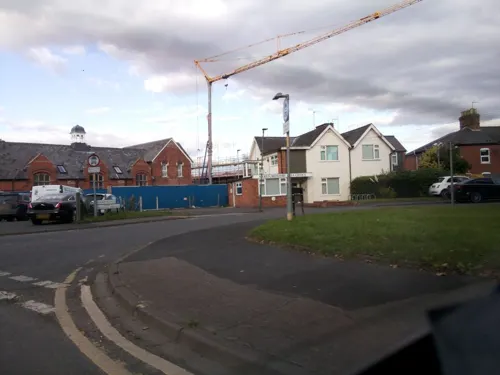

eN Sushi & BBQ
Restaurant · Asian, Barbecue, Korean, Ramen, Sushi
28 Garrick Lane, Hereford
Tu 17:00-22:30; We-Sa 12:00-22:00; Su 12:00-21:00

Simply Thai
Restaurant · Thai
Tu-Sa 12:00-14:30, Su 17:00-21:00, Mo-Th 17:00-22:00, Fr,Sa 17:00-22:30

Wobbly Brewery Tap
Bar and pub · 2.0 mi
Tillington Road, Hereford
Mo-Fr 16:00-23:00; Sa 12:00-23:00; Su 13:00-20:00
Bake and Create Bistro
Cafe · Coffee Shop, Breakfast, British, European, Sandwich, Cake · 1.5 mi
Emperor Way, Hereford
Mo-Fr 08:30-14:00
Hereford Beer House
Bar and pub
Beer and cidershop with tables, international draught and bottled beers
65 West Street, Hereford
164 more on the map.
History
Hereford became the seat of Putta, Bishop of Hereford, some time between 676 and 688 AD, after which the settlement continued to grow due to its proximity to the border between Mercia and Wales, becoming the Saxon capital of West Mercia by the beginning of the 8th century.
Hostilities between the Anglo-Saxons and the Welsh came to a head with the Battle of Hereford in 760, in which the Britons freed themselves from the influence of the English. Hereford was again targeted by the Welsh during their conflict with the Anglo-Saxon King Edward the Confessor in 1056 when, supported by Viking allies, Gruffydd ap Llywelyn, King of Gwynedd and Powys, marched on the town and put it to the torch before returning home in triumph. Hereford had the only mint west of the Severn in the reign of Athelstan (924–939), and it was to Hereford, then a border town, that Athelstan summoned the leading Welsh princes.
The present Hereford Cathedral dates from the early 12th century, as does the first bridge across the Wye. Former Bishops of Hereford include Saint Thomas de Cantilupe and Lord High Treasurer of England Thomas Charlton.
Read more of the history
Hereford was home to a small but relatively important Jewish community until 1290, when Jews were expelled from England by Edward I. Jews from Worcester and Gloucester moved to Hereford after their expulsion in January 1275 by the Queen mother, Eleanor of Provence. The Bishops of Hereford campaigned against the presence of the community, including Cantilupe, and Richard Swinefield, who tried to stop social contact between Christians and Jews.
The city gave its name (translated to French) to two suburbs of Paris: Maisons-Alfort (population 54,600) and Alfortville (population 36,232), due to a manor built there by Peter of Aigueblanche, Bishop of Hereford, in the middle of the 13th century.
A base for successive holders of the title Earl of Hereford, the city was once the site of Hereford Castle, which rivalled that of Windsor in size and scale. This was a base for repelling Welsh attacks and a secure stronghold for English kings, such as King Henry IV when on campaign in the Welsh Marches against Owain Glyndŵr. The castle was dismantled in the 18th century and landscaped into Castle Green.
After the Battle of Mortimer's Cross in 1461, during the Wars of the Roses, the defeated Lancastrian leader Owen Tudor (grandfather of the future Henry VII of England) was taken to Hereford by Sir Roger Vaughan and executed in High Town. A plaque now marks the spot of the execution. Vaughan was later himself executed, under a flag of truce, by Owen's son Jasper.
During the English Civil War, the city changed hands several times. On 30 September 1642, Parliamentarians led by Sir Robert Harley and Henry Grey, 1st Earl of Stamford occupied the city without opposition. In December they withdrew to Gloucester because of the presence in the area of a Royalist army under Lord Herbert. The city was again occupied briefly from 23 April to 18 May 1643 by Parliamentarians commanded by Sir William Waller, but it was in 1645 that the city saw most action. On 31 July 1645, a Scottish army of 14,000 under Alexander Leslie, 1st Earl of Leven besieged the city but met stiff resistance from its garrison and inhabitants. They withdrew on 1 September when they received news that a force led by King Charles was approaching. The city was finally taken for Parliament on 18 December 1645 by Colonel Birch and Colonel Morgan. King Charles showed his gratitude to the city of Hereford on 16 September 1645 by augmenting the city's coat of arms with the three lions of Richard I of England, ten Scottish Saltires signifying the ten defeated Scottish regiments, a very rare lion crest on top of the coat of arms signifying "defender of the faith" and the even rarer gold-barred peer's helm, found only on the arms of one other municipal authority: those of the City of London.
Nell Gwynne, actress and mistress of King Charles II, is said to have been born in Hereford in 1650 (although other towns and cities, notably Oxford, claim her as their own); Gwynn Street is named after her. Another famous actor born in Hereford is David Garrick (1717–1779).
The Bishop's Palace next to the cathedral was built in 1204 and is still in use today. Hereford Cathedral School is one of the oldest schools in England. The Harold Street Barracks were completed in 1856.
During World War I in 1916, a fire at the Garrick Theatre killed eight young girls who had been performing at a charity concert.
From the History section of Hereford on Wikipedia, under CC BY-SA 4.0.
More about Hereford
Geography
As with all of the UK, Hereford experiences a maritime climate, with limited seasonal temperature ranges, and generally moderate rainfall throughout the year. The nearest Met Office weather station, for which 30-year averages are available, is Credenhill weather station, about 4 miles (6 km) north west of the city centre. Before 2001, the weather station at Preston Wynne (7 miles, 11 km to the north-east) provided the data.
Since 2001, extremes at Hereford Credenhill have ranged from 33.6 °C (92.5 °F) during July 2006, to as low as −15.8 °C (3.6 °F) during December 2010.
In February 2020, many houses in Hereford were evacuated due to floods.
On 17 February 2020, the River Wye rose to 6.11 metres, the highest ever recorded, as a result of the weather pattern created by Storm Dennis.
Economy
Bulmers, now owned by Heineken – Cider and alcoholic beverages producer. Brands include Woodpecker Cider, Strongbow and Bulmers Cider
Avara Foods (formerly Cargill and Sun Valley) – Manufacturers and suppliers of food products for retailers and foodservice operators
Painter Brothers – Manufacturers of galvanized steel towers including the Skylon at the Festival of Britain
Herefordshire is a centre for cider production as it contains many acres of orchards; many breweries and associated organisations exist here, along with other heavy and light industries.
Education
A new higher education institution, the New Model Institute for Technology and Engineering (NMITE), has been created in Hereford, which had its first intake of students in September 2021. It is envisioned as a seed institution for a future University of Hereford within a decade.
Hereford College of Arts – a publicly funded art school on Folly Lane, with a Higher Education centre on College Road in the former main buildings of the Royal National College for the Blind. The University of Wales Trinity St Davids co-operate to provide degree qualifications.
Herefordshire and Ludlow College (HLC), formerly known as Hereford College of Technology – The Folly Lane facility includes a university centre for the University of Worcester.
The National School of Blacksmithing is the oldest established blacksmithing college in the UK, also the largest facility for training smiths in Europe. This is also part of HLC.
The Royal National College for the Blind – one of multiple institutions catering to the blind in Britain. The college occupies the former Hereford College of Education campus.
Holme Lacy College – an agricultural college that was part of the Pershore Group of Colleges (now Warwickshire College), but currently belongs to Herefordshire and Ludlow College (HLC).
The Steiner Academy Hereford – The first Rudolf Steiner school in England to become an academy.
From the Wikipedia article Hereford, under CC BY-SA 4.0.
Notable people from Hereford
 Frank OzBritish and American director, actor, and puppeteerPhoto: Jay Dixit, CC BY 4.0
 David GarrickBritish actor, playwright, theatre manager and producer (1717–1779)Photo: Thomas Gainsborough, Public domain
 Connor WickhamEnglish association football player (born 1993)Photo: CFCUnofficial (Chelsea Debs), CC BY-SA 2.0
 Edward William LaneBritish orientalist, translator, lexicographer and peacemaker (1801-1876)Photo: Stephencdickson, Public domain
 Beryl ReidBritish actress (1919–1996)Photo: Allan warren, CC BY-SA 3.0
 Marian Stamp DawkinsBritish biologistPhoto: Royal Society uploader ; crop by Crisco 1492, CC BY-SA 4.0
- Ellie GouldingEnglish singer‑songwriter (born 1986)
- Richard HakluytEnglish author, editor and translator (1553–1616)
- Thomas TraherneEnglish poet
- Dora CarringtonBritish painter, photographer and decorative artist (1893–1932)
- John Riseley-PrichardBritish racing driver (1924-1993)
- Simon CarrBritish cyclist (born 1998)
Born in Hereford, according to Wikidata (CC0). Each name links to its Wikipedia article.
Where to stay15
Churches and places of worship35
Shopping54
Gas and EV charging9
Schools, colleges and libraries38
Healthcare20
Wye Valley Community Diagnostic and Treatment Centre
Clinic and pharmacy · 1.0 mi
Holmer Road, Hereford
Map of Hereford
250 places. The map loads OpenStreetMap tiles when you open it.
Getting there and nearby towns
Gloucestershire Airport (GLO) is the nearest airport with scheduled flights listed in OpenStreetMap, 26 miles away.
- Ross on Wye 12 mi southeast, about 19 min by car
- Leominster 12 mi north, about 19 min by car
- Cinderford 19 mi southeast, about 30 min by car
- Ludlow 22 mi north, about 35 min by car
- Worcester 23 mi northeast, about 37 min by car
- Gloucester 24 mi southeast, about 39 min by car
- Tewkesbury 24 mi east, about 39 min by car
- Churchdown 26 mi southeast, about 42 min by car
- Stourport-on-Severn 27 mi northeast, about 43 min by car
- Cheltenham 29 mi east, about 47 min by car
Drive times are estimates from straight-line distance, not routes.
Towns near Hereford


Keep exploring
Local news
Headlines from INDB.
Reviews, tips and questions
Loading what members have shared...
Sources and licences
- GeoNames (CC BY 4.0): population, coordinates, regions and time zone
- Mapillary (see each image): photos
- OpenStreetMap contributors (ODbL 1.0): places, airports, map data
- Wikidata (CC0 1.0): elevation, founding date, time zone, website, landmarks and historic places
- Wikimedia Commons (see each image): photos
- Wikipedia (CC BY-SA 4.0): overview and history text
Photo credits
- Wye Bridge, Hereford, David Merrett, CC BY 2.0
- Hereford Museum and Art Gallery - DSCF1971, Rept0n1x, CC BY-SA 3.0
- Hereford Cathedral Exterior from NW, Herefordshire, UK - Diliff, Diliff, CC BY-SA 3.0
- 1 Castle Street, Hereford, September 2020, No Swan So Fine, CC BY-SA 4.0
- The Royal National College for the Blind (Hereford, United Kingdom), Richard Webb, CC BY-SA 2.0
- All Saints Church, Hereford - DSCF1910, Rept0n1x, CC BY-SA 3.0
- The Green Dragon Hotel, Hereford, September 2020 02, No Swan So Fine, CC BY-SA 4.0
- Edgar Street, HUFC26.2, CC BY 4.0
- Widemarsh Common, Richard Webb, CC BY-SA 2.0
- View Across Victoria Bridge, WelshDave, CC BY-SA 4.0
- Hereford Waterworks Museum (22245956715), Amanda Slater from Coventry, West Midlands, UK, CC BY-SA 2.0
- Street-level photo, southglos, CC BY-SA 4.0
- Street-level photo, southglos, CC BY-SA 4.0
- Street-level photo, southglos, CC BY-SA 4.0
- Street-level photo, russmcd, CC BY-SA 4.0
- Street-level photo, laye, CC BY-SA 4.0
- Street-level photo, trigpoint, CC BY-SA 4.0
- Street-level photo, southglos, CC BY-SA 4.0
- Street-level photo, southglos, CC BY-SA 4.0
- Street-level photo, southglos, CC BY-SA 4.0

Page built November 10, 2026. Spotted a mistake? Tell us or suggest a place.