


Sittingbourne, United Kingdom
Sittingbourne is a town of 54,392 people in England, United Kingdom.
Why visit Sittingbourne
Townapedia lists 3 museums and landmarks, 18 parks and trails, 85 places to eat, 4 places to stay and 3 attractions in and around town.
Highlights include The Light Cinema Sittingbourne, Romano-Celtic temple at Watling, Newington, Sittingbourne Heritage Museum and Milton Creek Country Park.
Weather in Sittingbourne
Forecast from MET Norway (CC BY 4.0). Full forecast
About Sittingbourne
Sittingbourne is an industrial town in the Swale district of Kent, southeast England, 17 miles (27 km) from Canterbury and 45 miles (72 km) from London, beside the Roman Watling Street, an ancient trackway used by the Romans and the Anglo-Saxons. In 2021 it had a population of 54,392.
From the Wikipedia article Sittingbourne (this version), under CC BY-SA 4.0.
Travel tips from other travellers: Sittingbourne on Wikivoyage (CC BY-SA 4.0).
Things to do3

Museums and landmarks3

Romano-Celtic temple at Watling, Newington
Monument and historic site · 2.6 mi
Romano-Celtic temple in a roadside settlement near Newington


Parks, trails and playgrounds18





6 more on the map.
Restaurants and cafes85
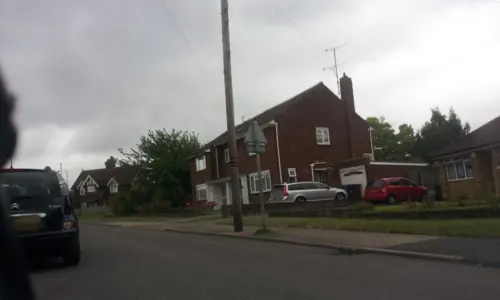
Matt Matts Cafe
Cafe · Breakfast, Coffee Shop · 0.6 mi
31 Chaucer Road, Sittingbourne
Mo -Fr 08:30-15:30; Sa 08:30-12:30
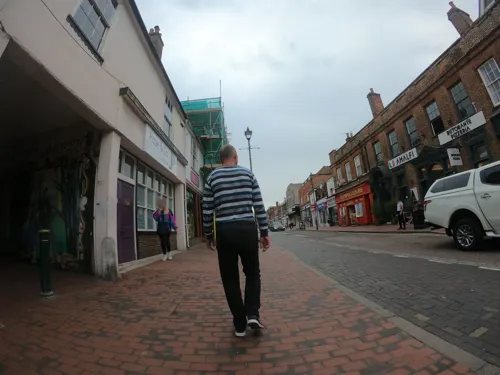

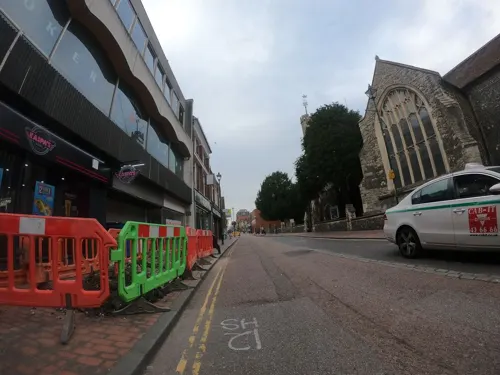

Nando's
Restaurant · Chicken, Portuguese
Bourne Place, Sittingbourne
no @ (Mo,Tu); We-Sa 11:30-22:00; Su 11:30-18:30

73 more on the map.
History
Sittingbourne owes its name to a modernised version of an observation on its location. The town's name came from the fact that there is a small stream or "bourne" running underground in part of the town. Hasted writing in the 1790s in his History of Kent states that:
Sittingbourne was anciently written Sedingbourne, in Saxon, Saedingburga, i.e. the hamlet by the bourne or small stream.
Another explanation is that the name Sittingbourne derives from the Old English sīdeingasburna meaning the 'stream of the dwellers on the slope'.
The Kent Hundred Rolls of 1274–75, preserved in the National Archives, record Sittingbourne as Sydingeburn in the following entries "
Item dicunt quod Johannes Maresescall de Synele tenet unam parvam purpresturam in villa de Sydingeburn et solvit domino regi per annum 1d et dominus rex nichil perdit et quod Petrus de London tenet unam parvam purpresturam in villa de Sydingeburn et solvit inde per annum domino regi 1d et rex nichil perdit." Translated as, "Then they say John Marshall de Synele holds one small encroachment in the vill of Sittingbourne and he pays the lord king 1d. each year and the lord king loses nothing and that Peter of London holds one small encroachment in the vill of Sittingbourne and he pays 1d. each year to the lord king and the king loses nothing."
Read more of the history
In 1921, the civil parish had a population of 9339. On 31 March 1930 the parish was abolished to form "Sittingbourne and Milton", part also went to Tunstall.
There is evidence of settlement in the area before 2000 BC, with farming and trading tribes living inland to avoid attack, yet close enough to access the sea at Milton Creek. In AD 43, the Romans invaded Kent, and to make access quicker between London and Dover, built Watling Street, which passed straight through Sittingbourne. As a point where sea access met road access, the port of Milton Regis became the Roman administrative centre for the area, with some 20 villas so far discovered, but Sittingbourne remained a minor hamlet throughout Roman times.
Most Roman finds in this area were due to the efforts of 19th-century brick makers who used topsoil to make bricks, and uncovered the finds; and preserved thanks to banker George Payne, who preserved or bought materials and published his works in 1893 in Collectanea Cantiana.
There was no entry for Sittingbourne in the Domesday Book of 1086, merely a note attached to Milton Regis showing a population of 393 households. However, after the murder of the Archbishop of Canterbury, Thomas Becket in 1170, pilgrims began to travel to Canterbury Cathedral and Sittingbourne became a useful hostelry for travellers. Sittingbourne is mentioned as a stopping point in Chaucer's The Canterbury Tales, with the Summoner in "The Wife of Bath's Prologue" saying:
But if I telle tales two or thre / Of freres er I come to Sidyngborne / That I shal make thyn herte for to morne
The parish church of St Michael was built in the 13th century. At that time, the High Street had 13 pubs and hostels. The Lyon – now the Red Lion – hosted King Henry V of England on his way back from the Battle of Agincourt, and Henry VIII visited Sittingbourne in 1522 and 1532. In 1708, the Rose Inn was built, originally called Rose Place and used as a private house. According to Edward Hasted "the principal inn now in it (Sittingbourne), called the Rose, is perhaps the most superb of any throughout the kingdom." In 1825 the future Queen Victoria and her mother, Princess Victoria of Saxe-Coburg-Saalfeld stayed overnight at the Rose Inn.
After the railway came in 1858, Sittingbourne became less a market trading and hostelry stop-off, and more a 19th-century centre of production to fuel the expansion of London, by producing bricks and paper from its clay substrata.
The area around Sittingbourne was subject to constant air raids by Zeppelins and aeroplanes during the First World War. The Germans used the town as a reference point for bearings on the way to London.
The first visit by a German aeroplane happened on Christmas Day 1914. Guns at Sheerness fired at the lone invader but still one shell dropped into a field at Iwade. The next event was to occur on 16 January 1915 when another solitary pilot from a German aerodrome in Belgium bombed Sittingbourne. This aircraft, a Taube, was pursued by two local airmen, but managed to escape after dropping a couple of bombs.
About 100 air-raid warnings were sounded in Sittingbourne during the First World War and anti-aircraft batteries were strengthened in 1917. The last big raid to pass over the town on Whit Sunday (19 May 1918), carried out by a number of Gothas, eliciting perhaps the most ferocious barrage from the ground defences the town had ever seen.
"The first of these duels occurred about an hour after the raid had been in progress, and probably this machine was caught while on its way to London. It was engaged by a daring aviation officer while at a great height. The British airman attacked his opponent so fiercely that the German was forced down to a lower height, and ultimately, to the joy of the onlookers, the Gotha burst into flames, seemed to break in two and came down piecemeal, all aflame. The wrecked machine and the three occupants fell by a farm. Two of the Germans fell into marshy ground and their bodies were deeply embedded in the mud. The third man's head struck a wall and was shattered like an eggshell. All three bodies were removed to a local aviation establishment. The fall of the burning Gotha was seen for miles around."
The second Gotha was surrounded by British fighters shortly after, returning from a successful raid on London.
Donald John Dean VC OBE of Sittingbourne was awarded the Victoria Cross for deeds carried out in France in 1918. His ashes are interred in the family plot at St John the Baptist Church, Tunstall, Kent.
As a result of the number of soldiers blinded during the war, the Kent Association for the Blind was formed in Sittingbourne in 1920.
From the History section of Sittingbourne on Wikipedia, under CC BY-SA 4.0.
More about Sittingbourne
Economy
The local clay was suitable for making bricks, and North Kent is geologically rich in chalk, which is not found in many other places in Europe in such abundance. This led to the development associated industries: water transport, paper, and cement; all of which continue today in the area.
In 1870, up to 2,628 men were working in the brick and tile industry, this is compared to Staffordshire (the next largest brick manufacturing area) that had only 1,566 men working in the industry. Brickmaking continued in the town well into the mid twentieth century. The bricks for the 3.45-mile (5,550 m) London Bridge – Greenwich Railway Viaduct were all made at Sittingbourne and transported to the site by barge.
Barges were needed to move many other raw materials and finished goods into the Thames and to London and beyond. Sittingbourne was ideally suited for this purpose and a successful barge-building industry developed at Milton Creek.
Sittingbourne developed into a port during the Industrial Revolution, from which Kentish produce was transported to the London markets. During this era over 500 types of barges are believed to have been built, centred around Conyer, a Roman hamlet of the village of Teynham, found at the head of a small creek between Sittingbourne and Faversham.
Education
Sittingbourne and the surrounding area have a number of primary schools. The main secondary schools in the town are Fulston Manor School, The Sittingbourne School, The Westlands School and two single sex Grammar Schools, Borden Grammar School (Boys) and Highsted Grammar School (Girls). Pupils wishing to apply for a year 7 place at grammar school have to take the Kent Test (11+) to assess if grammar school is a suitable option for them.
Sittingbourne Adult Education Centre provides some post-16 and adult training in the town and there is an Adult Skills centre located in the town centre. In May 2015 a post-16 technical college opened in the town.
From the Wikipedia article Sittingbourne, under CC BY-SA 4.0.
Notable people from Sittingbourne
 Andy DruryFootballer (born 1983)Photo: https://www.flickr.com/photos/juddy666/, CC BY 2.0
 Charles Henry CaffinAmerican art criticPhoto: Anonymous Unknown author, Public domain
- Ryan RichardsEnglish basketball player (born 1991)
- Lewis TheobaldEnglish editor and author (1688–1744)
- Edgar BrenchleyBritish ice hockey player (1912–1975)
- Robin Leigh-Pemberton, Baron KingsdownBritish banker and peer (1927-2013)
- Brian LuckhurstCricket player of England. (1939-2005)
- Petronella BarkerBritish actress
- Ben DoverEnglish pornographic actor, director and producer
- Jonathan PowellBritish television producer
- Colin ColeEnglish cricketer (1916-1994)
- Richard JacksonEnglish cricketer (born 1979)
Born in Sittingbourne, according to Wikidata (CC0). Each name links to its Wikipedia article.
Where to stay4
Churches and places of worship22
Church of the Sacred Heart of Jesus
Church · Roman Catholic
West Street, Sittingbourne
Shopping17
Gas and EV charging6
Schools, colleges and libraries29
Healthcare7
Map of Sittingbourne
194 places. The map loads OpenStreetMap tiles when you open it.
Getting there and nearby towns
Rochester Airport (RCS) is the nearest airport with scheduled flights listed in OpenStreetMap, 10 miles away.
- Faversham 7 mi east, about 11 min by car
- Sheerness 7 mi north, about 11 min by car
- Gillingham 9 mi northwest, about 14 min by car
- Rochester 10 mi west, about 17 min by car
- Maidstone 11 mi southwest, about 17 min by car
- Whitstable 13 mi east, about 20 min by car
- Snodland 13 mi west, about 20 min by car
- Southend-on-Sea 14 mi north, about 22 min by car
- South Benfleet 16 mi northwest, about 26 min by car
- Hadleigh 16 mi north, about 25 min by car
Drive times are estimates from straight-line distance, not routes.
Towns near Sittingbourne


Keep exploring
Local news
Headlines from INDB.
Reviews, tips and questions
Loading what members have shared...
Sources and licences
- GeoNames (CC BY 4.0): population, coordinates, regions and time zone
- Mapillary (see each image): photos
- OpenStreetMap contributors (ODbL 1.0): places, airports, map data
- Wikidata (CC0 1.0): elevation, founding date, time zone, website, landmarks and historic places
- Wikimedia Commons (see each image): photos
- Wikipedia (CC BY-SA 4.0): overview and history text
Photo credits
- Sittingbourne in 2007, John Salmon, CC BY-SA 2.0
- 1997 Lincoln Town Car - Sittingbourne, Hugh Llewelyn, CC BY-SA 2.0
- Sittingbourne railway station, Kent, England 01, Hugh Llewelyn, CC BY-SA 2.0
- The Golden Hope, Sittingbourne, July 2024, No Swan So Fine, CC BY-SA 4.0
- Watling Place Temple (Southwest View - 02), Doyle of London, CC BY-SA 4.0
- 1997 Lincoln Town Car, Hugh Llewelyn, CC BY-SA 2.0
- Milton Creek Country Park Play Area, Chelb, CC BY-SA 4.0
- Central Park Stadium Sittingbourne, Penny Mayes, CC BY-SA 2.0
- Cut Mark at Borden, St. Peter and St. Paul Church, Ray Hutchings, CC BY-SA 4.0
- Street-level photo, paulbiv, CC BY-SA 4.0
- Street-level photo, paulbiv, CC BY-SA 4.0
- Street-level photo, paulbiv, CC BY-SA 4.0
- Street-level photo, petermead, CC BY-SA 4.0
- Street-level photo, gness, CC BY-SA 4.0
- Street-level photo, paulbiv, CC BY-SA 4.0
- Street-level photo, paulbiv, CC BY-SA 4.0
- Street-level photo, paulbiv, CC BY-SA 4.0
- Street-level photo, petermead, CC BY-SA 4.0
- Street-level photo, petermead, CC BY-SA 4.0
- Street-level photo, paulbiv, CC BY-SA 4.0
- Street-level photo, paulbiv, CC BY-SA 4.0
- Street-level photo, petermead, CC BY-SA 4.0
- Street-level photo, paulbiv, CC BY-SA 4.0
- Street-level photo, paulbiv, CC BY-SA 4.0
- Street-level photo, paulbiv, CC BY-SA 4.0
- Street-level photo, paulbiv, CC BY-SA 4.0
- Street-level photo, petermead, CC BY-SA 4.0
- Street-level photo, paulbiv, CC BY-SA 4.0
- Street-level photo, paulbiv, CC BY-SA 4.0
- Street-level photo, paulbiv, CC BY-SA 4.0
- Street-level photo, paulbiv, CC BY-SA 4.0
- Street-level photo, paulbiv, CC BY-SA 4.0
- Street-level photo, paulbiv, CC BY-SA 4.0
- Street-level photo, tallguy, CC BY-SA 4.0
- Street-level photo, paulbiv, CC BY-SA 4.0
- Street-level photo, paulbiv, CC BY-SA 4.0
Page built November 10, 2026. Spotted a mistake? Tell us or suggest a place.