
Why visit Usk
Townapedia lists 3 museums and landmarks, 2 parks and trails, 21 places to eat, 1 place to stay and 2 attractions in and around town.
Highlights include Usk Bridge, Usk Rural Life Museum, Usk Castle and Tumble In The Jungle Soft Play.
Weather in Usk
Forecast from MET Norway (CC BY 4.0). Full forecast
About Usk
Usk (Welsh: Brynbuga) is a town and community in Monmouthshire, Wales, 10 miles (16 km) northeast of Newport. It is located on the River Usk, which is spanned by an arched stone bridge at the western entrance to the town. Usk Castle, above the town, overlooks the ancient crossing point. It developed as a small market town, with some industry including the making of Japanware, and with a notable prison built in 1841–42.
From the Wikipedia article Usk (this version), under CC BY-SA 4.0.
Travel tips from other travellers: Usk on Wikivoyage (CC BY-SA 4.0).
Things to do2
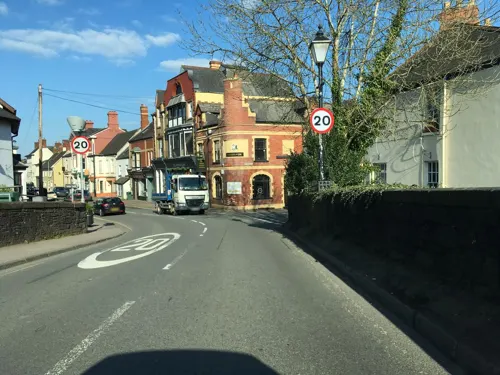
Usk Bridge
Bridge
Grade II* listed bridge in Usk, Monmouthshire, Wales

Museums and landmarks3
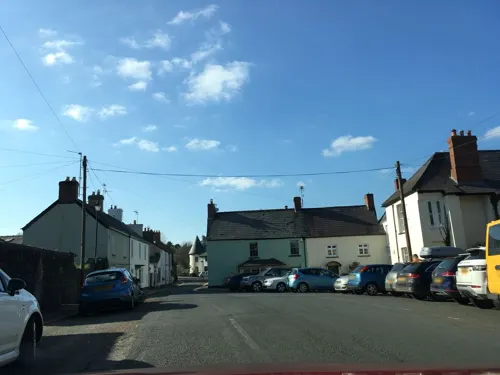

Usk Castle
Monument and historic site
Castle in Usk, Monmouthshire, Wales
Parks, trails and playgrounds2

Restaurants and cafes21
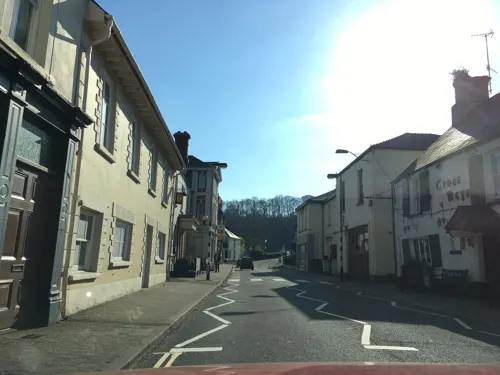
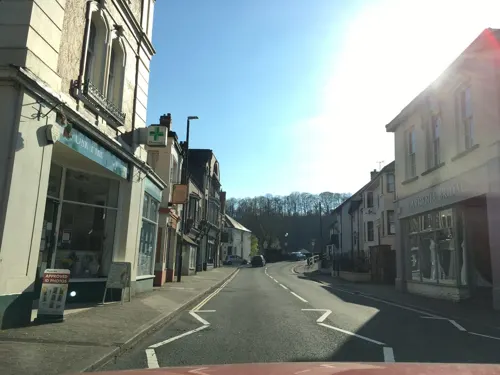
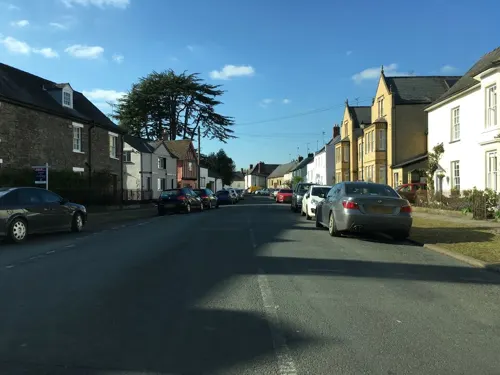
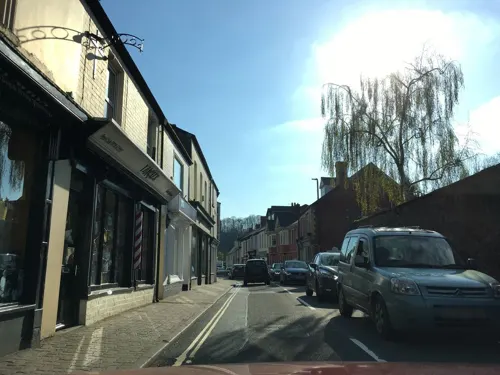
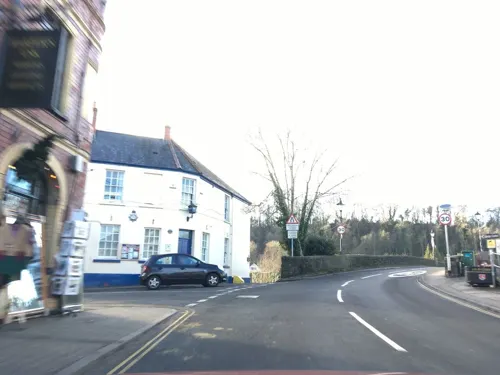
57 Bridge Street
Restaurant
57 Bridge Street, Usk
Mo off; Tu-Th 09:30-16:30; Fr 09:30-24:00; Sa 09:30-16:30; Su off
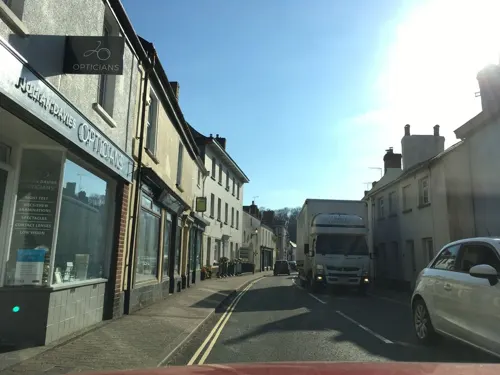
Lines Brew Co
Bar and pub
37a Bridge Street, Usk
Mo off; Tu off; We-Th 17:00-22:00; Fr-Sa 12:00-23:00; Su 12:00-22:00
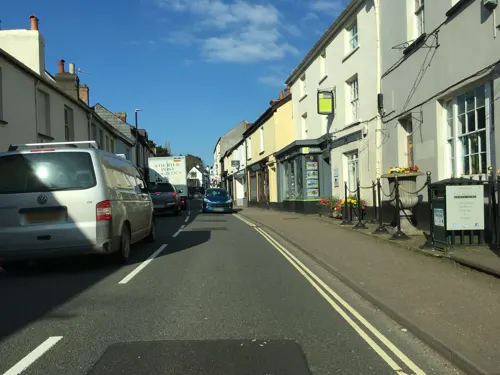


Castle Inn
Bar and pub
7 Twyn Square, Usk
Mo-Th 12:00-23:00; Fr 12:00-00:00; Sa 11:00-00:00; Su 12:00-22:30
The Olway Inn & Hotel
Bar and pub · 0.5 mi
Chepstow Road, Usk
Mo-Tu 17:00-21:00; We-Fr 16:00-23:00; Sa 12:00-23:00; Su 12:00-19:00
The Mad Platter Microbar & Kitchen
Restaurant · Grill, Seafood, Deli, Greek
7 Bridge Street, Usk
Mo off; Tu off; We-Th 12:00-24:00; Fr 12:00-24:00; Sa...

9 more on the map.
History
The Roman legionary fortress of Burrium was founded on the River Usk by the military commander Aulus Didius Gallus, around AD 55. He moved his XX Valeria Victrix legion into the area from its earlier base at Glevum (Gloucester). It was the earliest legionary fortress in Wales and although the site was constricted by hills, subject to flooding, and not on a navigable river, it did offer good communications inland up the river. The fortress at Usk was surrounded by ramparts and covered a large area. However, by around 75 AD, its disadvantages had become apparent and the Romans relocated their permanent military base further south to Caerleon, leaving only a small auxiliary fort and civilian settlement at Usk.
The Roman remains are buried on the southern side of Usk. Many of the Roman finds from Usk are now housed in the National Roman Legion Museum in Caerleon.
After the fortress was abandoned, it continued to be occupied as a civilian settlement, with evidence of ironworking. The Normans also realised Usk's geographical and military importance within the region, and the powerful de Clare family built Usk Castle as part of their plans for controlling the area's resources and people. The castle, now hidden from view by surrounding trees planted in the early 20th century, is one of the few castles still privately owned and occupied.
Read more of the history
The town was laid out in rectangular building plots, centred on the market square. Markets were originally held in Twyn Square, twyn being a Welsh word for "hillock".
The town was owned by the Earls of Gloucester and Hereford until 1314, when it was claimed by the Earl of Ulster through marriage. It descended in the female line to Lionel Duke of Clarence, the son of Edward III and through him to Mortimer Earl of March, Marshal of England. His nephew, Richard Duke of York then inherited and it became a favourite residence of his. At the death of Richard III in 1485 it was given by Henry VII to his son Arthur, Prince of Wales. In 1544 it became part of the dowry of Queen Katherine Parr and on the death of Catherine it was granted by Edward VI to the Earl of Pembroke. Its location meant that it was inevitably frequently caught up in the border disputes between the English and the Welsh in this section of the Welsh Marches.
Usk was the birthplace of Adam of Usk. His chronicle records the 'Welsh Revolt' in 1403, when Owain Glyndŵr burned Usk to the ground while gaining control of much of South Wales from the English under King Henry IV and his son, later to become King Henry V. The important Battle of Pwll Melyn in 1405 occurred immediately north of Usk Castle, when English forces routed their Welsh opponents, causing much loss of life, including that of Owain's brother Tudur. After their defeat, three hundred Welsh prisoners were executed in front of the castle. In 2005 the 600th anniversary of the battle of Pwll Melyn was commemorated by a son-et-lumiere show at the castle.
The town appears as "Uck" and "Branbuga" on the Cambriae Typus map of 1573.
The Great House of the town, later subdivided into smaller units, was built on Old Market Street in the mid-16th century for the Williams family. Its original entrance was at the rear of the present building, and faced onto gardens and meadows. Though much altered, the building retains many original features including chimney stacks and decorative plaster ceilings.
The town market was moved from Twyn Square in 1598 to a location closer to the river, at New Market Street. The Old Town Hall was built on the street at the same time; this was later partially rebuilt at several times during the 19th century, and is now used by the Royal British Legion.
In 1621 the wealthy Midlands wool merchant Roger Edwards, the owner of Allt-y-Bela in Llangwm, founded Usk Grammar School.
The first stone bridge at Usk, replacing one of wood, was built to the designs of Welsh architect William Edwards. Unlike the bridge downstream at Caerleon, it withstood the great floods of 1795. The bridge was strengthened and widened in 1836, but two of its arches were destroyed by floods in 1877 and later replaced.
In 1769 a Congregational chapel was built in Twyn Square. It was rebuilt, in the Gothic style in 1863, with a turret for one bell and room for 400 worshippers. The Jubilee Town Clock was originally positioned directly in front of the church.
From the late 18th century, Usk became well known for the high quality of its japanware, a process of decorating metals by applying a lacquer to tinplate. The process, known as Pontypool japan, was first developed in the west by Thomas Allgood of nearby Pontypool and was taken on in Usk in 1763 by his grandsons Thomas and Edward Allgood. Products from Usk included tin trays, jardinières, and coal boxes. However output declined with changing fashions in the 19th century, and the last Usk japanware was produced in 1860 on the site of what is now Bunning's builders' merchants.
Usk was a thriving market town in the first part of the 19th century, when many of its existing buildings were constructed, and into the Victorian era, although its population fell in the second half of the century as a result of agricultural depression.
From the History section of Usk on Wikipedia, under CC BY-SA 4.0.
Notable people from Usk
 Alfred Russel WallaceBritish naturalist, explorer, geographer, anthropologist and biologist (1823–1913)Photo: London Stereoscopic and Photographic..., Public domain
 Paul MurphyBritish politician (born 1948)Photo: Roger Harris, CC BY 3.0
 Elizabeth MortimerEnglish noblewoman (1371-1417)Photo: Tango, CC BY-SA 3.0
 Rory SutherlandBritish advertising executivePhoto: Betsy Weber, CC BY 2.0
 Jocelyn DaviesBritish politician (born 1959)Photo: National Assembly For Wales /..., CC BY 2.0
 Thomas ProtheroBritish businessman (1780-1853)Photo: anonymous, Public domain
 John TreasureBritish advertising executive (1924-2004)Photo: Yousuf Karsh, CC BY-SA 3.0
- Roger Mortimer, 4th Earl of Marchheir presumptive to Richard II of England between 1385 and 1398
- Sydenham EdwardsWelsh botanist, author, editor, and scientific illustrator (1768-1819)
- Allan WatkinsWelsh cricketer (1922–2011)
- Richard JonesWelsh footballer, born 1969
- William EvansWelsh footballer, born 1853
Born in Usk, according to Wikidata (CC0). Each name links to its Wikipedia article.
Where to stay1
Churches and places of worship13
Shopping4
Gas and EV charging1
Schools, colleges and libraries4
Healthcare2
Map of Usk
53 places. The map loads OpenStreetMap tiles when you open it.
Getting there and nearby towns
Bristol Airport (BRS) is the nearest airport with scheduled flights listed in OpenStreetMap, 24 miles away.
- Cwmbran 6 mi southwest, about 10 min by car
- Pontypool 6 mi west, about 10 min by car
- Newport 9 mi southwest, about 14 min by car
- Abergavenny 9 mi northwest, about 15 min by car
- Undy 10 mi southeast, about 16 min by car
- Abertillery 10 mi west, about 16 min by car
- Risca 11 mi southwest, about 17 min by car
- Chepstow 11 mi southeast, about 17 min by car
- Abercarn 11 mi west, about 17 min by car
- Monmouth 11 mi northeast, about 18 min by car
Drive times are estimates from straight-line distance, not routes.
Towns near Usk


Keep exploring
Local news
Headlines from INDB.
Reviews, tips and questions
Loading what members have shared...
Sources and licences
- GeoNames (CC BY 4.0): population, coordinates, regions and time zone
- Mapillary (see each image): photos
- OpenStreetMap contributors (ODbL 1.0): places, airports, map data
- Wikidata (CC0 1.0): elevation, founding date, time zone, website, landmarks and historic places
- Wikipedia (CC BY-SA 4.0): overview and history text
Photo credits
- Street-level photo, southglos, CC BY-SA 4.0
- Street-level photo, southglos, CC BY-SA 4.0
- Street-level photo, southglos, CC BY-SA 4.0
- Street-level photo, southglos, CC BY-SA 4.0
- Street-level photo, southglos, CC BY-SA 4.0
- Street-level photo, southglos, CC BY-SA 4.0
- Street-level photo, southglos, CC BY-SA 4.0
- Street-level photo, southglos, CC BY-SA 4.0
- Street-level photo, southglos2, CC BY-SA 4.0
- Street-level photo, southglos, CC BY-SA 4.0
- Street-level photo, southglos, CC BY-SA 4.0
- Street-level photo, southglos, CC BY-SA 4.0
- Street-level photo, southglos, CC BY-SA 4.0
- Street-level photo, southglos, CC BY-SA 4.0
- Street-level photo, southglos, CC BY-SA 4.0
Page built November 10, 2026. Spotted a mistake? Tell us or suggest a place.