

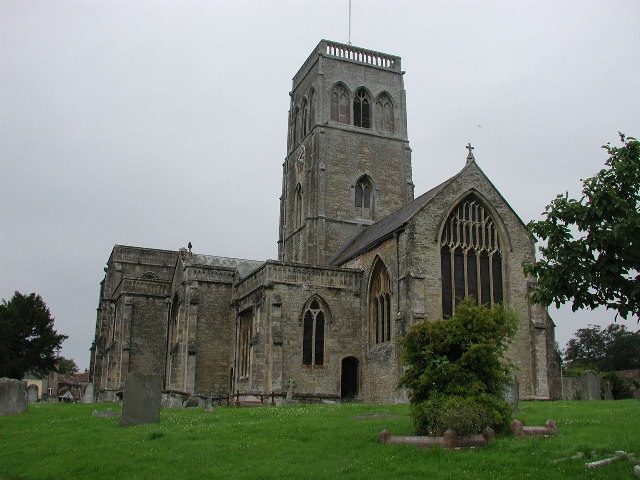


Why visit Wedmore
Townapedia lists 1 museum or landmark, 1 park or trail, 7 places to eat and 1 attraction in and around town.
Highlights include Peat Moors Centre.
Weather in Wedmore
Forecast from MET Norway (CC BY 4.0). Full forecast
About Wedmore
Wedmore is a large village and civil parish in the county of Somerset, England. It is situated on raised ground, in the Somerset Levels between the River Axe and River Brue, often called the Isle of Wedmore. The parish consists of three main villages: Wedmore, Blackford and Theale, with the 17 hamlets of Bagley, Blakeway, Clewer, Crickham, Cocklake, Heath House, Latcham, Little Ireland, Middle Stoughton, Mudgley, Panborough, Sand, Stoughton Cross, Washbrook, West End, West Ham and West Stoughton. The parish of Wedmore has a population of 3,318 according to the 2011 census.
From the Wikipedia article Wedmore (this version), under CC BY-SA 4.0.
Things to do1

Museums and landmarks1

Parks, trails and playgrounds1

Restaurants and cafes7



History
Iron Age remains have been found in the Wedmore area, and there are a number of Roman sites in the district.
The name Wedmore in Old English is thought to mean "hunting lodge" or "hunting moor" and there was a Saxon royal estate in the area. Centwine gained control of the area in 682 and named it 'Vadomaer' after one of the Saxon leaders, Vado the famous. After winning the Battle of Ethandun, Alfred the Great caused the Viking leader Guthrum and his followers to be baptised at Aller and then celebrated at Wedmore. After this the Vikings withdrew to East Anglia.
The Treaty of Wedmore is a term used by some historians inferred for the events in the Anglo-Saxon Chronicle, outlining how in 878 the Viking leader Guthrum was baptised and accepted Alfred the Great as his godfather. No such treaty still exists but there is a document that is not specifically linked to Wedmore that is a Treaty of Alfred and Guthrum. Alfred then left Wedmore in his will to his son Edward the Elder.
Wedmore was part of the hundred of Bempstone. Earthworks from a complex of buildings, including a hall and chapel, surrounded by a moat, have been identified. The site is believed to have been a bishop's palace demolished by John Harewel in the 1380s.
Read more of the history
In 1853 a hoard of 200 silver coins dating from the Saxon period was found in the churchyard. In 1988 a Saxon ring, made of copper alloy with a unique knot design and dating from the 6th or 7th century, was found in the village by Tim Purnell. It has been authenticated by the British Museum and a modern copy made by local jeweller Erica Sharpe.
According to the 1086 Domesday Book, Wedmore/Wetmore was one of the holdings of the Bishop of Wells with 18 cottagers, woodlands, pasture and two fisheries.
In the medieval period, Wedmore was the centre for the surrounding agricultural area, with weekly markets as well as a larger annual one. The market cross dates from the 14th century.
In the 17th century Dr John Westover built a mental hospital to which patients came from all over the West Country. This is believed to have been England's first private lunatic asylum. The doctor is thought to have treated his patients compassionately, ensuring that they had luxuries such as playing cards and tobacco. He kept a record of the ailments of Wedmore people over a period of 15 years.
The original post office in Church Street opposite the church itself, dates from Georgian times, while the Old Vicarage was built at the end of the 15th century. The George Hotel was a 16th-century coaching inn. John Tonkin built a fashionable house, in the Italianate style, which is now the pharmacy.
In 1799 Hannah More established a Sunday school for children in Wedmore in the face of opposition from the vicar and local gentry.
Wedmore's market cross was moved roughly 100 yards along The Borough in the 1830s to allow widening of the high street.
Between 1881 and 1898 the Reverend Hervey produced the Wedmore Chronicle which gives a picture of the people and area at the time.
In late 2018, Strongvox Homes commissioned the development of 35 new houses to the east of Wedmore First School Academy on Blackford Road, with a completion date of early 2020. The scheme comes in the wake of a previous application to build 60 homes opposite the school and 18 opposite Westholme Farm, also on Blackford Road. The development plans were called "ludicrous" and "unnecessary" by residents concerned about the strain placed on infrastructure in the Wedmore region. Wedmore Parish Council supported the development, saying "The neighbourhood plan will provide an element of affordable housing, which is much-needed in the village."
From the History section of Wedmore on Wikipedia, under CC BY-SA 4.0.
More about Wedmore
Geography
Wedmore is situated on raised ground, in the Somerset Levels between the River Axe and River Brue, often called the Isle of Wedmore, which is composed of Blue Lias and marl.
South of Wedmore are the Tealham and Tadham Moors, a biological Site of Special Scientific Interest which form part of the extensive grazing marsh and ditch systems of the Somerset Levels and Moors. The water table is high throughout the greater part of the year with winter flooding occurring annually, by over-topping of the River Brue. 113 aquatic and bankside vascular plant species have been recorded from the field ditches, rhynes and deep arterial watercourses. A diverse invertebrate fauna is associated in particular with ditches that have a good submerged plant community. The water beetle fauna is exceptionally rich, with the nationally rare species Hydrophilus piceus and Hydrochara caraboides together with the rare soldier flies Stratiomys furcata and Odontomyia ornata. Good numbers of dragonflies and damselflies occur including the Hairy Dragonfly (Brachytron pratense) and the Variable Damselfly (Coenagrion pulchellum).
Arts and culture
Wedmore has a number of annual festivals including the Arts Festival, a summer street fair, Wedmore by Lamplight street fair at Christmas, and a large Harvest Home and village parade on the playing field each year. Wedmore Playing Fields also offer sporting facilities for tennis, football, cricket and bowls.
Arts events are held at Wedmore Village Hall, both those produced locally and national tours. Wedmore Opera stages large-scale classic opera in a specially designed and constructed marquee venue and also in Wedmore Village Hall. The group were founded in 1988 "around a kitchen table" and to date have staged more than 60 performances of 18 productions. They recently performed Gilbert and Sullivan's Pirates of Penzance, and in 2018 they aim to stage Verdi's La Traviata to mark their 30th anniversary, as this was their first production. Wedmore Theatre is the longest standing arts organisation in Wedmore and has put on many productions over the past 40 years.
Local people created and host the original Turnip Prize, a parody of the Turner Prize. This competition (celebrating the worst of bad modern art) takes place annually at The New Inn.
Education
The educational system in the Cheddar Valley consists of first schools for children between the ages of 4 and 9, two middle schools (ages 9 to 13) and a secondary school for pupils up to the age of 18 years.
Established in 1876 as Wedmore First School, and upgrading to academy status in July 2011, the first school built for Wedmore has 211 pupils, with a capacity of 210, aged from four to nine. On 1 September 2016, it became part of a multi-academy trust known as the Wessex Learning Trust. The trust comprises eight schools within the Cheddar Valley geographic area who together offer educational provision from ages 2–19.
Hugh Sexey is a middle school and specialist Technology College in Blackford named after royal auditor Hugh Sexey (1556–1619). The school had 620 pupils in June 2012, who join aged 9 in Year 5 and stay until age 13 in Year 8, after which they go to The Kings of Wessex Academy in Cheddar. Hugh Sexey is also a Wessex Learning Trust member.
I.T. for the Terrified was started in Wedmore in 1999, as a community project so that volunteers could share their computer skills with the local community in a user-friendly and informal setting. In 2001 it moved to the rear of The George Hotel, and in 2009 it moved to a converted cow barn in the grounds of The Kings of Wessex Academy in Cheddar.
From the Wikipedia article Wedmore, under CC BY-SA 4.0.
Notable people from Wedmore
- Dickie Burroughcricketer (1909-1994)
- Charles Neville Strode SmithBritish Royal Marines officer (1898-1955)
Born in Wedmore, according to Wikidata (CC0). Each name links to its Wikipedia article.
Churches and places of worship11
Schools, colleges and libraries2
Hugh Sexey Church of England Middle School
School · Anglican · 1.4 mi
Healthcare1
Map of Wedmore
24 places. The map loads OpenStreetMap tiles when you open it.
Getting there and nearby towns
Bristol Airport (BRS) is the nearest airport with scheduled flights listed in OpenStreetMap, 11 miles away.
- Draycott 3 mi northeast, about 5 min by car
- Wells 7 mi east, about 12 min by car
- Street 8 mi southeast, about 12 min by car
- Burnham-on-Sea 8 mi west, about 13 min by car
- Blagdon 8 mi northeast, about 13 min by car
- Westonzoyland 10 mi southwest, about 16 min by car
- Weston-super-Mare 11 mi northwest, about 18 min by car
- Bridgwater 11 mi southwest, about 17 min by car
- Yatton 11 mi north, about 18 min by car
- Shepton Mallet 12 mi east, about 19 min by car
Drive times are estimates from straight-line distance, not routes.
Towns near Wedmore


Keep exploring
Local news
Headlines from INDB.
Reviews, tips and questions
Loading what members have shared...
Sources and licences
- GeoNames (CC BY 4.0): population, coordinates, regions and time zone
- Mapillary (see each image): photos
- OpenStreetMap contributors (ODbL 1.0): places, airports, map data
- Wikidata (CC0 1.0): elevation, founding date, time zone, website, landmarks and historic places
- Wikimedia Commons (see each image): photos
- Wikipedia (CC BY-SA 4.0): overview and history text
Photo credits
- Wedmore centre, Roger Cornfoot, CC BY-SA 2.0
- Wedmore church, ChurchCrawler, CC BY-SA 2.0
- The Old Vicarage, Wedmore, Dave.Dunford, CC BY-SA 4.0
- Church Villa, Wedmore, Dave.Dunford, CC BY-SA 4.0
- Gate to St Mary's Church, Wedmore, Dave.Dunford, CC BY-SA 4.0
- Westhay, Martin Bodman, CC BY-SA 2.0
- St Gregory's church Weare, ChurchCrawler, CC BY-SA 2.0
- Rodney Stoke church, Adrian and Janet Quantock, CC BY-SA 2.0
- St Peters Church Draycott - exterior 5, 10mmsocket, CC BY-SA 4.0
- HughSexeyMiddleSchool, Adrian and Janet Quantock, CC BY-SA 2.0
- George Inn Wedmore, Roger Cornfoot, CC BY-SA 2.0
- Street-level photo, southglos, CC BY-SA 4.0
- Street-level photo, southglos, CC BY-SA 4.0
- Street-level photo, southglos, CC BY-SA 4.0
- Street-level photo, southglos, CC BY-SA 4.0
- Street-level photo, ukchris, CC BY-SA 4.0
- Street-level photo, southglos, CC BY-SA 4.0


Page built November 10, 2026. Spotted a mistake? Tell us or suggest a place.