


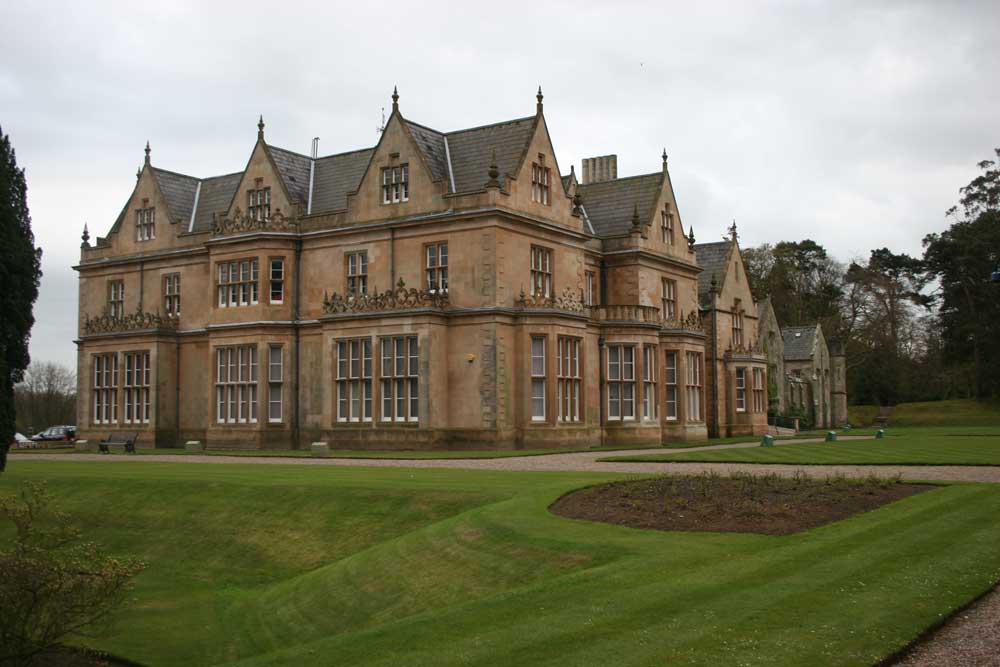

Bangor, United Kingdom
Bangor is a town of 61,011 people in Northern Ireland, United Kingdom.
Why visit Bangor
Townapedia lists 10 museums and landmarks, 18 parks and trails, 92 places to eat, 8 places to stay and 2 attractions in and around town.
Highlights include Omniplex Bangor, Ward Park Aviary, Bangor Castle and Bangor Town Museum.
Weather in Bangor
Forecast from MET Norway (CC BY 4.0). Full forecast
About Bangor
Bangor ( BANG-gər; from Irish Beannchar [ˈbʲaːn̪ˠəxəɾˠ]) is a seaside city and civil parish in County Down, Northern Ireland, on the southern side of Belfast Lough. It is within the Belfast metropolitan area and is 13 miles (22 km) east of Belfast city centre, to which it is linked by the A2 road and the Belfast–Bangor railway line. The population was 64,596 at the 2021 census.
From the Wikipedia article Bangor, County Down (this version), under CC BY-SA 4.0.
Travel tips from other travellers: Bangor on Wikivoyage (CC BY-SA 4.0).
Things to do2


Museums and landmarks10



Parks, trails and playgrounds18




6 more on the map.
Restaurants and cafes92
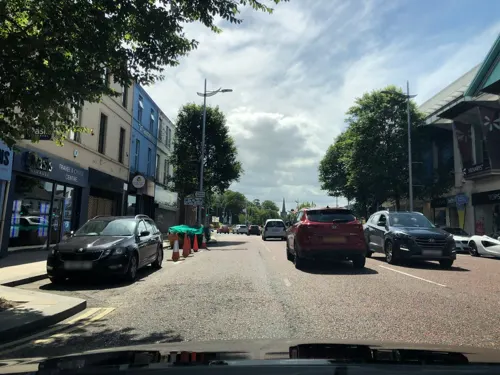
Bangla Bangor
Restaurant · Indian
115 Main Street, Bangor
Mo-Su 12:00-14:30,16:30-23:00; Fr,Sa 12:00-14:30,16:30-23:30
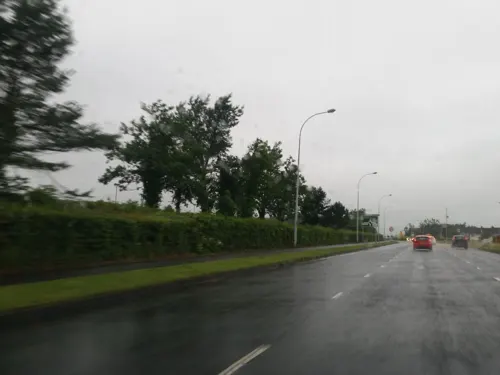

Underground Dining
Restaurant
119 High Street, Bangor
Tu-Th 12:00-14:30,17:00-20:30; Fr 12:00-14:30,17:00-21:30; Sa...
King Fu
Restaurant
93-95 High Street, Bangor
Mo-Th, Su 16:30-23:30; Fr, Sa 16:30-00:00

80 more on the map.
History
Bangor has a long and varied history, from the Bronze Age people whose swords were discovered in 1949 or the Viking burial found on Ballyholme beach, to the Victorian pleasure seekers who travelled on the new railway from Belfast to take in the sea air. The city has been the site of a Gaelic Irish monastery renowned throughout Europe for its learning and scholarship, the victim of violent Viking raids in the 8th and 9th centuries, and the new home of Scottish and English planters during the Plantation of Ulster.
Read more of the history
The Annals of Ulster says that the monastery of Bangor was founded by Saint Comgall from Antrim in the year 555, while other annals give the year as 558. It was where the Antiphonary of Bangor (Antiphonarium Benchorense) was written, a copy of which can be seen in the town's heritage centre. The monastery had such widespread influence that the city is one of only four places in Ireland to be named in the Hereford Mappa Mundi in 1300. The monastery, situated roughly where the Church of Ireland Bangor Abbey stands at the head of the city, became a centre of great learning and was among the most eminent of Europe's missionary institutions in the Early Middle Ages.At Bangor, Comgall instituted a rigid monastic rule of incessant prayer and fasting. Far from turning people away, this ascetic rule attracted thousands. When Comgall died in 602, the annals report that three thousand monks looked to him for guidance. Named Bennchor Mór, "the great Bangor", to distinguish it from its British contemporaries, it became the greatest monastic school in Ulster as well as one of the three leading monasteries of Celtic Christianity. The others were Iona, the great missionary centre founded by Columba, and Bangor on the Dee, founded by Dinooth; the ancient Welsh Triads also confirm the "Perpetual Harmonies" at the house.
Throughout the sixth century, Bangor became famous for its choral psalmody. "It was this music which was carried to the continent by the Bangor missionaries in the following century". Divine services of the seven hours of prayer were carried out throughout Bangor's existence, however the monks went further and carried out the practice of laus perennis. In the twelfth century, Bernard of Clairvaux spoke of Comgall and Bangor, stating, "the solemnization of divine offices was kept up by companies, who relieved each other in succession, so that not for one moment day and night was there an intermission of their devotions." This continuous singing was antiphonal in nature, based on the call and response reminiscent of Patrick's vision, but also practised by St. Martin's houses in France. Many of these psalms and hymns were later written down in the Antiphonary of Bangor which came to reside in Colombanus' monastery at Bobbio, Italy.
In 580, a Bangor monk named Mirin took Christianity to Paisley in the west of Scotland, where he died "full of sanctity and miracles". In 590, the fiery Colombanus, one of Comgall's leaders, set out from Bangor with twelve other brothers, including Saint Gall who planted monasteries throughout Switzerland. In Burgundy, Columbanus established a severe monastic rule at Luxeuil which mirrored that of Bangor. From there he went to Bobbio in Italy and established the house which became one of the largest monasteries in Europe.
Saint Malachy was elected abbot of the monastery in 1123, a year before being consecrated Bishop of Connor. His extensive travels around Europe inspired him to rejuvenate the monasteries in Ireland, and he replaced the existing wooden huts with stone buildings.
The modern city had its origins in the early 17th century when James Hamilton, a Lowland Scot, arrived in Bangor, having been granted lands in North Down by King James VI and I in 1605. In 1612, King James made Bangor a borough which permitted it to elect two MPs to the Irish Parliament in Dublin. The Old Custom House, which was completed by Hamilton in 1637 after James I granted Bangor the status of a port in 1620, is a visible reminder of the new order introduced by Hamilton and his Scots settlers.
In 1689 during the Williamite War in Ireland, Marshal Schomberg's expedition landed at Ballyholme Bay and captured Bangor, before going on to besiege Carrickfergus. Schomberg's force went south to Dundalk Camp and were present at the Battle of the Boyne the following year.
The city was an important source of customs revenue for the Crown and in the 1780s Colonel Robert Ward improved the harbour and promoted the cotton industries; today's seafront was the location of several large steam-powered cotton mills, which employed a large workforce.
The end of the 18th century was a time of great political and social turmoil in Ireland. The United Irishmen, inspired by the American and French Revolutions, sought to achieve a greater degree of independence from Britain. On the morning of 10 June during the Irish Rebellion of 1798, a force of United Irishmen, mainly from Bangor, Donaghadee, Greyabbey and Ballywalter attempted to occupy the nearby town of Newtownards. They met with musket fire from the market house and were subsequently defeated.
By the middle of the 19th century, the cotton mills had declined and the city changed in character once again. The laying of the railway in 1865 meant that inexpensive travel from Belfast was possible, and working-class people could afford for the first time to holiday in the city. Bangor soon became a fashionable resort for Victorian holidaymakers, as well as a desirable home to the wealthy. Many of the houses overlooking Bangor Bay (some of which have been demolished to make way for modern flats) date from this period. The belief in the restorative powers of the sea air meant that the city became a location for sea bathing and marine sports, and the number of visitors from Great Britain increased during the Edwardian era at the beginning of the 20th century, which also saw the improvement of Ward Park.
From the History section of Bangor, County Down on Wikipedia, under CC BY-SA 4.0.
More about Bangor
Geography
Bangor lies on the east coast of Northern Ireland, on the south shore of the mouth of Belfast Lough, north east of central Belfast.
Ballycroghan (from Irish Baile Cruacháin, meaning 'townland of the small stack/hill')
Ballykillare (from Irish Baile Cille Láir, meaning 'townland of the central church')
Ballymaconnell (from Irish Baile Mhic Dhónaill, meaning 'McConnell's townland')
Ballymacormick (from Irish Baile Mhic Cormaic, meaning 'McCormick's townland')
Ballymagee (from Irish Baile Mhic Aodha, meaning 'Magee's townland')
Ballyree (from Irish Baile an Fhraoigh, meaning 'townland of the heather')
Ballyvarnet, historically 'Ballyvernan' (from Irish Baile Bhearnan, meaning 'townland of the gap')
Carnalea (from Irish Carnán Lao, meaning 'the cairn of the calf')
Conlig (from Irish An Choinleac, meaning 'the hound-stone', referring to a standing stone on Runestone Hill)
Rathgill or Rathgael (from Irish Ráth Giall, meaning 'fort of the hostages')
Economy
Bangor had an estimated Gross Domestic Product (GDP) of the equivalent of $US678 million in 2015. In 2021, there were 385 businesses in the city centre.
Education
Colleges and schools in the area include South Eastern Regional College, Bangor Academy and Sixth Form College, Bangor Grammar School, Glenlola Collegiate School, and St Columbanus' College. Primary schools include Towerview Primary School, Clandeboye Primary, Ballyholme Primary School, Kilmaine Primary, St Malachy's Primary, St Comgall's Primary, Grange Park Primary, Ballymagee Primary, Bloomfield Primary, Kilcooley Primary, Rathmore Primary, Towerview Primary, and Bangor Central Integrated Primary School.
There are also a number of secondary, grammar, and primary schools in nearby towns and the vicinity of Bangor such as Crawfordsburn Primary & Groomsport Primary; Priory Integrated College, Sullivan Upper School, Regent House Grammar School, Movilla High School, Strangford College, Campbell College, and Rockport School are secondary schools.
From the Wikipedia article Bangor, County Down, under CC BY-SA 4.0.
Notable people from Bangor
 Josh MagennisNorthern Irish association football player (born 1990)Photo: Biser Todorov, CC BY 4.0
 Gary LightbodyNorthern Irish musicianPhoto: © Markus Felix | PushingPixels ( contact me ), CC BY-SA 4.0
 Foy VanceIrish singer-songwriterPhoto: Harald Krichel, CC BY-SA 3.0
 Aimee RichardsonActress from Northern IrelandPhoto: Gage Skidmore, CC BY-SA 3.0
 Jonny QuinnBritish drummerPhoto: Sven Mandel, CC BY-SA 4.0
 Rebecca McKennaNorthern Irish footballerPhoto: James Boyes from UK, CC BY 2.0
 Alex EastonNorthern Irish politician (born 1969)Photo: ©House of Commons, CC BY 3.0
- Stephen Martinfield hockey player
- Colin BlakelyNorthern Irish actor (1930–1987)
- Lembit ÖpikBritish politician (born 1965)
- Winifred Carneysuffragist, trade unionist, Irish independence activist (1887-1943)
- David MontgomeryBritish media executive
Born in Bangor, according to Wikidata (CC0). Each name links to its Wikipedia article.
Where to stay8
Churches and places of worship26
Shopping26
Gas and EV charging8
Schools, colleges and libraries19
Saint Malachy's Primary School
School · Roman Catholic · 1.2 mi
197 Clandeboye Road, Bangor
Healthcare7
Map of Bangor
216 places. The map loads OpenStreetMap tiles when you open it.
Getting there and nearby towns
George Best Belfast City Airport (BHD) is the nearest airport with scheduled flights listed in OpenStreetMap, 9 miles away.
- Newtownards 5 mi south, about 8 min by car
- Holywood 6 mi west, about 10 min by car
- Carrickfergus 7 mi northwest, about 11 min by car
- Dundonald 7 mi southwest, about 11 min by car
- Newtownabbey 10 mi west, about 15 min by car
- Belfast 11 mi southwest, about 18 min by car
- Larne 14 mi northwest, about 23 min by car
- Lisburn 18 mi southwest, about 28 min by car
- Downpatrick 23 mi south, about 37 min by car
- Portadown 35 mi southwest, about 57 min by car
Drive times are estimates from straight-line distance, not routes.
Towns near Bangor


Keep exploring
Local news
Headlines from INDB.
Reviews, tips and questions
Loading what members have shared...
Sources and licences
- GeoNames (CC BY 4.0): population, coordinates, regions and time zone
- Mapillary (see each image): photos
- OpenStreetMap contributors (ODbL 1.0): places, airports, map data
- Wikidata (CC0 1.0): elevation, founding date, time zone, website, landmarks and historic places
- Wikimedia Commons (see each image): photos
- Wikipedia (CC BY-SA 4.0): overview and history text
Photo credits
- Bangor The Long Hole At Dusk, Geograph, CC BY-SA 2.0
- Robert French, Bangor Church, National Library of Ireland on The Commons, Public domain
- Main Street, Bangor, County Down (16192309618), Public Record Office of Northern Ireland, No restrictions
- Rear of Bangor Abbey, Andrew Muir from Bangor, UK, CC BY 2.0
- BangorCastle2, MartinRobinson at English Wikipedia, CC BY-SA 3.0
- BangorAbbeyAD688, Notafly, CC BY-SA 3.0
- Street-level photo, laye, CC BY-SA 4.0
- Street-level photo, mcda, CC BY-SA 4.0
- Street-level photo, laye, CC BY-SA 4.0
- Street-level photo, laye, CC BY-SA 4.0
- Street-level photo, mcda, CC BY-SA 4.0
- Street-level photo, laye, CC BY-SA 4.0
- Street-level photo, laye, CC BY-SA 4.0
- Street-level photo, laye, CC BY-SA 4.0
- Street-level photo, laye, CC BY-SA 4.0
Page built November 10, 2026. Spotted a mistake? Tell us or suggest a place.