


Much Wenlock, United Kingdom
Much Wenlock is a town of 2,211 people in England, United Kingdom.
Why visit Much Wenlock
Townapedia lists 11 museums and landmarks, 9 places to eat, 2 places to stay and 4 attractions in and around town.
Highlights include Albert Edward Bridge, Buildwas Bridge, Benthall Hall and Much Wenlock Museum.
Weather in Much Wenlock
Forecast from MET Norway (CC BY 4.0). Full forecast
About Much Wenlock
Much Wenlock is a market town and parish in Shropshire, England; it is situated on the A458 road between Shrewsbury and Bridgnorth. Nearby, to the north-east, is the Ironbridge Gorge and Telford. The civil parish includes the villages of Homer (1 mile (1.6 km) north of the town), Wyke (2 miles (3 km) north-east), Atterley (2 miles (3 km) south-east), Stretton Westwood (2 miles (3 km) south-west) and Bourton (3 miles (5 km) south-west). The population of the civil parish, according to the 2001 Census, was 2,605, increasing to 2,877 by 2011.
From the Wikipedia article Much Wenlock (this version), under CC BY-SA 4.0.
Travel tips from other travellers: Much Wenlock on Wikivoyage (CC BY-SA 4.0).
Things to do4

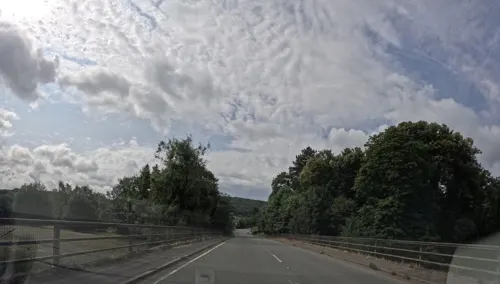
Albert Edward Bridge
Bridge · 3.3 mi
Bridge in Shropshire, England, UK


Museums and landmarks11

Benthall Hall
Museum · 2.7 mi
Grade I listed historic house museum in Shropshire, England, UK


Much Wenlock Museum
Museum
High Street, Much Wenlock
May-Sep Th-Su 10:30-13:00, 13:30-16:30; Oct-Apr Fr-Su 10:30-13:00,...

Broseley Pipeworks
Monument and historic site · 3.3 mi
Industrial museum in Broseley, United Kingdom
Restaurants and cafes9
George & Dragon Inn
Bar and pub
2 High Street, Much Wenlock
Mo,Tu 17:00-23:00; We-Su 12:00-23:00


Where to stay2


History
Richard Fletcher mentions Much Wenlock as one of the possible locations where a Sub-Roman British Christian community may have survived the Anglo-Saxon occupation and eventually integrated with the conquerors and influenced their culture.
The town of Wenlock is known to have grown up around an abbey or monastery founded around 680 by Merewalh, a son of King Penda of Mercia, with the small town within its parish boundaries. King Penda installed his daughter Milburga as abbess in 687. Milburga of Wenlock was credited with many miraculous works. The abbey flourished until around 874 when it is thought that a Danish Viking attack occurred.
The Domesday Book records the manor as 'Wenloch' and forming part of the hundred of Patton. It was already at this time a fairly large settlement, with 73 households. The abbey is also recorded in the book, separately. In the 11th century another religious house was built on the same site by Leofric, Earl of Mercia and Countess Godiva his wife. In the 12th century this was replaced by a Cluniac priory, established by Roger de Montgomery after the Norman Conquest, the ruins of which can still be seen and which is now in the care of English Heritage.
Read more of the history
Early in the 12th century the hundred of Patton was merged with Culvestan to form the hundred of Munslow, but in 1198 Much Wenlock, together with the other manors held by Wenlock Priory, was transferred to the hundredal jurisdiction of the Liberty of Wenlock (also known as Wenlock Franchise).
The Manor of Much Wenlock belonged to the Cluniac Priory until the dissolution of the monasteries in 1540 when it passed to the Lawley family, and then by marriage of Ursula Lawley to the Bertie family.
In 1468 Edward IV granted the men of Much Wenlock a charter forming the Borough of Wenlock, at the request of Sir John Wenlock, and "in consideration of the laudable services which the men of the town performed in assisting the king to gain possession of the crown." The charter was confirmed in 1547 by Henry VIII after Wenlock Priory was suppressed in the Dissolution of the Monasteries in 1539. The charter was again confirmed in 1631 by Charles I.
Over the years the borough asserted jurisdiction over the liberty of Wenlock. The lands of the liberty included rural areas and a number of detached parts well outside the town, and this resulted in an unusual, geographically dispersed borough. At its height, it was – by area – the largest borough in England outside London and encompassed several of the towns that now constitute Telford. The borough had unusual boundaries, covering Much Wenlock itself, but also Little Wenlock, Broseley and Ironbridge, a total area of 71 square miles (180 km2). In 1836 the borough was reformed as a municipal borough under the Municipal Corporations Act 1835, and lost some of its rural areas and detached parts. The borough was further reduced in size in 1889, and was finally abolished in 1966.
11-year-old Alice Glaston from Little Wenlock may have been hanged together with two men in Much Wenlock in 1544, for an unknown crime. The evidence surrounding how Alice met her death is provided from a single source and open to interpretation. The Cambrian Journal dated 1861 provides a transcription of local parish registers written by the vicar of Much Wenlock, Sir Thomas Butler. This text provides a list of burials clearly marked by year, including the following from 1544.
"Here was buried John Dod of the parish of Little Wenlock, who was hanged here, as also Alice Glaston, 11 yrs of age, of the parish of Little Wenlock, and Wm. Harper, a tailor."
Sir Thomas Wolryche, 1st Baronet (1598–1668) was an English landowner and politician who sat in the House of Commons for Wenlock between 1621 and 1625. He fought in the Royalist army in the English Civil War, serving as military governor of Bridgnorth.
In 1714, the Manor of Much Wenlock was held by Viscount Gage, who sold it to the Williams-Wynn family.
In the 19th century the town and much of the surrounding land came into the possession of James Milnes Gaskell, from his wife's family the Williams-Wynns. James was MP for Wenlock for many years. His son Charles Milnes Gaskell restored the Priory lodging as a home with his wife Lady Catherine, daughter of the Earl of Portsmouth. There they entertained many famous people of the day, writers, politicians, artists and explorers, among them Thomas Hardy, Henry Adams, Henry James, Thomas Woolner, Henry Morton Stanley, Isabella Bird and Philip Webb.
Much Wenlock has become known as the birthplace of Wenlock Olympian Games set up by William Penny Brookes and his Wenlock Olympian Society (WOS) in 1850. In 1861 he was also instrumental in setting up the Shropshire Olympian Games and later in 1866, the National Olympian Games. Dr Brookes is credited as a founding father of the Modern Olympic Games. In 1890 it was the turn of the Raven Hotel to be the venue for the annual post Wenlock Olympian Games' dinner, and Baron Pierre de Coubertin was the guest of honour. Copies of some of the WOS's archive images are on display in the hotel, including letters from Coubertin to Brookes. The Wenlock Olympian Games, a nine-day event staged on eight sites across Shropshire, are still held annually during July, and are still organised by WOS. Much Wenlock's secondary school is named William Brookes School after Dr Brookes.
The London 2012 Summer Olympics mascot was named Wenlock to honour Brookes, WOS and Much Wenlock. On 30 May 2012, the Olympic flame of the 2012 Summer Olympics, was carried through Much Wenlock to acknowledge the founding footsteps of Brookes.
When the Borough was abolished in 1966 the core Wenlock parts became part of the Bridgnorth Rural District, with other parts also going to Dawley Urban District and to Wellington Rural District. In 1974 Much Wenlock joined Bridgnorth District until it was abolished in 2009. It is now represented in the unitary Shropshire Council.
From the History section of Much Wenlock on Wikipedia, under CC BY-SA 4.0.
Notable people from Much Wenlock
 Tony LevinEnglish jazz drummer (1940–2011)Photo: Richard Kaby, CC BY 2.0
 Rosemary Butlerpolitician (born 1943)Photo: National Assembly for Wales, CC BY 2.0
- Mary BeardEnglish classicist (born 1955)
- Rosemary LeachBritish actress (1935–2017)
- Jonathan BarnesBritish historian and philosopher (born 1942)
- William Penny BrookesBritish doctor (1809-1895)
- Isobel CooperEnglish Operatic pop soprano singer
- Roger PreeceEnglish footballer and manager (born 1968)
- Edward PearceEnglish political journalist and writer
- Selina Catherine StowBritish botanical collector (ca. 1870—1956)
Born in Much Wenlock, according to Wikidata (CC0). Each name links to its Wikipedia article.
Churches and places of worship4
Shopping6
Gas and EV charging1
Schools, colleges and libraries2
Healthcare1
Map of Much Wenlock
40 places. The map loads OpenStreetMap tiles when you open it.
Getting there and nearby towns
Birmingham Airport (BHX) is the nearest airport with scheduled flights listed in OpenStreetMap, 35 miles away.
- Ironbridge 4 mi northeast, about 6 min by car
- Telford 7 mi northeast, about 12 min by car
- Bridgnorth 7 mi southeast, about 11 min by car
- Wellington 7 mi north, about 12 min by car
- Hadley 8 mi northeast, about 13 min by car
- Shrewsbury 11 mi northwest, about 18 min by car
- Great Hanwood 12 mi northwest, about 20 min by car
- Alveley 13 mi southeast, about 21 min by car
- Newport 14 mi northeast, about 23 min by car
- Codsall 15 mi east, about 24 min by car
Drive times are estimates from straight-line distance, not routes.
Towns near Much Wenlock


Keep exploring
Local news
Headlines from INDB.
Reviews, tips and questions
Loading what members have shared...
Sources and licences
- GeoNames (CC BY 4.0): population, coordinates, regions and time zone
- Mapillary (see each image): photos
- OpenStreetMap contributors (ODbL 1.0): places, airports, map data
- Wikidata (CC0 1.0): elevation, founding date, time zone, website, landmarks and historic places
- Wikimedia Commons (see each image): photos
- Wikipedia (CC BY-SA 4.0): overview and history text
Photo credits
- 1 High Street, Much Wenlock, Richard Law, CC BY-SA 2.0
- Albert Edward Bridge, D4nnyt at English Wikipedia, Public domain
- Benthall Hall A, Gammock, CC BY-SA 4.0
- COVIDNewspaperBoard, MudnuK, CC0
- The Old Windmill near Much Wenlock, Anthony Parkes, CC BY-SA 2.0
- Much Wenlock Priory (35386051096), Amanda Slater from Coventry, West Midlands, UK, CC BY-SA 2.0
- Street-level photo, hobgoblin, CC BY-SA 4.0
- Street-level photo, hobgoblin, CC BY-SA 4.0
- Street-level photo, hobgoblin, CC BY-SA 4.0
- Street-level photo, hobgoblin, CC BY-SA 4.0
- Street-level photo, hobgoblin, CC BY-SA 4.0
- Street-level photo, hobgoblin, CC BY-SA 4.0
- Street-level photo, hobgoblin, CC BY-SA 4.0
- Street-level photo, hobgoblin, CC BY-SA 4.0
- Street-level photo, hobgoblin, CC BY-SA 4.0
- Street-level photo, hobgoblin, CC BY-SA 4.0
- Street-level photo, trigpoint, CC BY-SA 4.0
- Street-level photo, southglos, CC BY-SA 4.0
Page built November 10, 2026. Spotted a mistake? Tell us or suggest a place.